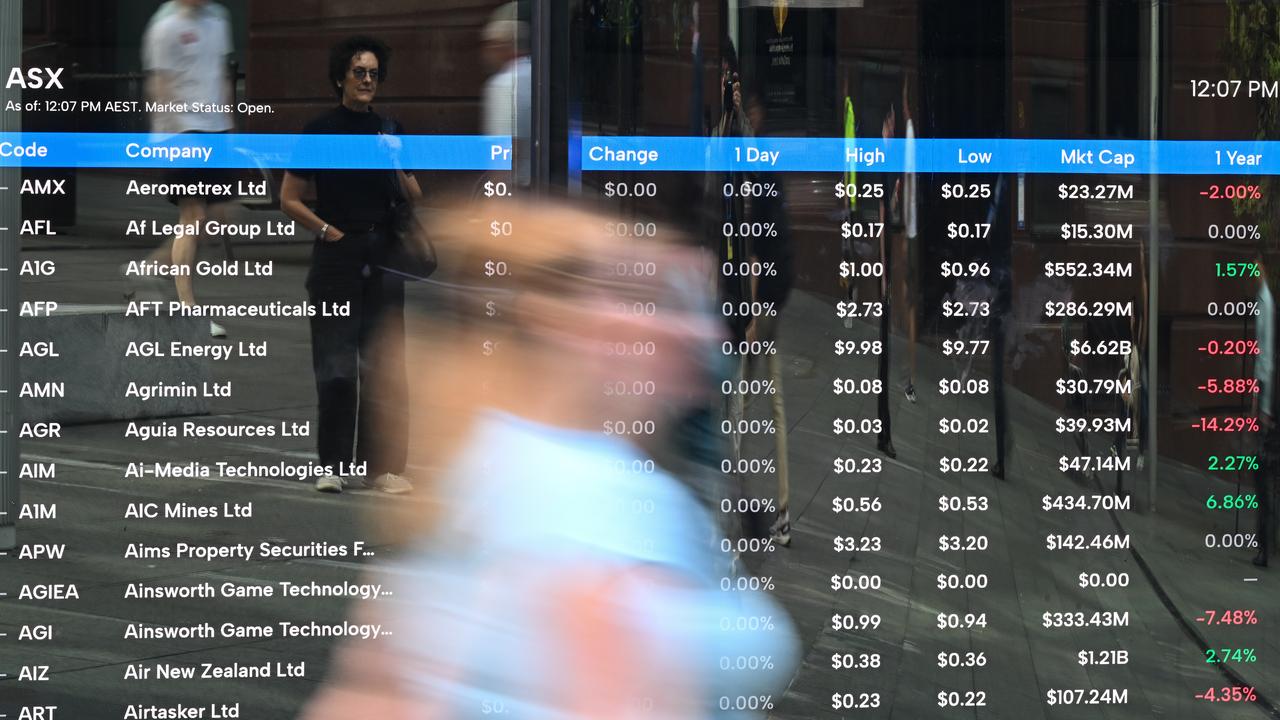
Australia’s share market is on track for its worst day in three weeks as oil prices surge following re-escalating conflict in the Persian Gulf.
The S&P/ASX200 fell 61.9 points on Thursday, down 0.7 per cent, to 8,723.2, as the broader All Ordinaries lost 57.2 points, or 0.64 per cent, to 8,922.1.
“A flare-up of Middle East tensions has rattled global markets again and jammed a war risk premium back into asset prices,” Capital.com senior market analyst Kyle Rodda said.
“Crude prices rallied after strikes continued between the US and Iran, and US President Donald Trump said that the ceasefire was ‘over’.”
The Brent benchmark has surged to above $US82 a barrel, roughly on par with the conflict’s early days but significantly lower than its March peak near $US120.
Woodside and Santos each advanced more than 1.5 per cent, while Ampol surged 2.5 per cent and fellow refinery operator Viva gained 0.5 per cent.
Coal miners also improved, along with uranium producers, as India’s Prime Minister Narendra Modi told a Melbourne business event that Australia’s uranium reserves were key to his nation’s nuclear journey.
The basic materials sector tumbled 1.9 per cent as gold slumped to $US4,075 ($A5,880) an ounce, while mega miners BHP, Rio Tinto and Fortescue also sold off as iron ore futures retreated.
Banks weighed on the exchange, with all big four banks and Macquarie trading lower, as the heavyweight financials sector handed back the bulk of the previous two sessions’ gains.
Health care stocks and real estate trusts were also under pressure, while IT and utilities performed best outside of the energy sector.
In company news, Fletcher Building shares jumped more than five per cent in early trade after hiking its earnings guidance by more than six per cent to between $400 million to $403 million.
Telstra staged a minor rebound from Wednesday’s nearly three per cent dump following a major outage.
The Australian dollar is buying 69.30 US cents, down from 69.33 on Wednesday at 5pm, and has been trading in a tight range despite the Persian Gulf re-escalation forcing a rethink in global inflation expectations.
Renewed conflict will likely complicate the Reserve Bank’s road ahead, with its biggest risk to Australia imported price growth rather than to the share market, Global X ETFs senior investment strategist Billy Leung said.
“Any sustained disruption to oil supply or shipping through the Strait of Hormuz has the potential to push fuel and freight costs higher, feeding through to everything from transport and groceries to business input costs,” Mr Leung said.
“If energy prices remain elevated, it could delay the inflation outlook just as households and businesses were hoping for lower interest rates.”

Australian Associated Press is the beating heart of Australian news. AAP is Australia’s only independent national newswire and has been delivering accurate, reliable and fast news content to the media industry, government and corporate sector for 85 years. We keep Australia informed.