


Palantir has been lobbying the Government to control the National Disability Insurance Scheme”s (NDIS) data, potentially exposing Australia’s most vulnerable. Claudia Weisenberger reports.
If the NDIS Amendment Bill passes this week — and it will — a computer program will have the authority to cut a disabled person’s funding. If the program gets it wrong, section 59E(3) of the Bill provides that the decision stands anyway.
There is no appeal.
What nobody has been told — and what nobody in Parliament has asked — is who built the computer, whose data it uses, and what it does with what it learns about 800,000 disabled Australians.
The answers, buried in Freedom of Information refusals and AusTender records, point toward one of the most controversial technology companies in the world.
A company whose software has helped deport immigrants in the United States, was given access to NHS patient records in the United Kingdom — a decision now being reversed — and which there are reasonable grounds to believe helped automate military targeting in Gaza.
Its CEO describes the company’s purpose as helping the West scare enemies and, on occasion, kill them.
What the documents show
In 2023, Samuel Porter, then Deputy CEO and Chief Operating Officer of the NDIA, took a personal meeting with the Australian President of Palantir. The NDIA’s own security architect flagged that Palantir did not hold the required government security clearance. The engagement continued anyway.
Freedom of Information documents, obtained by disability advocate Sam Connor, show it ran from April 2023 to February 2024 — spanning a Proof of Concept, Palantir’s Foundry Cloud Architecture Diagram and Security Whitepaper, multiple documents titled ‘Palantir Technologies — Failed Payments NDIA,’ follow-up sessions on SAP integration, and a Palantir Terms of Service.
In November 2025, Palantir received its Protected-level security clearance — the level at which NDIS participant files sit.
The NDIA declined to release all 22 documents,
citing business information exemptions — protecting Palantir’s commercial interests rather than the public’s right to know.
The NDIA is exempt from Commonwealth Procurement Rules and does not publish its contracts on AusTender — making independent verification impossible.
In response to questions from Michael West Media, a NDIA spokesperson said: “The NDIA has not used Palantir technology and has no plans to do so.”
The statement did not address the Freedom of Information documents showing extended engagement between the NDIA and Palantir from April 2023 to February 2024, including a Proof of Concept, a pitch on failed NDIS payments processing, and a Palantir Terms of Service document. It did not address why 22 documents relating to that engagement were refused in full.
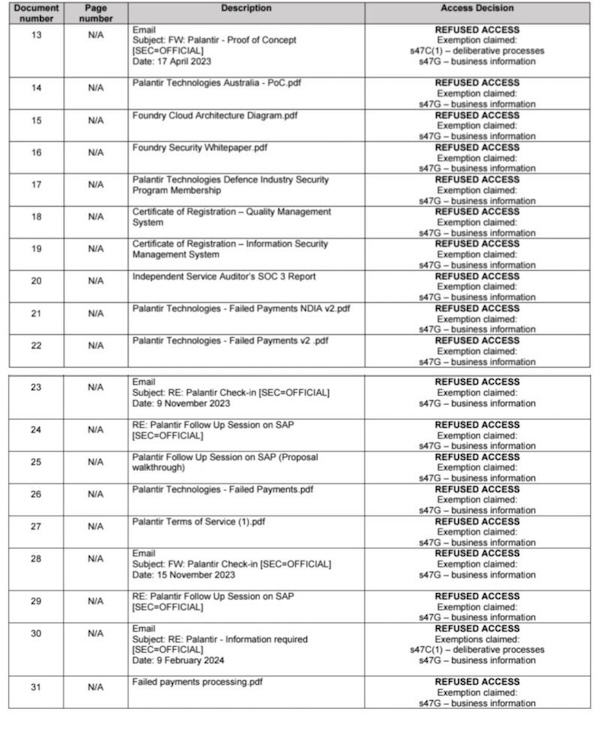
FOIs show NDIS Palantir connection
What can be confirmed: AusTender records show AUSTRAC — one of 24 agencies sharing participant data with the NDIA through the Fraud Fusion Taskforce — holds an active Palantir contract for ‘Data Analytics capability’ worth $8.83 million, running to June 2027.
Participant data shared with AUSTRAC is therefore already being processed on Palantir infrastructure.
The government has committed $442 million to rebuild the NDIS’s digital infrastructure. The new PACE payment platform is already live. The $358.5 million digital enrolment and payment system will introduce automated real-time
checking of every claim for 800,000 participants.
Nobody asked those 800,000 people whether they consented to their data being processed this way. No privacy impact assessment has been published. No consultation with disabled people has taken place.
When automated systems get it wrong — and at this scale, they will — a participant loses funding they depend on to live. To eat. To get out of bed. To breathe. There is no human on the other end of the phone. There is no appeal. There is a computer program and a decision that stands.
What the Bill does
For the first time in Australian law, the Bill expressly permits a computer program to make decisions involving ‘discretion’ and ‘evaluative judgment’ — decisions previously reserved for humans. Section 59E(3) goes further: an automated decision stands even if the required safeguards were not followed.
Schedule 1 removes review rights. New section 34A makes a ministerial funding cut non-reviewable.
Here is what that means. A participant in a wheelchair receives an automated notice — her funding for home modifications has been cut. The computer got it wrong. Her occupational therapist’s report was filed under the wrong support category. Under section 59E(3), the decision stands anyway.
Under section 34A, she cannot challenge it. She has a wheelchair and a house she can no longer live in safely. And nowhere to go.
The Robodebt Royal Commission described exactly this architecture — automated decisions, delegated authority, reduced oversight — as the precondition for unlawful harm at scale. The NDIS is five times the size of Centrelink’s debt-raising program. The people affected are among the most vulnerable in the country.
Parliament is handing a Commonwealth agency the power to automate decisions, conduct coercive investigations and share data across 24 agencies — without telling the people affected who is building the system, or what will happen when it gets it wrong.
The questions that need answers this week
First: FOI documents show the NDIA engaged with Palantir for nearly a year, including a Proof of Concept and Terms of Service discussions. Did that engagement proceed to a contract — and if not, who did?
Second: 800,000 disabled Australians have not been told what data is being collected about them, who holds it, or what it will be used for. When will they be?
Third: section 59E(3) provides that an automated decision stands even when the required safeguards were not followed. In plain English — the system can break the rules and the decision still counts. Who approved that, and why?
In the shadows of Robodebt
The last time a Commonwealth agency built this kind of automated decision architecture — with delegated authority, reduced oversight and no meaningful right of appeal — a Royal Commission found it unlawful.
People lost their homes. People took their own lives. Nobody was prosecuted. The architects faced no legal consequences whatsoever.
The NDIS is five times the size. The people affected are among the most vulnerable in the country. When this goes wrong — and people are harmed — will the architects of this system face criminal prosecution? Or will history simply repeat itself?
Disability advocate Sam Connor has called on the government to publicly clarify whether Palantir products will be used in NDIS integrity functions. Palantir’s association with the NDIS, as per the FOI disclosures, is the result of Labor associates lobbying the government.
“The President of Palantir is a former Labor Defence politician, Mike Kelly AM – one of their chief lobbyists is another, former autoelectrician turned Defence Minister, Joel Fitzgibbon. More than 14 of Palantir’s 42 staff appear to have come from Labor political or public service backgrounds.”
The NDIA was contacted for comment at 11am AEST on 17 August 2026. An NDIA spokesperson responded prior to the 5pm AEST deadline; their statement is incorporated in the article above

Claudia Weisenberger is a management consultant with deep experience in pharmaceuticals, hospital transformations, and strategic due diligence across four continents. She combines sharp analysis with hands-on execution.