
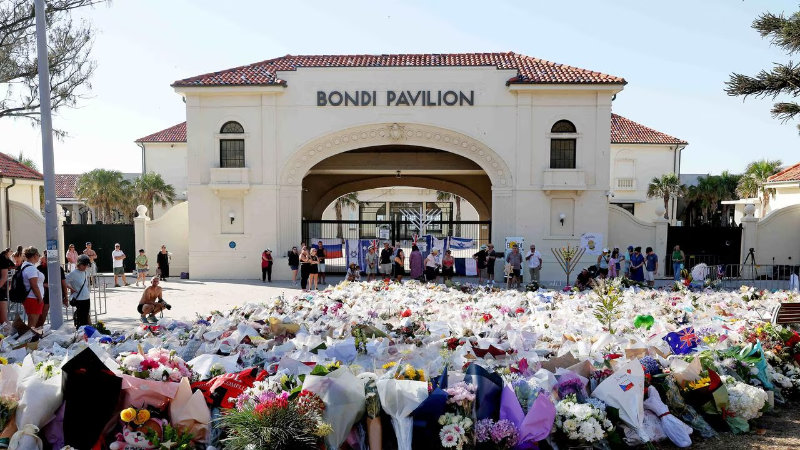
They came to Bondi to murder as many Jews as possible, but also shattered a political consensus and an often-unacknowledged sense of national coherence. How are we to cope, Julie Mackin asks?
The two gunmen who visited such horror on the Jewish community on 14 December 2025 could never have imagined how successful they would be. Their ambition was clearly to murder as many people as possible and make the happiest day in the Jewish calendar one that would be remembered with heartache and fear for years to come.
They may have achieved this.
But they have also left us scrambling to make sense of this attack, the reasons behind it and how it so quickly became weaponised in the hands of some of Australia’s most divisive people, in politics and the media.
Australia is hurt
There is a pall hanging over Sydney as the fireworks and rifles are packed away, the skies remain grey, and NSW Premier Chris Minns has successfully reframed New Year’s Eve celebrations as an act of defiance, as he drew a direct line between the hundreds of thousands of Sydneysiders who marched in support of Palestine and the two murderous gunmen. Splitting the community has become his schtick.
Political leadership has failed us in a moment when we need clear, calm leadership to help us hang together. This is more than a political, security or social crisis; it is a psychological moment that needs investigation and understanding. Because the unseen engine driving this moment is not quiet conscience.
Some may challenge the legitimacy of analysing a nation psychoanalytically in the same way an individual can be understood psychologically. As Judith Butler suggests,
“Nations are not the same as individuals’ psyches, but both can be described as ‘subjects’, albeit of different orders.” Right now, we need new tools to help us through.
In reading the nation as a psychological subject and applying the thinking of one of the world’s most influential psychoanalysts, a picture begins to emerge. That is of a nation confused and anxious and reacting in a way Melanie Klein investigated in her work on the paranoid/schizoid position.
This is the earliest and most primitive psychological state for us. Klein describes infants as terrorised by a fear of annihilation with no capacity to manage complexity. To protect herself from the terror, the baby splits the mother into a wholly-good mother, and a wholly-bad mother. The good mother protects and holds the goodness of the baby, and the wholly-bad mother holds all the baby’s rage and hate she projects into it.
As an infant, and perhaps as a nation, this psychological splitting preserves us, but not for long.
I believe this is where we are today. We are, in our many and varied ways, splitting along lines of identity, faith, politics and national identity in order to manage our meaning-making, our anxiety and our growing fear of the (m)Other.
The result is our sense of “us” is shattered.
Warnings of ISIS links ignored. The anatomy of the Bondi attacks
What is to be done?
Nations have tools the young baby does not have. We have ways of moving out of this splitting if we have the courage to use them – but no one should imagine this will be easy.
Simply, the first step is to withdraw the projection of both who is all-good and all-bad from communities and individuals. We do this by slowing down and exploring the facts, by slowly coming to grips with complexity.
That is why, from a psychological point of view, a federal Royal Commission makes good sense.
A Royal Commission gives the Prime Minister the opportunity to become what Donald Winnicott called “the good-enough mother”. That is the leader who does not have all the answers but is willing to endure the discomfort of not knowing, together with the child, and to metabolise the difficulties along the way.
Secondly, a Royal Commission will take time to establish, take evidence and report back, and we all need time to let the pain, fear and fury settle down. Splitting is done with fear-soaked speed, but recovery happens when the nation slows down and begins to think with a different part of the psyche.
Thirdly, Klein argued the infant moved beyond the paranoid/schizoid position when she had a moment of recognition. When the infant caught sight of the (m)other in her wholeness. It was at this point the infant’s anxiety for itself begins to become concern for the (m)Other. It is a moment when the infant/nation begins to see the truth and withstand it.
It is a moment of deep sadness and deepening love as the infant/nation understands the harm it has willed and/or done to the (m)Other. It is the beginning of both love and psychological maturity.
Finally, the NSW Premier, Chris Minns, is not trusted by all the parties as he has sought to use this horror to achieve his ambition of shutting down the pro-Palestine rallies.
Anthony Albanese is the only political leader who has refused to weaponise this crisis for his own interests.
Trust matters more than likability right now.
Learning from recent history
We have seen what it is like to go through this shameful and distressing process before. There was a glimpse of this recognition and remorse in 2019, when an Australian gunman shot dead fifty Muslims at prayer in Christchurch, New Zealand.
In a moment of shame, Australians watched New Zealand’s Prime Minister Jacinda Ardern tell the world that the white supremacist who committed the atrocity was not one of ‘them’.
Australian novelist Richard Flanagan finished her sentence at a Palm Sunday Rally for Refugees in Canberra, Australia, saying:
“He is one of us. And the terrible truth is that we are him. We are our media, which too often promotes neo-Nazis. We are our parliament, which voted for a neo-Nazi slogan, resolving that it’s ‘OK to be white’. We are our Senator [Fraser Anning], who called for a ‘final solution’ to the so-called problem of immigration … Christchurch proves one thing; national security does not lie in the fairy tale of border security; it does not repose in the ongoing torture of free human beings; it exists in tolerance and human decency. (Flanagan, 2019)”
We can do this.
Port Arthur via Oslo to Bondi. History repeats, lessons ignored at our peril

Julie Macken is a former journalist, political consultant and currently an advocate. She completed a PhD at Western Sydney University in 2023 and has recently published 'Australia's Schism in the Soul'. She is on the board of Sweltering Cities, the Sydney Peace Foundation and Australian Peace and Security Forum and member of the RFS.