


AI is reducing the number of people who keep private health insurance afloat. When they go, we’ll all have to pay. Claudia Weisenberger investigates.
Nobody knows exactly how artificial intelligence will reshape the Australian economy. The modellers are still arguing. The government says there is no evidence of broad disruption. The recruitment firms say the job market is a dumpster fire.
The truth is somewhere in between — and the numbers are only beginning to show it.
Except in the private health insurance (PHI) sector, where we can already watch it happening. We have quarterly data, published by a federal regulator, going back decades. We have a system sensitive enough to register an income shock within months. And we have a structural vulnerability that economists have been warning about since 2019.
This is not just a PHI story, though. It is a preview of what AI displacement does to any system that depends on stable middle-income employment.
The PHI death spiral
In 2019, health economist Stephen Duckett predicted that without reform, PHI would cover less than 40% of the population by 2030. He called it a death spiral — as younger, healthier people drop their insurance, premiums rise, more people drop out, and the cycle continues.
The system is held together by a cross-subsidy: younger, higher-earning workers pay premiums that subsidise the claims of older, sicker members. When that cohort loses income, the signal appears almost immediately in the membership data.
Private health insurance. Unfit for purpose and in need of reset
The actuaries saw one threat coming: an ageing risk pool slowly draining the system. Nobody modelled a second one arriving at the same time — a structural jobs shock landing squarely on the younger, healthier, higher-income workers whose premiums keep private health insurance solvent.
Jobs disappearing
The jobs going are exactly the jobs that hold PHI together, including Qantas, Canva. WiseTech. NAB. CBA. KPMG. Block Inc. (Afterpay’s parent).
In the past year, these companies — spanning technology, banking, professional services and aviation — have collectively cut thousands of Australian white-collar roles: software engineers, technical writers, finance staff, HR, marketing, communications and call centre workers.
Every one of these roles came with a PHI premium attached.
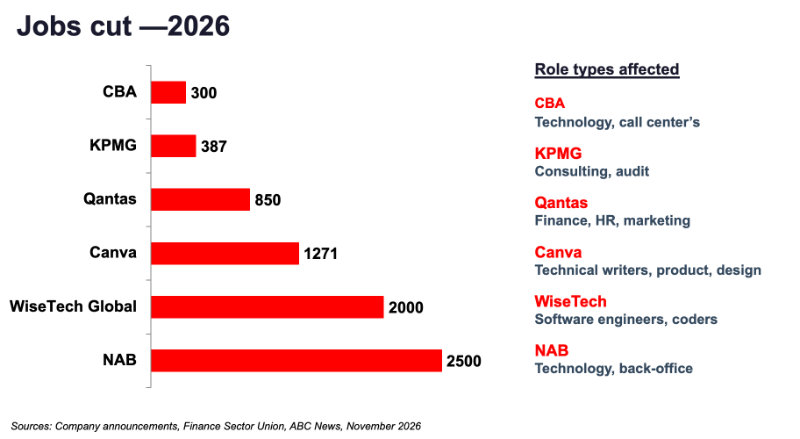
Last week, Qantas also announced it would cut 850 corporate jobs in finance, HR and marketing — mostly Sydney-based — with the work moving to India via Accenture. The Australian Services Union accused Qantas of using AI as cover for offshoring Australian jobs.
Registrations at Sydney-based recruitment firm Samuels Donegan surged 250%, with nearly half of all new registrations since March arriving in just two months. “I’m finding a lot of uni grads that have got corporate-style degrees — in finance, HR, marketing, cybersecurity — they’re not getting a look in,” recruiter Tammie Ballis said.
Deloitte Access Economics estimates Australia will have around
77,900 fewer white-collar jobs over the next five years.
CPA Australia has flagged the entry-level contraction: 8% of businesses have already cut junior accounting and finance hiring due to AI. These are the next generation of PHI members who will never join the pool at all.
Pressure to drop hospital cover
According to APRA’s March 2026 quarterly statistics, 45.8% of Australians — just under 12.8 million people — hold hospital cover, the product that funds the cross-subsidy the whole system depends on. Treasury’s own research has consistently shown PHI coverage rises sharply with income. But the brackets most exposed to AI displacement are the same ones most likely to hold cover and least likely to tolerate premium increases if their income falls.
The data to model this exists, but so far it appears Treasury hasn’t done that analysis.
There is a further trap buried in the tax system. Singles earning above $93,000 face a levy surcharge if they don’t hold hospital cover. Fall below that threshold — as AI-driven wage cuts are pushing people to do — and the surcharge disappears. So does the incentive to stay insured.
COVID precedent
Melbourne Institute research found that 15 per cent of Australians with private health insurance dropped or reduced their cover during COVID-19. Among those who lost jobs due to COVID specifically, the rate was 18%. People under financial stress were three times as likely to reduce cover. Nearly a third of Australians aged 35 to 44 reduced or dropped their cover entirely.
COVID was temporary. AI displacement is structural and permanent. There is no JobKeeper for a profession automated out of existence. There is no recovery timeline for entry-level roles redesigned out of existence.
The Reserve Bank’s November 2026 Statement on Monetary Policy forecasts unemployment rising to 5.1% by December 2028, while warning separately that five per cent of all Australian financial wealth is now held in AI-exposed equities — a problem for every Australian with a super balance, not just those who lost their job.
The jobs go first. The growth comes later. The gap between those two events is where the PHI pool quietly bleeds.
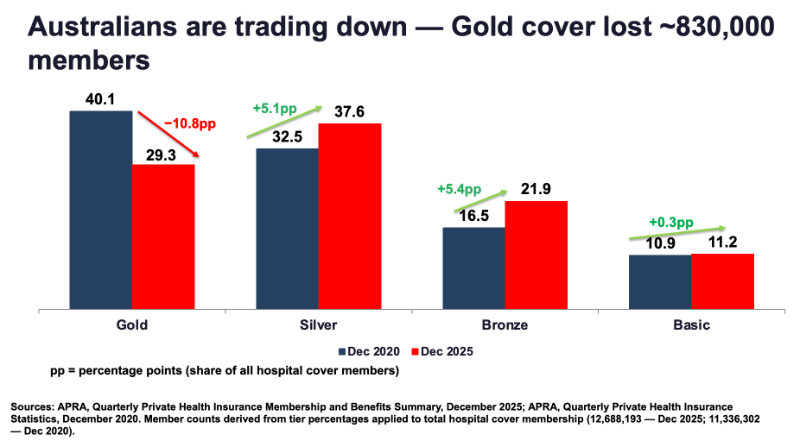
Over five years to end of 2025, PHI lost 830,000 members from ‘Gold Cover’, the highest standard tier of private hospital insurance.
What’s next?
None of this appears in any government modelling of PHI sustainability. The Department of Health’s Modernising Private Health Insurance Impact Analysis, released in May 2026, models rebate changes, premium indexation, and regulatory reform. It does not model AI.
When the pool shrinks, the remaining members carry more. Premiums rise. Some of those remaining — older, sicker, with fewer options — make the same calculation and leave. The private hospital system, which funds around two-thirds of all planned surgery in Australia, loses its revenue base. Wards close. Elective surgery migrates to the public system.
The public waiting list — already at record strain — gets longer. Everyone waits.
The pressure on the pool is not coming from one direction. While AI displacement is pushing working-age members out from below, government policy is pushing older members out from above. From 1 April 2027, Health Minister Mark Butler will scrap the age-based uplift to the private health insurance rebate. For Australians aged 70 and over, the rebate drops from 32% to 24% — an estimated $807 a year in additional costs when combined with the annual premium increase.
Butler says the change is “necessary and the right thing to do.” National Seniors Australia says almost
a quarter of its members would need to dip into savings to keep their cover.
The system is structurally unable to defend itself. Community rating — the rule that stops insurers pricing by age or risk — means there is no price signal when the cross-subsidising cohort walks out the door. Premiums simply rise for whoever remains.
Private Healthcare Australia’s answer is to double the Medicare Levy Surcharge for high-income earners — from 1.5% to 3%. It is their strongest lever. It does nothing for workers whose income has already fallen below the threshold. There is no lever left.
You may never lose your job. You may never drop your cover. But if enough people around you do — and they already are — the system you depend on starts to fail. Quietly. Structurally. Without announcement.
Private health insurance is not the only system built on the assumption that middle-income employment is stable. It is just the one where the data already shows what is coming, and there is no plan for this.
The AI “dumpster fire”. White-collar jobs vanish as markets split

Claudia Weisenberger is a management consultant with deep experience in pharmaceuticals, hospital transformations, and strategic due diligence across four continents. She combines sharp analysis with hands-on execution.