



AI icon Jensen Huang just lost his job, but he’ll be OK. For thousands of Australian white-collar workers, the AI threat is existential. Claudia Weisenberger reveals the data.
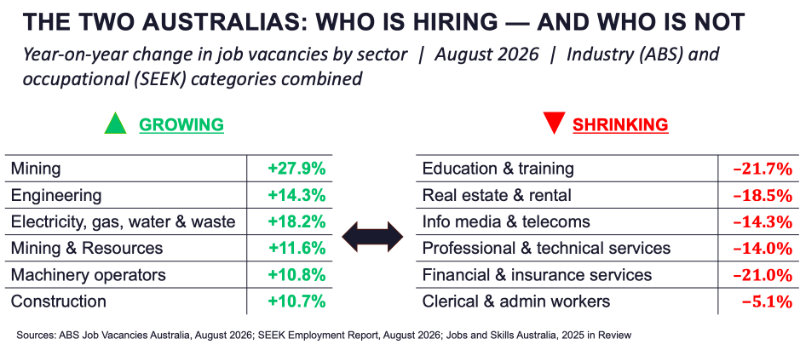
The data is in. Everything growing wears a hard hat or drives machinery. Everything shrinking sits at a desk or writes code.
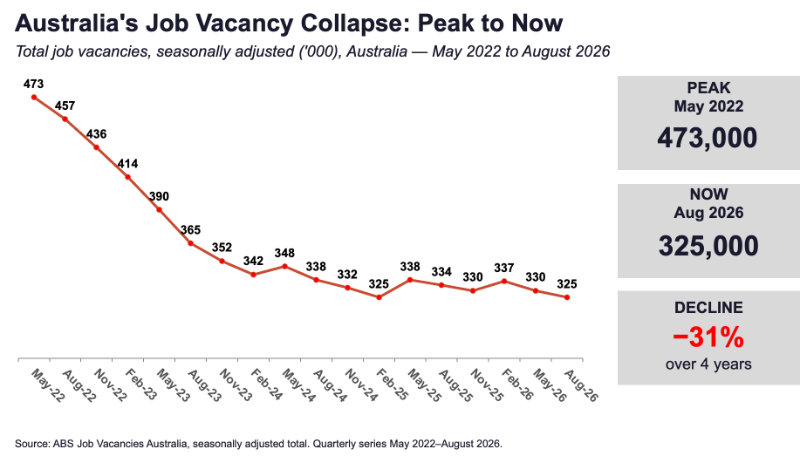
Since May 2022, Australia has lost nearly a third of its advertised job vacancies. Total vacancies have fallen from 473,000 to 325,000 — a decline of 31% that has continued for more than three years, through interest rate cycles, two federal budgets, and a change in government.
The Reserve Bank calls it a normalisation. Recruiters call it a collapse.
Because the aggregate number conceals something the official framing does not. Australia’s job market is not simply shrinking — it is splitting. One half is growing faster than at any point since the mining boom. The other is in a contraction that has now run for more than three years.
And the line between them is not drawn by geography, or by age, or by education. It is drawn by what you do with your hands.
The AI signal
Roles most exposed to AI are contracting at nearly seven times the rate of roles least exposed. The gap between them is the AI signal, isolated in the vacancy data.
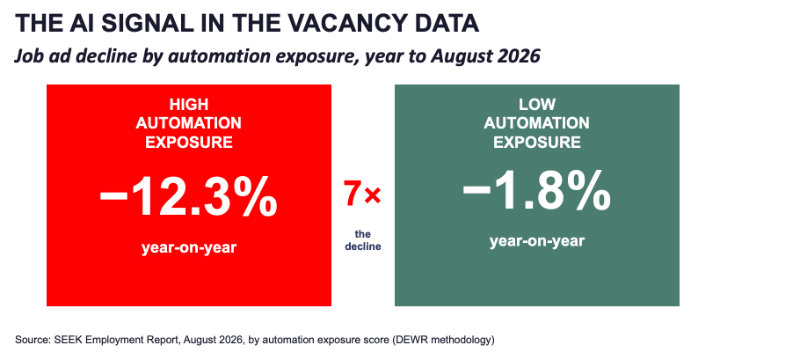
That is a sevenfold difference. The gap between them is the AI signal, isolated in the vacancy data.
Sarah Donegan, managing director of recruitment firm Samuels Donegan, said Australia was in the midst of a horror “redundancy season.” Her agency recorded a 250% spike in jobseeker registrations in October 2026, with nearly half of all registrations since March arriving in just the past two months.
Business commentator and recruiter Tammie Ballis described 2026 as a “dumpster fire.” “I’m finding a lot of uni grads that have got corporate-style degrees — in finance, HR, marketing, cybersecurity — they’re not getting a look in,” she said.
This is consistent with what the data suggests. The sectors those graduates trained for — finance, professional services, information technology — are precisely where vacancies are falling fastest.
What is disappearing?
The contraction is not evenly spread. It is concentrated precisely where knowledge work is.
Professional, scientific and technical services — lawyers, accountants, IT consultants, management advisers — lost 14% of vacancies in a single year, and 17.4% in just the three months to August 2026. Financial and insurance services shed 21% in one quarter. Information media and telecommunications — the ABS’s nearest equivalent to an IT sector — is down 14.3% year-on-year.
The government had a target of 1.2 million technology jobs by 2030. According to Jobs and Skills Australia, it currently stands at approximately 999,000. The Department of Industry has quietly stopped publishing progress updates.
Meanwhile, clerical and administrative workers — one of Australia’s largest occupational categories — saw vacancies fall 5.1%, amounting to tens of thousands fewer entry-level positions advertised next year.
Clerical and administrative work is one of the most common pathways into the workforce for school leavers and career changers. When those jobs stop appearing, entire cohorts stop entering — not because the work has gone offshore, but
because software has absorbed it.
That is where the damage compounds. CPA Australia found that 8% of Australian businesses had already cut junior accounting and finance hiring due to AI — against an Asia-Pacific average of 17% and rising.
These are not just jobs lost. They are workers who will not enter the system at all: not as income tax contributors, not as superannuation accumulators, not as private health insurance members.
Structural changes hiding in plain sight
The global headwinds are real — interest rates, recession risk, offshoring, structural competition. But Deloitte Access Economics has modelled what AI adds on top: 77,900 fewer white-collar jobs over the next five years, above and beyond every headwind already in the outlook. That is the AI premium. That is the number that belongs in the forecast and doesn’t.
The Department of Employment and Workplace Relations saw the signal in its own 2026 analysis. AI-exposed occupations grew at 5.6% to February 2026. The least exposed grew at 9.5%. Its conclusion: “no evidence to date of broad labour market upheaval.”
What it did not ask — and what no government agency has modelled — is what a structural contraction in white-collar employment does to the communities built on the assumption that those incomes keep flowing.
Not in one announcement. Not in one budget. In the slow arithmetic of fewer job ads, shorter careers, thinner pipelines. The GP clinic whose privately insured patients stop renewing. The superannuation balance that stops compounding at thirty-two. The mortgage that made sense on two incomes and doesn’t on one. The tax base that was never going to collapse — just quietly, persistently, shrink.
Australia has watched this happen to manufacturing towns. Geelong lost its car industry and a generation of young men who had expected to follow their fathers into the plant. Whyalla watched its steelworks hollow out and its main street empty over a decade.
Elizabeth, Wollongong, Moe — the same story repeated, the same gap between when the jobs left and when the data caught up. By then the schools were struggling, the GPs had left, and the superannuation balances that were supposed to fund retirement never got started.
The difference this time is that it is not happening in one town, or one industry, or one region.
It is happening everywhere, all at once,
with no announcement and no closure date. Just fewer jobs listed each month — and a generation that will not get the chance to start.

Claudia Weisenberger is a management consultant with deep experience in pharmaceuticals, hospital transformations, and strategic due diligence across four continents. She combines sharp analysis with hands-on execution.