


The Federal government is once again allowing Australia’s most protected company to trample over its workers, offshore tax, and send critical AI skills abroad. Michael Sainsbury with the never-ending story.
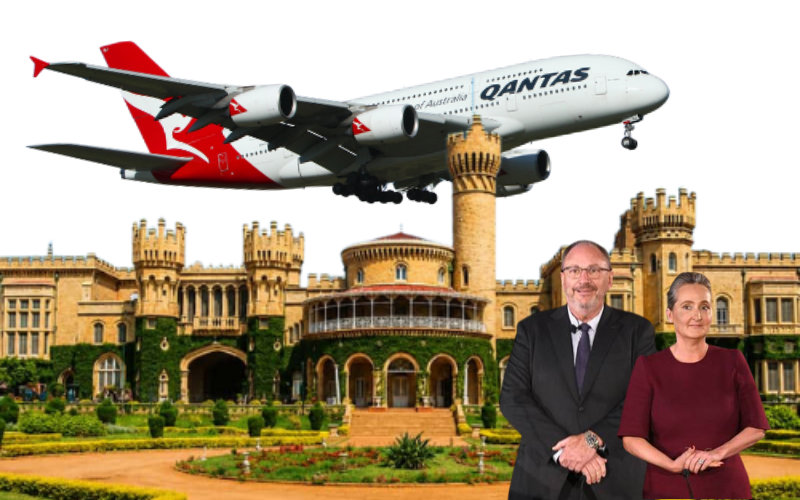
Yesterday, Qantas announced it’s cutting nearly 1,000 jobs, doing a deal with tech consultants Accenture, and sending many of the jobs to the mecca of outsourcing, Bangalore.
The timing of the announcement coincides with Qantas holding its Annual General Meeting in Canberra last Friday (Nov. 6), for the first time since 2012.
At the shareholder dog and pony show, Qantas chairman John Mullen admitted that he and his fellow directors had met with members of the government the night before, yet he made no mention of the Accenture deal.
The deal is all about technology and AI, and the meeting was clearly a softening-up session, a meeting to make sure that the Albanese government and Australia’s biggest corporate mendicant, which shook down Australian taxpayers for $2.7B during COVID, were “on the same page”.
And it worked, so far there has been
silence from the government benches.
History repeats
There is a pattern here. The last time that Qantas held its AGM in Canberra in November 2012, there was a clutch of major issues that Qantas was lobbying the government on, led by approval of its alliance with Emirates. Qantas and Emirates applied to the Australian Competition and Consumer Commission (ACCC) on Sept. 10, arguing the ‘killer’ tie-up would improve the international competitiveness of Qantas.
Virgin’s expansion and its foreign backers were also before regulators, and then CEO Alan Joyce was pressing for equal treatment under the Qantas Sale Act, arguing it imposed ownership restrictions its rivals did not face.
At its previous Canberra AGM on Oct. 13, 2005, the airline was lobbying the Howard government on three main fronts, led by its campaign to keep Singapore Airlines off the Pacific route. Qantas also wanted the foreign ownership limits in the Qantas Sale Act eased.
In 2004, Qantas chair Margaret Jackson and Geoff Dixon said the restrictions added about 3% to the airline’s cost of global equity capital. At the AGM, Jackson told shareholders that security costs had risen to $260 million, more than 400% above 2001 levels. She also said the board was pushing for policy changes on competition, sharing of security costs and foreign ownership.
Unions furious
Today, unions are rightly furious. Not only is Qantas once more sending jobs offshore, but it has also backpedalled on promises. Qantas has offshored heavy maintenance and the concomitant skill set to Abu Dhabi, Manila and Los Angeles. It continues to bulk up cabin crew hubs in London, Singapore, Auckland, Phuket, Manila and Jakarta. All offshore cabin crew are on lower pay than their Australian counterparts.
“Qantas told us directly [when the Accenture deal was leaked in August] there was no plan to offshore any jobs”, Australian Services Union Assistant National Secretary Scott Cowen said. “Qantas staff have the right to an explanation”.
The deal also sees critical AI skills are being developed in India by an American company,’ skills Australia desperately needs. Sure, Qantas likes to talk up its Adelaide AI centre, but if it’s so good, why this?
Taxpayers should also be furious. That’s hundreds of Qantas employees who no longer pay tax; that benefit goes to the Indian and US governments, where Accenture is domiciled.
Lobbying excellence
The government has been bought, fed, watered and upgraded by Australia’s most effective government lobbying tool, the exclusive Chairman’s Lounge.
Qantas insiders have warned that there may be more redundancies to come. “The company’s regional airlines are now under a second restructure in 18 months”, a Qantas pilot told MWM.
“They are centralising and rationalising duplicated functions. Sunstate and National Jet Systems ( two of the four main regional airlines) are aiming to get a single Airline Operating Certificate (AOC). The rumour mill is in overdrive, with a total of 1,500 jobs, including outsourcing, being targeted”.
The Mendicant Roo has still not returned a cent of the $2.7B of taxpayer money it was handed by the Morrison government during COVID – and has said it won’t, in any case. That was money that enabled it to fund thousands of redundancies, at least 1,700 of them illegal.
Meanwhile, Rampart today reveals ($) how Jetstar fought tooth and nail to avoid refunding customers stranded during COVID, and mostly succeeded.
On the day of its AGM, Qantas used the opportunity to tell the same Australians that propped it up during COVID that it would be continuing to jack up airfares and trim capacity to help keep it in healthy profit.
Healthy profits and even healthier bonuses
Healthy profits mean healthy executive bonuses, and Mullen told shareholders at the AGM – after handing Qantas chief executive Vanessa Hudson a special long-term incentive of a possible 411, 000 share rights over three years, valued at $4.07m today – that “we would like to pay her more”. Unsurprisingly, Qantas shares rose 6.3% on the outsourcing news;
job cuts are catnip to the market.
Hudson and her fellow senior executives also benefited from a decision by the board’s remuneration committee to override the remuneration model that would have zeroed out the group’s short-term remuneration as the company did not meet its profit targets.
Proxy adviser ISS recommended voting against Hudson’s short-term incentive because the performance hurdles weren’t met, but shareholders still carried all five resolutions, including the remuneration report.
Meanwhile, over the past three years Hudson has insisted that the airline’s pilots, cabin crew and ground staff sign up to five-year Enterprise Bargaining Agreements that include a two-year pay freeze.
Industrial action looming
Despite Mullen’s claim that the company’s relationship with unions is much improved, evidence points precisely the other way. Earlier this year, the main “red tail” Qantas pilots union, the Australian and International Pilots Association, issued a rare rejection of a new EBA and voted for protected industrial action (PIA) for the first time since Alan Joyce locked out pilots in 2011.
Last month, pilots at National Jet Systems voted for PIA as the company ramps up the use of regional pilots in its mainline business using its new A220s and second-hand A319 and A320, aircraft that are 15-20 years old yet are described by Qantas as “mid-life.”
“Pilots and cabin crew earn substantially less, about 30% less than Qantas mainline. Yet increasingly Network and NJS are “flying intercity routes as well as a growing number of international routes including Auckland-New Zealand and a plan for Darwin-Singapore”, another pilot told MWM.
As Vanessa Hudson continues to prove that she is very much providing a seamless leadership from Alan Joyce, Transport Workers Union National Secretary Michael Kaine linked the deal to the airline’s illegal outsourcing of ground staff in 2020. He said Qantas keeps finding
new ways to degrade the spirit of Australia beyond recognition.
Qantas off the hook for data breach they could have seen coming

Michael Sainsbury is a former China correspondent who has lived and worked across North, Southeast and South Asia for 11 years. Now based in regional Australia, he has more than 25 years’ experience writing about business, politics and human rights in Australia and the Indo-Pacific. He has worked for News Corp, Fairfax, Nikkei and a range of independent media outlets and has won multiple awards in Australia and Asia for his reporting. He is a fierce believer in the importance of independent media.