
The Pacific Islands Forum has again failed to condemn China for its missile test, instead walking a middle ground and “registering concern” over the show of force.
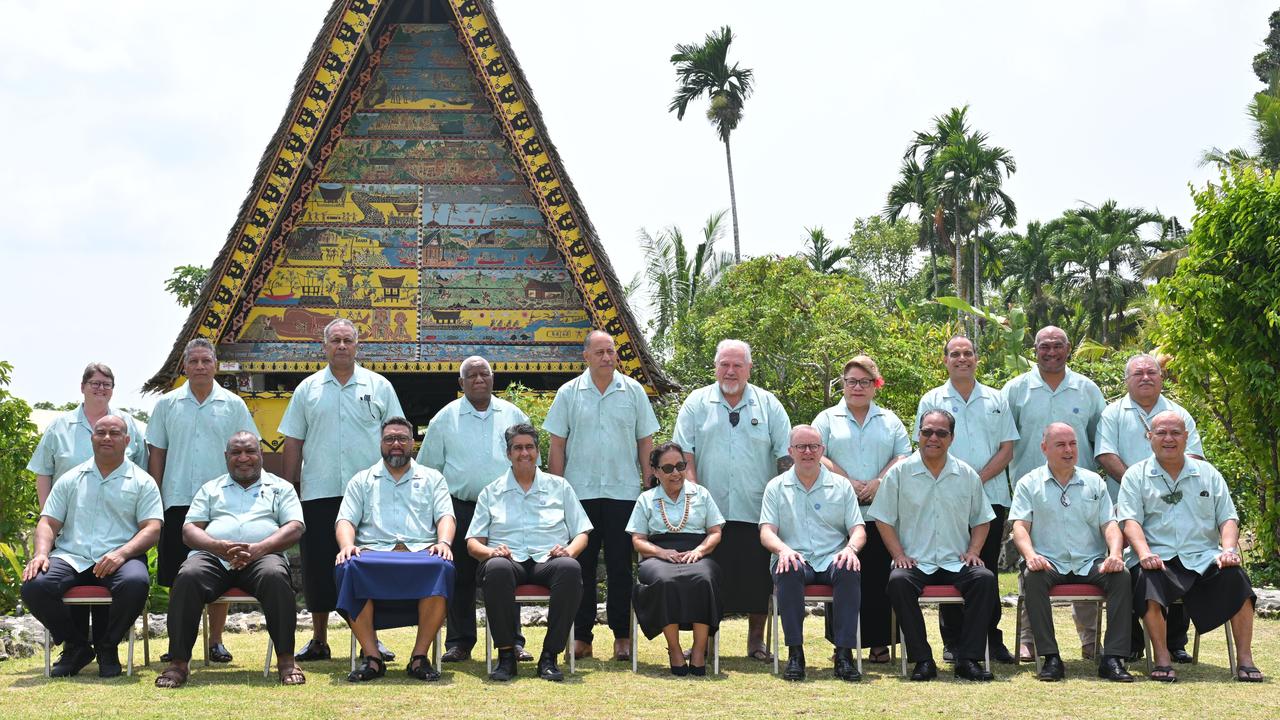
Prime Minister Anthony Albanese left Palau on Thursday after this year’s summit, following the leaders-only retreat which brought the week-long talks to a close.
The 18 PIF representatives made a number of reforms, including splitting dialogue partners into a two-tiered system, and adding a new annual police ministers gathering to the regional calendar.

The week in Palau has been flavoured by geopolitical competition between China and the west, including high-profile diplomacy by Taiwan, an ally of the Micronesian host nation.
One of the biggest talking points has been the lack of a regional response to China’s nuclear-capable inter-continental ballistic missile test in July.
Intelligence shows the dummy missile flew over the Philippines, Palau and Micronesia’s airspace before landing in the Pacific Ocean.
Several nations have criticised the test, just the second since 1980, but PIF failed to do so at a foreign ministers meeting last month.
The response has become something of a litmus test for PIF and its members for their strategic positioning.
The communique’s relevant clause includes a reference to the Fiji-led Ocean of Peace declaration made last year, which states the region should be free from coercion and militarisation.
However, it doesn’t name China by name, nor use heftier diplomatic language than “concern”.

“Recalling the Blue Pacific Ocean of Peace declaration, leaders registered concern about the recent inter-continental ballistic missile (ICBM) test which overflew a number of members without adequate notice,” the relevant clause read.
“Leaders call on all states undertaking ICBM testing to provide transparency and provide reassurance, including through provision of advanced notification of at least 24 hours in accordance with international practice.”
In a rare move for the usually-consensus based forum, Nauru dissented from the clause.
Kiribati, another country which reportedly vetoed a stronger statement at the foreign ministers meeting, did not offer the same objection.

While Australian officials were happy with the agreed statement, it fell short of some pre-retreat expectations, including from host Palau.
Earlier on Thursday, President Surangel Whipps made clear his displeasure at the test, which followed a 2024 effort.
“They sent a missile next to French Polynesia, another one next to Tuvalu, crossing over our airspace. They never bothered to tell us that’s what’s happening,” he said.
“I said ‘there’s a lot of space between Japan and Guam, why don’t you send it there? Why does it have to come to the middle of the Pacific when last year we just signed a declaration of peace?’
“We don’t want our backyard, our homes, to be threatened and really disrespected.”

Mr Whipps said “a unified Pacific voice” would be critical to get Beijing to “respect sovereignty”.
In other decisions of the leaders retreat, PIF will categorise external powers, currenly known as “dialogue partners” as either strategic or sector partners.
The 13 strategic partners will be China, the US, France, Germany, the UK, the EU, Canada, Japan, India, Indonesia, Singapore, South Korea and the UAE.
Those partners will be able to continue to travel to leaders meetings, while sector partners will be referred to the annual foreign ministers gathering.
A region-wide security pact, championed by Solomon Islands Prime Minister Matthew Wale, did not progress – as expected, given Mr Wale’s absence.
A proposal to bring the Australia-backed Joint Heads of Pacific Security (JHOPS) under the Pacific Islands Forum has also won a level of support.

Australian Associated Press is the beating heart of Australian news. AAP is Australia’s only independent national newswire and has been delivering accurate, reliable and fast news content to the media industry, government and corporate sector for 85 years. We keep Australia informed.