
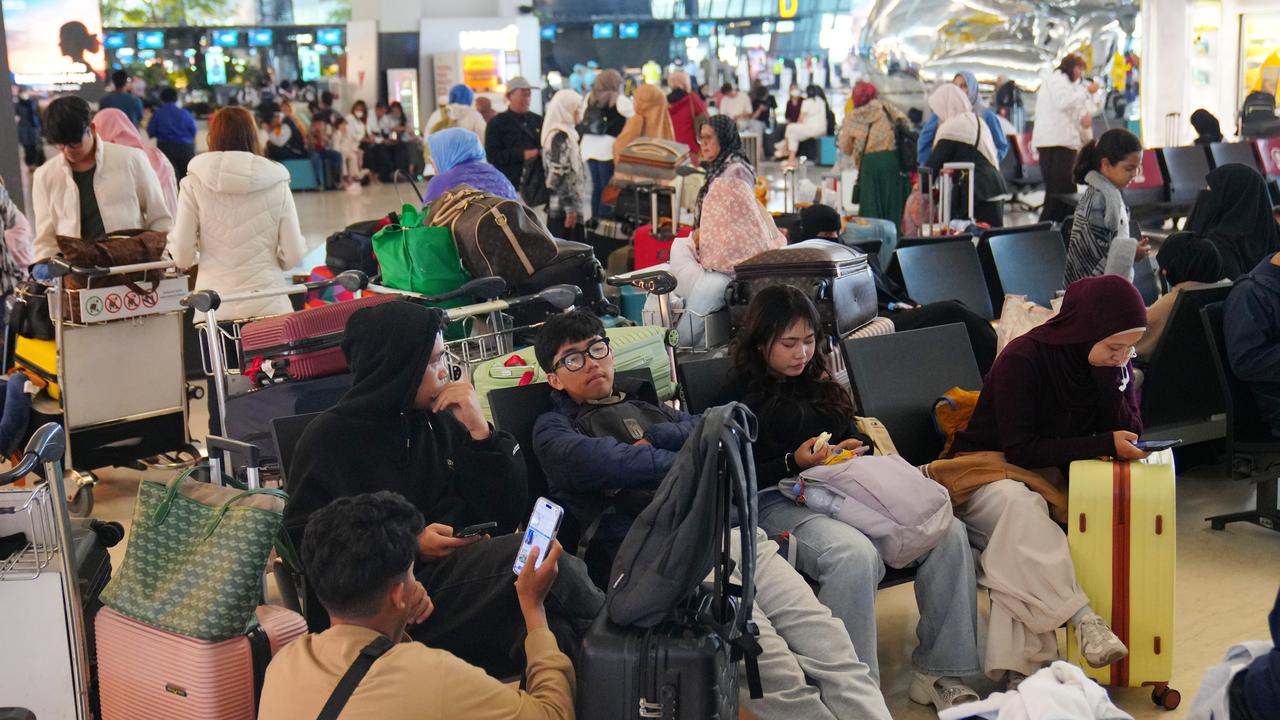

Flights to and from Indonesia’s capital of Jakarta have resumed after ash from a volcanic eruption forced a two-day closure that halted nearly 3000 flights.
Soekarno-Hatta International Airport and Halim Perdanakusuma Airport serving Jakarta, Husein Sastranegara Airport in West Java’s Bandung city and two smaller airports in Banten province reopened just after midnight, Transportation Minister Dudy Purwagandhi said on Tuesday.
Three other airports remained closed until 10am, including Radin Inten II Airport in Lampung on the southern tip of Sumatra island, despite improving conditions at some facilities. Atung Bungsu Airport in Pagar Alam in South Sumatra province had resumed normal operations on Monday morning.
“We are taking a conservative approach because wind direction is highly dynamic,” Purwagandhi said in a statement.
“We want to ensure that volcanic ash has moved away from airports around Anak Krakatau.”

Although tests at several airports showed no traces of volcanic ash, the extended closures would allow time for inspecting and cleaning surfaces and equipment like runways, taxiways and aircraft that may have been exposed to volcanic ash, Purwagandhi said.
The continuous eruption of Anak Krakatau with lava fountains and loud booms ended on Sunday but the volcanic island remained active on Tuesday morning.
The airport closures on Sunday and Monday disrupted nearly 2961 flights, including 622 international services, and affected about 341,000 passengers.
The government also authorised schools in areas affected by volcanic ash to shift temporarily to online learning to reduce students’ exposure to ash.
Anak Krakatau is a volcanic island in the Sunda Strait between Indonesia’s main islands of Java and Sumatra. Its name means “child of Krakatau,” and the volcano is the offspring of the infamous Krakatau, whose monumental 1883 eruption triggered a period of global cooling.
Indonesia has more than 120 active volcanoes and frequently experiences eruptions due to its location along the Pacific “Ring of Fire,” the ring of seismic faults around the Pacific Ocean where most global seismic activity occurs.

Australian Associated Press is the beating heart of Australian news. AAP is Australia’s only independent national newswire and has been delivering accurate, reliable and fast news content to the media industry, government and corporate sector for 85 years. We keep Australia informed.