
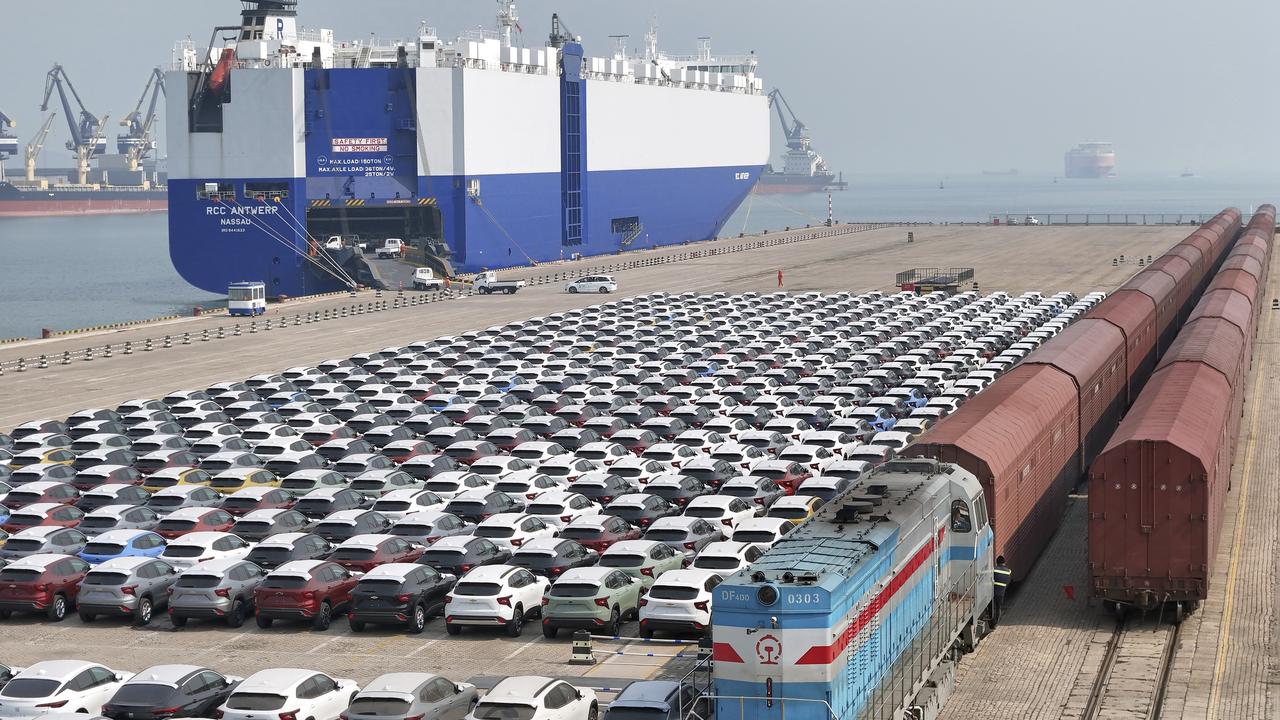

China’s exports surged 36.3 per cent in September from a year earlier, its customs agency says, bringing it on track to exceed 2025’s record trade surplus as pressure ramps up from its trading partners, including the European Union, to rebalance trade.
The exports data, which was better than what economists had expected, accelerated from the 25 per cent growth in August.
High-tech goods such as semiconductors and autos have helped fuel its rising shipments overseas.
Imports climbed 31 per cent in September year-on-year, also accelerating from August’s 28.2 per cent rise.
That resulted in a $US133.5 billion ($A190.8 billion) trade surplus for China in September, widening from $US119.1 billion in August.
For the first nine months, China’s trade surplus reached $US938 billion, with expectations growing that it could surpass 2025’s full-year $US1.2 trillion record.

Strong exports have helped drive China’s overall economic growth in 2026 at a time when domestic consumption and investment remained sluggish, weighed on by a years-long real estate sector downturn.
However, China’s export resilience faced mounting challenges, said Ecaterina Bigos, a senior market strategist at BNP Paribas Asset Management.
“While US-China trade tensions have eased somewhat, the EU’s push to rebalance directly targets high-value exports,” she said.
The US has launched an ongoing probe against China and other trading partners on their excess industrial capacity, although Washington and Beijing in September reached an agreement to extend their trade truce and cut tariffs on $US60 billion worth of goods.
The EU has particularly been struggling to rebalance a trade deficit exceeding $US1.1 billion a day with China.
EU trade chief Maros Sefcovic, following his visit to Beijing where he met his Chinese counterpart Wang Wentao last week, said a deal has been reached with Beijing, including halving Chinese hybrid car imports into the EU during the next few years.
Many of China’s trading partners faced weak growth prospects and were fearful of their manufacturing industries being overrun by exports from China, said Eswar Prasad, a professor of economics and trade policy at Cornell University.
Policymakers have also pointed to a weakened yuan, China’s currency, versus the US dollar and other currencies contributing to Chinese exports being cheaper overseas when compared with goods from other countries, adding to trade imbalances.
China has said it has “no need or intent” to gain competitive advantages through currency devaluation and that its trade growth has been driven by its industrial competitiveness in the global market.

Australian Associated Press is the beating heart of Australian news. AAP is Australia’s only independent national newswire and has been delivering accurate, reliable and fast news content to the media industry, government and corporate sector for 85 years. We keep Australia informed.