

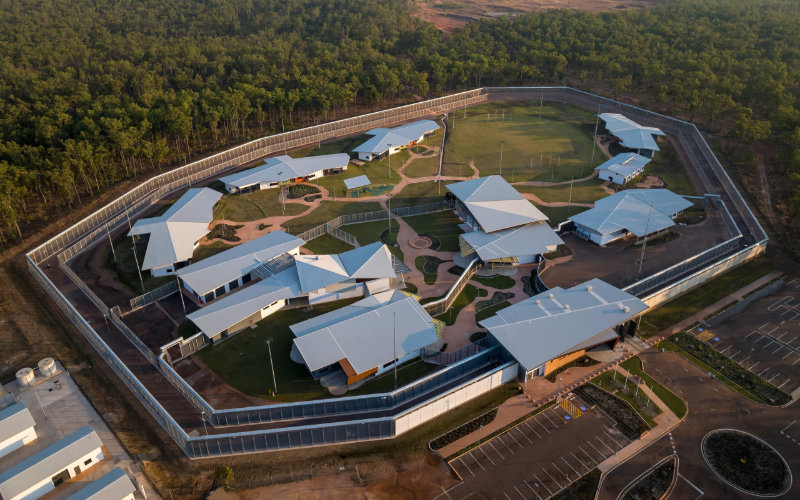

The Northern Territory and Queensland governments have refused to let the UN human rights advocate into their youth detention centres. What are they hiding, Aleta Moriarty asks?
The United Nations Special Rapporteur on the Rights of Indigenous Peoples, Dr Albert Barume, arrived in Australia this week. He had planned to inspect the Holtze Youth Detention Centre near Darwin, and the Cleveland Youth Detention Centre in Townsville, where Aboriginal and Torres Strait Islander children make up most of those detained.
Amnesty International Australia said it’s the second time in less than a year that the NT Government has refused UN human rights experts’ access to its detention facilities.
“We should be opening our doors to international scrutiny, not shutting them,” said Uncle Rodney Dillon, Palawa Elder and Indigenous Rights Advisor at Amnesty International Australia.
Ten-year-old criminals
In most of Australia, a ten-year-old, a child still losing their baby teeth, is old enough to be a criminal. According to the Australian Institute of Family Studies, the age is 10 in New South Wales, Queensland, Western Australia, South Australia, Tasmania, the Northern Territory and under Commonwealth law.
The ACT raised its age to 14 in July 2025, with exceptions for some serious offences, and Victoria raised its age to 12 but now both major parties in the forthcoming election are going out on a tough on youth crime platform. The NT raised its age to 12 in 2023, then lowered it back to 10 the following year, as if childhood could be turned up and down with the electoral weather.
On an average day in 2024–25, 453 First Nations young people aged 10 to 17 woke up in detention, 62% of all the children Australia locks up.
They were about 23 times as likely to be detained as non-Indigenous kids.
The UN Committee on the Rights of the Child recommends a minimum age of criminal responsibility of at least 14, already the most common age worldwide. Canada sets it at 12. South Africa raised its age to 12 in 2022, and France presumes children under 13 can’t be held criminally responsible. Australia keeps company with England, also at 10, and the United States, where most states set no minimum at all.
The cost of locking up children
A Productivity Commission report shows Australia spent $1.1B in 2024–25 locking up children. Each child in detention cost $3,635 a day, about $1.3m a year, money that could be spent on early preventative measures or addressing the root causes of juvenile delinquency.
Locking children up doesn’t change what they do – it only teaches them where society thinks they belong, locking them into a pattern of institutionalisation. About 85% of children released from sentenced detention are back under sentenced supervision within 12 months.
In Victoria, the Sentencing Advisory Council found that children first sentenced at 10 to 12 had a six-year reoffending rate of 86%, more than double the 33% for those first sentenced at 19 or 20.
The younger we take them, the longer we keep them.
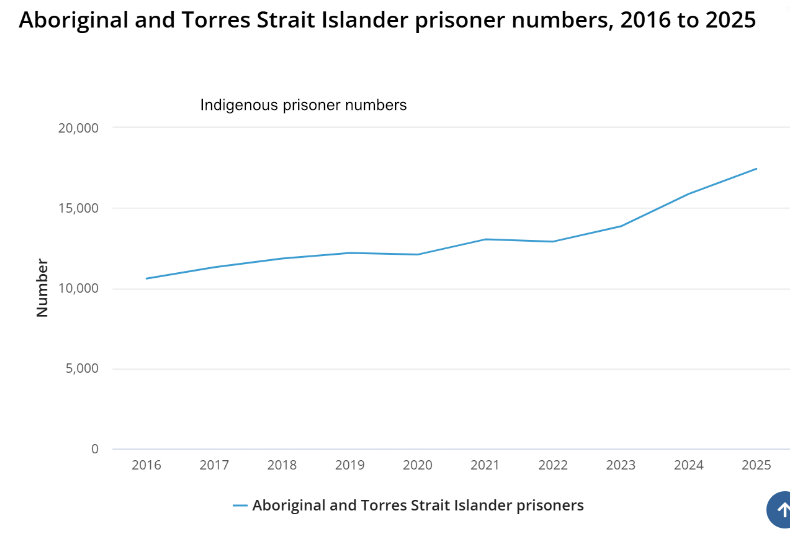
Many of those children grow up to be the adults filling our prisons. In 2026 there were 18,396 Aboriginal and Torres Strait Islander prisoners (average daily number), up 7% (1,238 persons) from 17,158 in June 2025.
First Nations people make up 37% of everyone behind bars, and they’re imprisoned at about 16.8 times the non-Indigenous rate, and the number keeps going up.
Forever prisoners
Some never come out. In 2024–25, 33 Aboriginal and Torres Strait Islander people died in custody, the most in a single year since 1979–80.
For those who survive it, the sentence keeps running long after release. An Indigenous man in this country is more likely to have seen the inside of a cell (almost 15% of Indigenous men have been incarcerated) than the inside of a graduation hall (about 10% of First Nations adults hold a bachelor’s degree, against 35% of non-Indigenous adults).
It is time to look at alternative approaches to justice and law, including restorative justice for youth delinquency and to address the underlying issues, trauma, poverty and racism that underpin this data.
Mounting international pressure
Australia went before the UN’s Universal Periodic Review in January 2026. The review examines every member state’s human rights record roughly every five years. More than 40 countries, including Germany, France and Norway, urged Australia to raise the age of criminal responsibility. Australia rejected those recommendations.
Of the 332 recommendations it received overall, it accepted 128, or 38%, according to Human Rights Watch. That’s down from 51% at its previous review in 2021.
Australia has a record of keeping UN monitors out of its detention facilities. The UN Subcommittee on Prevention of Torture suspended its first visit to Australia in October 2022 after being denied access to some facilities in New South Wales and Queensland, then terminated the visit in February 2023.
In December 2025, the UN Working Group on Arbitrary Detention was refused entry to every detention institution in the Northern Territory. Working Group member Dr Ganna Yudkivska said the NT’s refusal was a first in more than 30 years of UN detention monitoring worldwide.
Gap not closing
Barume’s visit is examining more than detention, including how Australia implements the UN Declaration on the Rights of Indigenous Peoples (Australia endorsed the UN Declaration on the Rights of Indigenous Peoples in 2009 but has never written it into domestic law and is itself non-binding), self-determination, redress for historical injustices, and rights to lands, territories and resources.
The government’s own data shows how far there is to go. The Productivity Commission’s 2026 Closing the Gap annual data report found that, past the halfway point,
of the 19 targets, only four have been met or are on track,
Four are getting worse: adult imprisonment, children in out-of-home care, children’s development when they start school, and suicide. First Nations children are in out-of-home care at a rate of 52.2 per 1,000, 11.5 times the rate for non-Indigenous children. The youth detention target hasn’t moved from its baseline.
Barume will present his preliminary findings and recommendations at a press conference in Sydney on 13 November. His formal report will go to the UN Human Rights Council in September 2027.
Privatised refugee detention centres: a billion dollar failure

Aleta is a practitioner researcher in human rights, disability inclusion and gender. She is completing a PhD at University of Melbourne and has twenty years of experience working across agencies including the United Nations, UN Women, World Bank, and the University of Melbourne. She is currently standing as an Independent Candidate for Western Victoria. Her website is www.aletamoriarty.com