

The US and Iran’s cat-and-mouse game with maritime mines in the Strait of Hormuz has cast a spotlight on Australia’s underinvestment in equipment to protect key shipping lanes and ports from sea-floor munitions.
All but one per cent of Australia’s international trade undertakes sea journeys, with the nation’s ports handling 1.6 billion tonnes of cargo a year, according to the Australian Maritime Safety Authority.
But in recent years, Australia’s capacity to protect ships from explosive devices hidden in the water has weakened.
In 2024, the Albanese government shelved Project SEA1905, a tender to modernise Australia’s mine countermeasure capabilities, to save money.

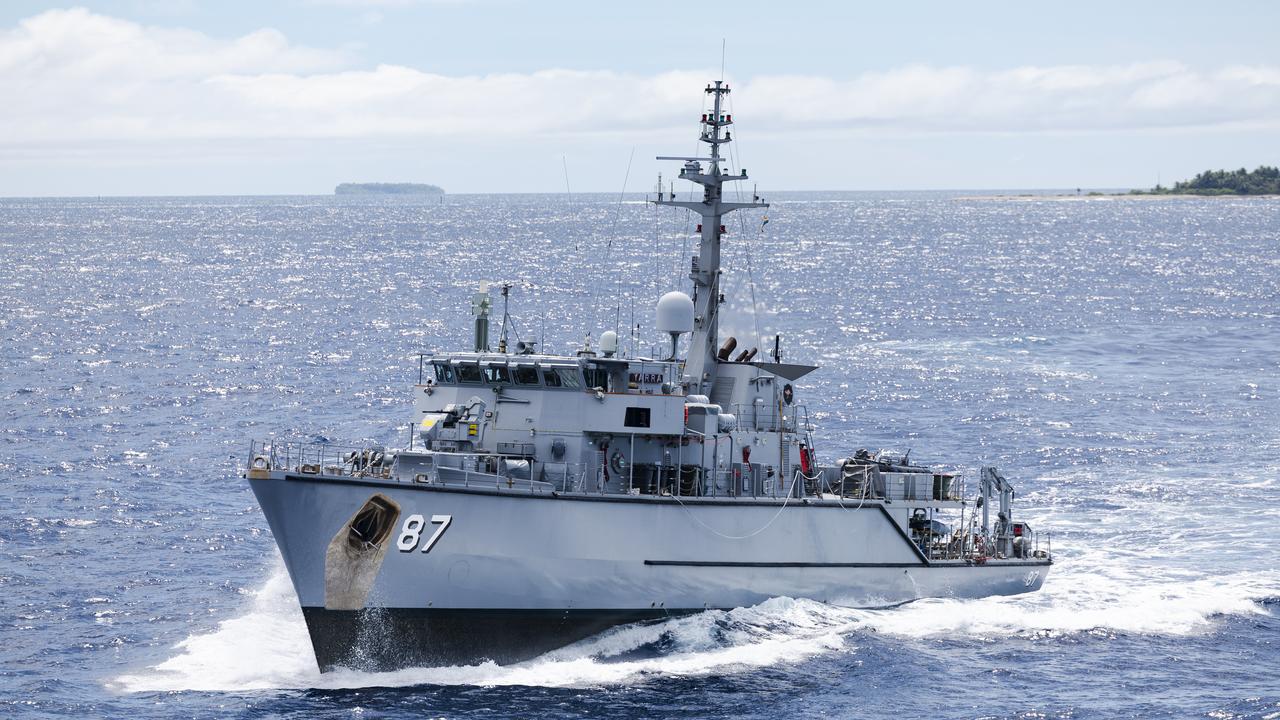
The decision left the navy with only two ageing Huon-class minehunters in service from an original fleet of six. The two remaining are likely to be decommissioned in the short term, with no plans announced to replace them.
“Mine warfare is one of the areas which has seen cuts in order to transfer money to other higher priority and sexier projects,” senior lecturer in maritime strategy at UNSW Canberra Richard Dunley says, referring to the AUKUS nuclear-powered submarines and frigate shipbuilding projects.
The decision to skimp on countermine measures could be a future own goal for Australia, potentially leading to major supply chain disruptions in the event of conflict, according to defence analysts.
There was a taste of that scenario earlier in 2026 when petrol stations ran dry, airlines grappled with jet fuel shortages and farmers struggled to secure fertiliser as shipping disruptions worsened in the Strait of Hormuz amid war between Iran and the US.
US Central Command in August said the nation’s military forces had reached a “major milestone” in clearing the strait’s international shipping lanes of sea mines laid months earlier by Iran.
Yet mine-clearing experts say an area can never be definitely declared as mine-free, but risk can be reduced.

“I think Australia is grossly underprepared when it comes to the ability to detect and destroy mines,” says Jennifer Parker, a maritime strategy expert affiliated with multiple Australian universities, who served in the Royal Australian Navy for 20 years.
“If you don’t have a mine clearance capability, then your submarines, your ships can easily be neutralised,” Ms Parker says.
Ms Parker notes the Tanker War between Iran and Iraq in the 1980s, where Tehran was laying mines in the Strait of Hormuz, was a wake-up call for Australia that led to the purchase of the six minehunters.
The current crisis should spur a similar jolt, she says.
Future regional conflicts “almost certainly” would see Australian ports, choke points and key shipping routes targeted with mines, Ms Parker says, noting Germany and Japan laid mines in Australian waters during both world wars.
China and Russia have vast stockpiles of mines. Beijing has up to 100,000 and Moscow an estimated 125,000, according to the US Naval Institute.
Defence experts predict China could blockade Taiwan with mine-laying operations in the event of a conflict.

Australia finds itself in a “capability valley” when it comes to mine countermeasures, Macquarie University associate professor in strategic studies Adam Lockyer says.
“Alarmists will likely say that ‘time is up’ and that war with China could erupt any day now. Eternal optimists might say that war is still a remote possibility and even then, decades into the future,” he tells AAP.
“The truth is probably in between these positions,” he says, while acknowledging the region has far more to gain from finding ways to trade peacefully with China.
“The danger is that relations deteriorate, and Beijing announces that it is laying mines along trade routes. Then insurance skyrockets and trade slows down because it becomes less financially viable.”
French defence firm Exail and Saab Australia were shortlisted for the SEA1905 competition to provide mine countermeasure systems and equipment, before the tender was unexpectedly canned.
Exail, which is being bought by defence corporation Thales, is already supplying its mine countermeasure toolkits to the Belgian, Dutch and Saudi Arabian navies. Other countries including the US, UK and India are in talks.

These toolkits include uncrewed surface vessels, underwater drones equipped with sonar that detect and identify mines, and swimming robots that neutralise ordnance.
An autonomous surface vessel is doing doughnuts in the harbour for engine testing on the day AAP visits the company’s factory in Belgian port city Oostende.
Inside on the factory floor, workers are skilfully hand-wiring the electronics that go into the bright yellow underwater drones.
“All defence is an insurance policy, but mine countermeasures is an insurance policy for the insurance policy to protect your trade,” says Exail’s business development director Ben Vickery, a former mine clearance diver for Britain’s Royal Navy.
Modern minehunting using drones and artificial intelligence systems “keeps the sailors safe” and is more efficient because navies can conduct parallel operations with multiple drones in the water, Exail chief commercial officer Antony Penn tells AAP.

A ship doesn’t have to explode for a mine to be considered effective, he says, and the mere idea that an area is not mine-free casts enough doubt for captains to halt shipping.
A Defence spokesperson said the government is continuing to invest and transition to autonomous systems to further enhance the Australian Defence Force’s mining and mine counter-measure capability.
The government has also directed the ADF to accelerate the acquisition of autonomous mine hunting and neutralisation systems, the spokesperson said.
The US has pressured Australia and other nations to increase military budgets, and Defence Minister Richard Marles says Australia has lifted its defence spending to 2.8 per cent of GDP by the NATO measure.
Meeting with his US counterpart in Washington DC on Thursday Australian time, Mr Marles says he came with a “good story” to tell on expenditure.
“This is the biggest peacetime increase in defence spending that we’ve done … we understand the American position, but I think that is a story which is well received here,” he says.
The reporter travelled to Belgium with support from Exail.

Australian Associated Press is the beating heart of Australian news. AAP is Australia’s only independent national newswire and has been delivering accurate, reliable and fast news content to the media industry, government and corporate sector for 85 years. We keep Australia informed.