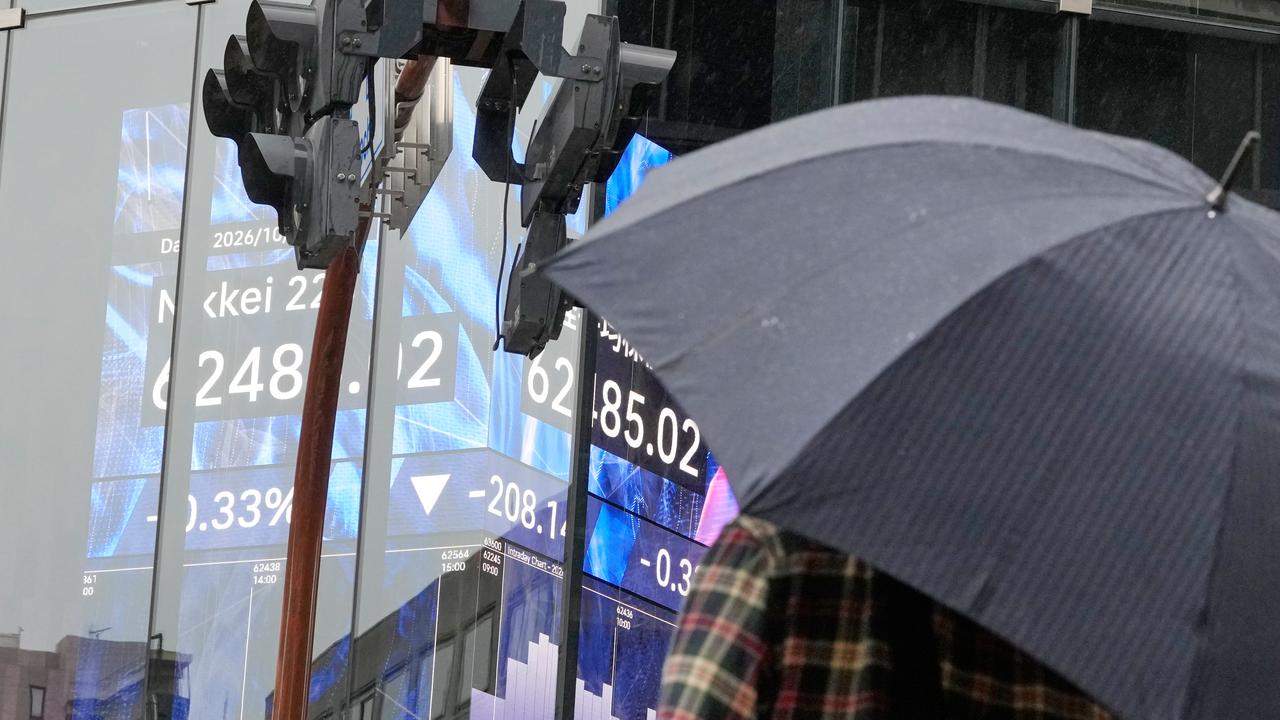

Global shares have edged up as oil eased from six-month highs before a week of central bank meetings and corporate earnings that will further test confidence in the AI boom.
The oil price was down about two per cent to $US114.60 after reports that Qatari mediators were in Tehran on Sunday as part of an effort to de-escalate tensions in co-ordination with the US.
Brent futures jumped 6.2 per cent last week to their highest weekly close since mid-2022 as Houthi attacks in Saudi Arabia stoked energy supply concerns.
The Houthi group in Yemen said on Monday it had attacked Saudi Arabia’s East-West crude oil pumping stations and Riyadh airport, but there was no immediate confirmation from Riyadh.
MSCI’s All-World index was last a touch higher on Monday, having fallen nearly one per cent last week, while in Europe, the STOXX 600 was up 0.4 per cent, led by energy-sensitive stocks such as industrials.
Volatility was contained, given the wall of macroeconomic event risk this week, in the form of multiple central bank meetings and earnings from the AI hyperscalers.
“The combination is formidable: mega-cap earnings, AI funding concerns, global semiconductor results, five major central bank meetings and potentially market-moving inflation and growth data,” Pepperstone head of research Chris Weston said.
“The danger isn’t simply that markets move sharply. It’s that one catalyst changes the interpretation of the next, creating feedback loops across equities, rates, FX and volatility,” he said.
New Zealand’s central bank is widely expected to raise rates on Wednesday.
Markets assume the US Federal Reserve will stand pat, but they imply an 80 per cent chance that it will pull the trigger in December.
Much the same is priced in for the Bank of Japan and the European Central Bank.
A key reading on US core inflation should show cost pressures remained elevated at 3.1 per cent in September, while the economy is forecast to have grown at a brisk 3.2 per cent annualised pace thanks in part to furious spending on data centres.
“The Fed is set to skip raising rates at its October meeting but is likely to deliver a second hike in December,” analysts at Goldman Sachs said in a note.
“The most important risk is that oil futures are above our forecasts, largely reflecting concerns about potential further conflict with Iran,” they added.
“The more extreme and long-lasting the energy shock becomes, the more Fed participants will worry that inflationary pressures could broaden.”
On Wall Street, S&P 500 and Nasdaq futures gained 0.3 per cent.
Aside from the Fed, earnings are in store from Alphabet, Microsoft and Amazon, as one-third of S&P 500 companies report.
Yields on 10-year Treasuries were flat at five per cent, below October’s peak of 5.36 per cent.
The Japanese yen slipped, as the dollar gained 0.3 per cent to trade about 157.28 yen, while the euro rose 0.1 per cent to $US1.121 after France dodged a credit downgrade last week.
French government bond yields were down 5 bps at 4.973 per cent, below last week’s peak above five per cent.
Sterling held at $US1.3346 with Britain’s new finance minister, John Healey, set to deliver his first budget on Wednesday against a backdrop of rising global borrowing costs and high energy prices due to the US-Israeli war on Iran.
Futures on the Brazilian real were down more than 10 per cent after Brazilian President Luiz Inacio Lula da Silva won an unprecedented fourth term on Sunday.

Australian Associated Press is the beating heart of Australian news. AAP is Australia’s only independent national newswire and has been delivering accurate, reliable and fast news content to the media industry, government and corporate sector for 85 years. We keep Australia informed.