
Global bond markets have come under renewed pressure, with Treasury yields hitting their highest in decades and threatening stocks, even though tech names managed to draw some support from AI chipmaker Micron’s blockbuster earnings.
The 10-year US Treasury yield, a yardstick for global borrowing costs and asset prices, rose to 5.34 per cent, its highest since 2002 before dip buyers stepped in, bringing it back to 5.28 per cent.
It posted its biggest quarterly rise this century in the three months to September, with the selling pressure also rippling through bonds in France, Britain and Japan.
Yields have been surging around the world as soaring energy costs fan inflation and as the boom in AI and data centre building lifts expectations for growth and for where short-term interest rates will settle.
Stalling peace talks between the US and Iran to end the seven-month-long war in the Middle East have kept crude prices elevated.
Brent futures surged 42 per cent in the July-September quarter, and the December contract, the current benchmark, was last at $US100 a barrel.
“We have had a prolonged sell-off in bonds – they have been correlated with oil prices and also we’ve had strong US data,” said Rory McPherson, chief market strategist at Wren Sterling.
“We don’t have enough buyers who want to buy bonds.”
That all left European shares under pressure on Thursday, with the broad STOXX 600 down 0.75 per cent and European banks off 1.8 per cent though US share futures managed to hold steady.
Helping the US were high-stakes earnings from Micron, a key supplier to AI bellwether Nvidia.
They signalled strong demand for AI memory chips, with financial commitments under long-term supply agreements at $US32 billion ($A46 billion), up from $US22 billion in June.
That helped push tech-heavy stock markets in Asia higher.
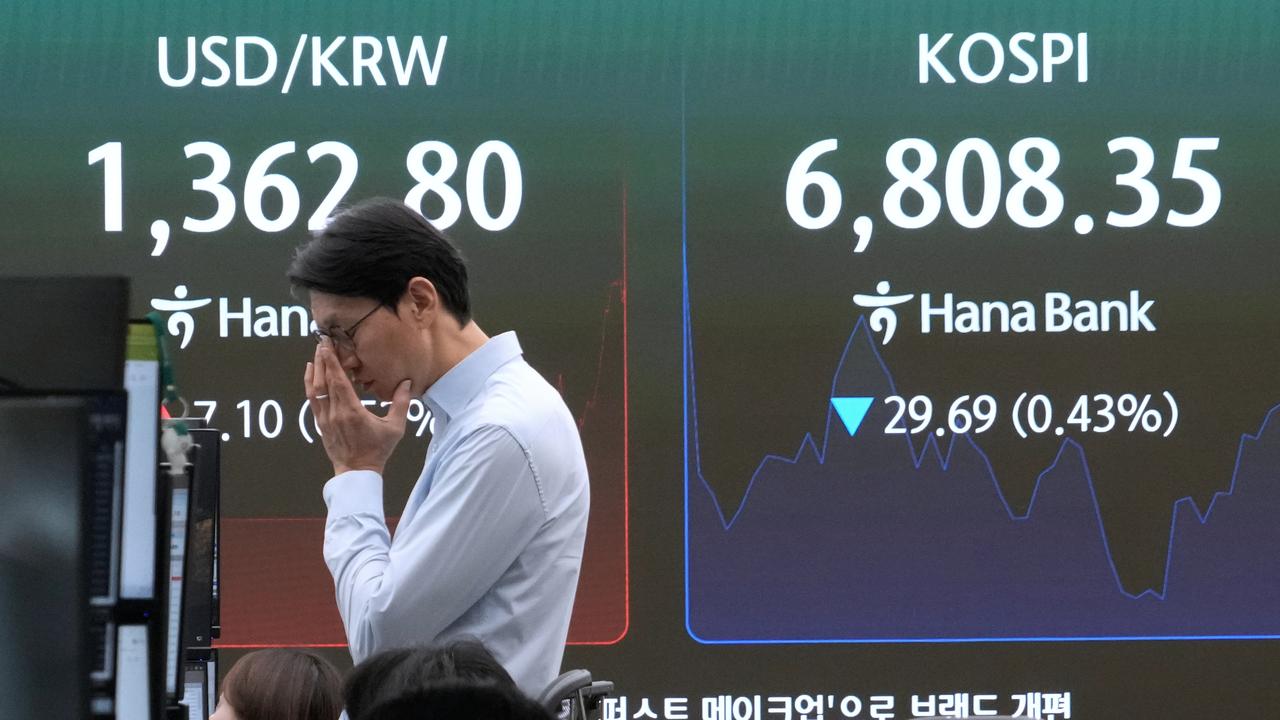
Japan’s Nikkei jumped more than three per cent, and South Korea’s KOSPI reversed earlier losses to gain 1.7 per cent.
Global yields surged in September as bond prices tumbled, amid the soaring energy costs and the AI boom, leaving investors bracing for a period where interest rates stay higher for longer.
Market focus has been on how long US Treasury yields stay above the psychologically important five per cent level while some investors even weigh the possibility of yields breaching six per cent.
The US 10-year yield gained 87 basis points in the July-September quarter, the biggest quarterly rise since 1994, LSEG data showed.
France’s 10-year yield gained 120 basis points in the quarter, the most since 1987, and its yield briefly jumped by a further 10 basis points on Thursday to 4.96 per cent, closing in on the symbolic five per cent level.
It too then eased back and was last down 2 bps at 4.82 per cent, though the French budget process is keeping investors on edge.
Yields in Japan have also climbed to multi-decade highs, while Britain’s 30-year yield nudged above six per cent.
Somewhere in the mix for bonds also was a reduction in bets on a further Federal Reserve rate hike in October after Wednesday’s softer-than-expected US inflation reading.
Traders are pricing in a 38 per cent chance of a Fed hike in September, versus 50 per cent a day earlier, CME’s FedWatch tool showed.
In currency markets the winner from the bond sell-off has been the dollar, which was stronger again on Thursday.
The euro was down 0.3 per cent at $US1.1297 and sterling was down by a similar amount at $US1.3223.
Gold was up a touch at $US4,174 an ounce.

Australian Associated Press is the beating heart of Australian news. AAP is Australia’s only independent national newswire and has been delivering accurate, reliable and fast news content to the media industry, government and corporate sector for 85 years. We keep Australia informed.