
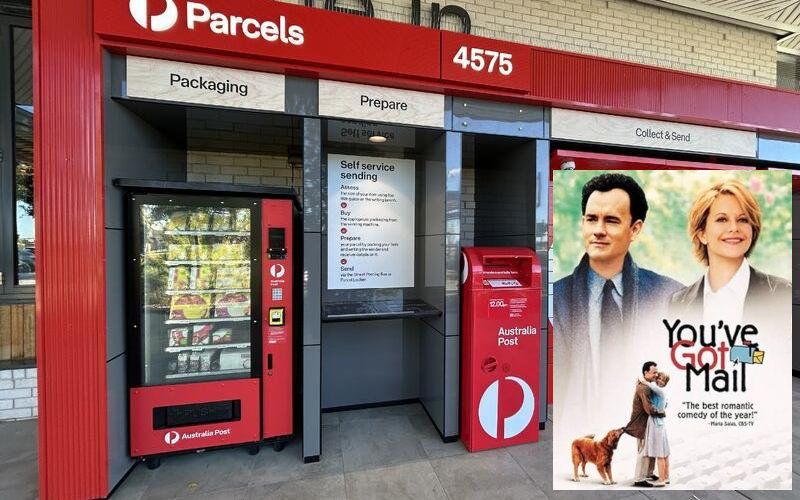
As revenue slowly declines, Australia Post is closing post offices and replacing them with unattended kiosks. Andrew Gardiner on the future of the Licenced Post Office.
A post box, a parcel locker and a vending machine for stamps or envelopes now qualify as a ‘24/7 Post Office’, according to Australia Post (AusPost). Its Marketing GM spruiks this unmanned infrastructure as offering “24/7 access“, making it “easier for Australians to do the things they need to do”.
But critics say it’s a vehicle for terminating over-the-counter service from actual human beings. That could make our “doing things” decidedly harder, and toss up to 2,701 current LPO operators – who ponied up for premises, equipment, AusPost décor, working capital or, in many cases, the license itself – on the vocational scrap heap.
At a heated hearing before the Senate Environment and Communications committee earlier this month, AusPost faced accusations of hiding a plan to close scores of staffed Licensed Post Offices (LPOs) and of starving license holders of funds required to keep them afloat.
Hear Australia’s highest paid public employee lie to a Senate hearing.
Australia Post CEO Paul Graham says the board’s approval was not for a “trial” program to close post offices.
A few minutes later …
AP’s legal counsel confirms the board approved a “trial” to close POs. pic.twitter.com/vu8V4MOImb
— Robert Barwick (@RobbieBarwick) September 21, 2026
Parcel lockers are central to those plans, as was (reportedly) offering financial help to struggling LPO operators so they would “voluntarily” relinquish their permanent licenses.
Under the reported plan, those permanent licenses would be supplanted by a finite contract set to expire at some point. LPO Group chairman Scott Etherington, who represents operators, sees this as a prelude to closing outlets altogether, comparing the accompanying financial relief to offering a glass of water – with strings attached – to a man dying of thirst.
“When I walk up to (that) man and say, ‘It’s completely up to you whether you choose to take this glass of water,’ most people would say that’s not really a voluntary choice”, he told the committee, adding, “And that’s exactly where we are”.
Mass closures
Freedom of Information documents confirm 87 LPOs were permanently closed from January 2024 to March this year. Many of these closures – in suburban and regional areas alike – followed financial pressures and reduced demand, much of it caused by 1,510 parcel lockers (and counting).
Fewer parcels stored at an LPO means less money for licensees. “I get around $2.40 per parcel I store here, but just $1.20 for items I put in a parcel locker”, Etherington, the Gulgong (NSW) LPO operator, told MWM.
They’re running us into the ground. Every time you turn around, we’re doing something for free.
It could all have been so different. Etherington says LPOs are the only ones who can pick up the slack caused by banks and government service offices closing down in struggling regional communities.
But he says AusPost “shows no interest” in pursuing an idea that could address their financial squeeze.
The Post Bank idea
That idea was Post Bank, first introduced in 2010, which would have used Australia’s 4,000-odd LPOs and corporate Post Offices as the physical branch network for a publicly-owned retail bank. Not to be confused with Bank@Post (the limited system LPOs already offer), it was thought Post Bank would simultaneously solve both struggling LPOs and the ongoing blight of bank branches closing due to a lack of customers.
“The closure of many banks in small communities certainly creates the need for Australia Post to serve those communities”, then-AusPost CEO Christine Holgate said in 2018. “Without a place where people can actually have some basic financial services, communities die”.
Holgate resigned under pressure from then-PM Scott Morrison in 2020, ostensibly over her 2018 decision to reward senior executives with $20,000 Cartier watches. But Bank Reform Now’s CEO, Peter Brandson, strongly implied Holgate’s fate was linked to the Post Bank plans.
“Perhaps it will be in the best interests of the people if MPs and senators encourage some competition in the sector by backing calls for a National Australia Post Bank, the type of operation Christine Holgate was working towards before she was so rudely interrupted”, he told a Senate committee in 2021.
New broom in charge
Holgate’s replacement at AusPost, former Woolworths supply chain chief Paul Graham, kept the relatively modest Bank@Post system but made no moves for anything more. “Australia Post is not a Bank”, he said in 2023.
It was Graham who came under fire at the hearing earlier this month for failing to disclose the leaked plan to close 36 suburban LPOs in Sydney and Melbourne and, reportedly, to push struggling regional operators to give up their permanent licenses. “You deliberately deceived our committee”, Senator Sarah Henderson told Graham.
In response, Graham argued these plans were “embryonic”, “not active” and, therefore, didn’t merit a mention before the committee. Yet the number of parcel lockers (with all the implications they carry for LPOs) has jumped by 68 per cent since he took over as CEO in 2021.
Post30
While published details are scarce, it’s broadly understood that more parcel lockers and fewer LPOs are part of AusPosts’s four year restructuring plan, known as Post30. “We’ve got a leadership team focused on shrinking the network to meet the current business, rather than growing the business to fill this network”, Etherington told the Senate.
In Poland, perhaps the model for AusPosts’s plans, lockers have become a mass-market alternative to traditional delivery points, having been rolled out across the entire country. Those lockers are run by newcomer InPost, and the more traditional points of contact by the Polish Post Office, with the latter struggling to compete, acknowledging in 2024 that its “current financial situation is very difficult” before starting down a restructuring path of its own.
While lockers in Poland clearly proved popular and efficient, there are few if any areas of that country as sparsely populated as regional Australia, whose communities are rapidly losing person-to-person contact points for basic services.
“A replacement of traditional Post Offices by alternative points of presence could have a high negative impact on people from vulnerable groups and those living and working in regional, rural areas”, a consultation report for the 2023–24 review of postal regulation read.
Take Carnamah (WA) which has been without a bank for four years after the local Westpac closed down. Colleen Bennier runs the local LPO from her business, the Bush Basket, and has added ‘Carnamah’s banker’ to her ever-expanding job description.
“I will do my damnedest to service our community the best way I possibly can through AusPost guidelines, but it will not be the same as a bank,” she said.
AusPost says the combination of a post box, parcel locker and vending machine will make it “easier for Australians”. But it couldn’t possibly replace Colleen.

An Adelaide-based graduate in Media Studies, with a Masters in Social Policy, I was an editor who covered current affairs, local government and sports for various publications before deciding on a change-of-vocation in 2002.