

Civil rights groups are urging universities to protect academic freedom and the right to peaceful protest as vice chancellors front the royal commission into anti-Semitism.
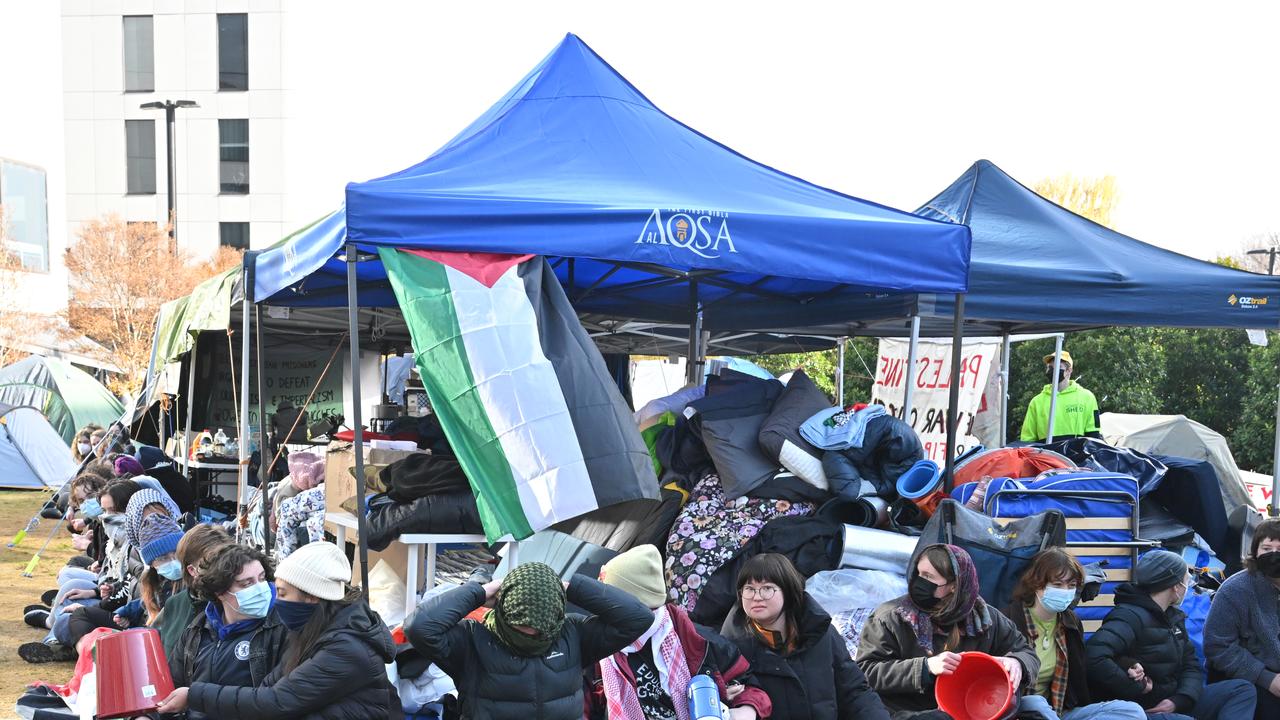
The Australian National University is one of a number of tertiary institutions facing questions over pro-Palestinian encampments on their campuses.
But in a joint statement, more than 40 groups including Amnesty International, the Human Rights Law Centre and National Union of Students expressed “grave” concern about measures restricting protests and political speech at universities.
“Universities must adopt a presumption in favour of permitting peaceful protest, including indoors, outdoors and online,” their statement said.
The groups also called for disruptive protests to be allowed on campuses and for universities to properly address racism.
It was published the morning the Australian National University’s acting provost Joan Leach conceded that a pro-Palestine encampment on campus had caused “psychosocial risks” and made students feel unsafe.
The encampment lasted for 110 days in 2024, making it one of the longest-running at any Australian university.
ANU for Palestine said at the time that the encampment became “untenable” after the university “called the police on us, censored us, and lied about us”.
Professor Leach said official intervention in the protest was justified as it came to pose a risk to students.
Separately, she confirmed the university had conducted investigations into a Nazi salute allegedly made at a student union meeting in 2025.
The incident was partly captured on video, though was “difficult to discern”.
The investigation could not determine whether the gesture was a Nazi salute and found it would be out of character, Prof Leach said.
A finding of no misconduct was made.
An office of integrity will be established at the university in August, providing a centralised, trauma-informed point for complaints at the university.
It was recommended in 2025 for reasons not related to the encampment, and instead in a review that uncovered misconduct in the university’s College of Health and Medicine.

Earlier in the week, a former ANU student, known as Liat, told the Royal Commission on Anti-Semitism and Social Cohesion she felt fearful on campus and had lost many of her friends because she was a Zionist.
“I spent the majority of my university education in an environment that was characterised by people justifying and excusing, and sometimes encouraging the murder, the rape, and the brutalisation of people on the other side of the world and here because those people happen to be Jewish,” she said.
ANU’s interim vice-chancellor Rebekah Brown was set to appear on Thursday as university representatives continue to grapple with blurred lines in separating criticism of Israel from anti-Semitism.
Western Sydney University chancellor Jennifer Westacott, who is not scheduled to appear at the commission, released a personal submission to the inquiry in which she said the recent rise in anti-Semitic incidents in Australia was a failure of collective leadership.
The normalisation of anti-Jewish hate “created the antecedents of the December 14 massacre”, said Professor Westacott, who is also on the board of Jewish non-profit the Dor Foundation.

Australian Associated Press is the beating heart of Australian news. AAP is Australia’s only independent national newswire and has been delivering accurate, reliable and fast news content to the media industry, government and corporate sector for 85 years. We keep Australia informed.