


Musicians have been legally entitled to superannuation since 1 July 1992. Almost none of them ever got it. Now a 37-year-old jazz festival has bitten the dust and nobody in Canberra saw it coming because nobody asked. Josh Barnett investigates.
The law languishing for 34 years
Nobody saw it coming because nobody asked. Musicians have been legally entitled to superannuation since July 1, 1992. Almost none of them ever got it.
Now, the crackdown meant to finally enforce that law has taken down a 37-year-old jazz festival, The Newcastle Hunter Jazz Festival, and nobody in Canberra saw it coming … because nobody asked.
Here’s the deal. The Superannuation Guarantee is money an employer puts aside for your retirement, on top of your wage. For musicians, the obligation to pay it isn’t new legislation, isn’t a Labor initiative, and isn’t part of this year’s tax changes.
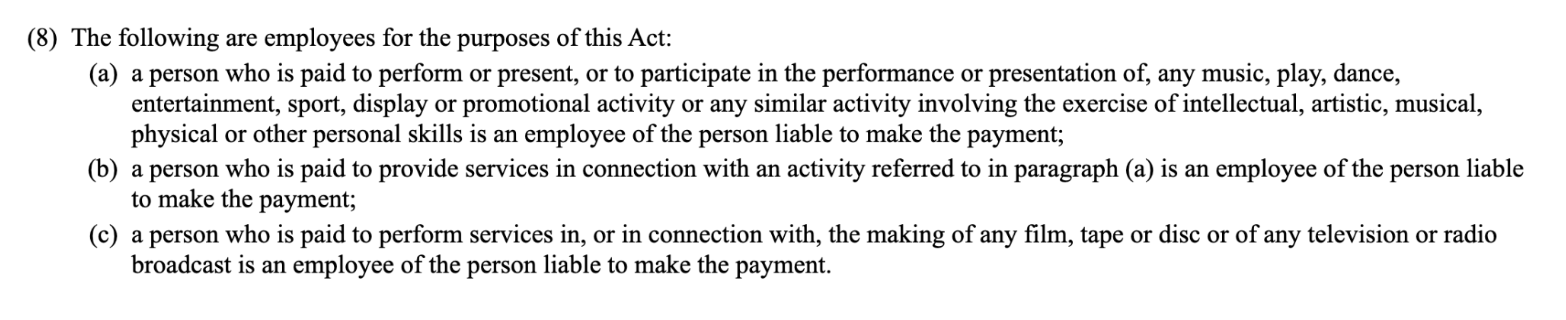
Section 12(8) of the Superannuation Guarantee (Administration) Act 1992 has treated performers as employees for super purposes since the Act commenced on 1 July 1992. If you were paid to play a gig any time in the last thirty-four years, super guarantee was owed to you.
I’ve worked as a professional musician full time for over twelve years and played more than a thousand shows. I have never once received a cent of super from a public gig.
That’s not an unusual experience. A 2024–25 MEAA survey found 82 percent of Musicians had never received super for a gig at all.
A law only on paper
A one-off pub gig never generated a paper trail that flagged it as a debt. Super used to be self-reported quarterly, with no real-time check from the musician, the venue, or the regulator. It didn’t fail to get paid because someone noticed a shortfall and let it slide. It never entered the picture as something owed in the first place.
Plenty of venues also worked on the assumption, wrong as it turns out, that an ABN and an invoice took them out of the obligation entirely. Years of a federal government uninterested in closing that gap left the assumption unchallenged.
The scale of it shows up in the ATO’s own numbers:
a national super guarantee gap of $6.2 billion a year,
about six percent of everything actually owed, built almost entirely on a system that relied on employers reporting themselves rather than anyone checking.
Nothing about what musicians are legally owed changed this year. What changed is that the three things letting it go unpaid for three decades all disappeared in the same twelve months.
Three deadlines in one year
First, the deadline itself. In November 2025 the Albanese government passed the Treasury Laws Amendment (Payday Superannuation) Act 2025, effective 1 July this year. Under the old system, an employer had four chances a year to miss a payment. Now ,every payday is its own deadline: seven business days, every time. For a venue running dozens of one-off gigs a year, that’s not the same obligation with a tighter clock. It’s potentially
50 separate chances to get slugged with a penalty charge.
Second, the free tool the ATO ran for small operators to pay super without buying payroll software, the Small Business Superannuation Clearing House, shut down on 30 June this year. A volunteer committee that might have muddled through on a free government tool now has to find, and pay for, commercial software instead.
Third, the regulator started looking directly at this corner of the economy for the first time in two decades. On 17 June this year the ATO released Draft Ruling SGR 2026/D1, its first new guidance on super and multi-party bookings since SGR 2005/2, which it replaces.
The draft targets agencies and booking platforms rather than a simple venue-books-band arrangement. But it’s still the clearest sign the ATO has turned its attention to live music bookings for the first time since 2005.
None of that changed what musicians are owed.
It changed what a small operator can get away with not knowing.
How the ATO reckons a booking works
The ATO publishes its own worked examples of exactly this scenario, and they’re worth reading closely because they show the actual mechanism rather than a general principle.
In one example, a venue called Renee’s Hotel engages a three-piece band, Joel, Ted and Jasmine, to play weekly under an oral contract, paid $300 each per performance. Because the venue is paying each of them individually, the ATO’s conclusion is direct: Renee’s Hotel will have to pay super to each of their nominated super funds.
Change one fact, and the answer flips. If Joel, Ted and Jasmine tell the venue they operate as a company, the ATO’s position is that the venue will not have to pay super on behalf of any member of the band, because the company is the counterparty.
The obligation doesn’t disappear. It moves onto the company,
if the company chooses to honour it.
Change the booking again, to a private wedding at an agreed flat rate, and no super is owed to anyone in the band at all, because it’s private, domestic, and under the hours threshold.
Same band, same songs, same night’s work. Three different super outcomes, and the venue picks which one applies just by how the contract gets written.
Taxman misses the leader of the band
Every example the ATO publishes assumes the venue knows exactly who’s in the band and pays each of them by name. That is not how most working musicians actually get booked.
As a session player, you get called for a gig by a bandleader, sometimes with people you’ve never played with before. The bandleader usually doesn’t have an ABN registered under the band’s name. They invoice the venue as themselves, get paid one lump sum, and split it however they decide once the gig is over.
The venue has no direct financial relationship with anyone else on stage.
None of the ATO’s published examples cover this. One is named individuals paid directly. One is an incorporated band. One is a private function. Nowhere is there an example of one person invoicing for a group that isn’t a company, then dividing the proceeds among people the venue never dealt with directly.
It’s common enough that at least one music-industry booking platform has addressed it in writing. Bands Australia, in a guide for gigging musicians, says super depends on “who is contracting with the client, and who is being paid for their own labour.” Its own conclusion: “none of this means super is owed or not owed in any particular case.”
So the regulator has confirmed, in writing, that an ABN doesn’t get a venue out of paying super. It has never said what happens in the arrangement most working musicians are actually booked under.
The first casualty
Only mere days after the new laws were introduced one of Newcastle’s biggest festivals cancelled.
On 11 July the Newcastle and Hunter Jazz Club posted a notice to its members that The 37th Newcastle Hunter Jazz Festival, running since the 1980s, is cancelled. Not for lack of bands. Not for lack of funding. According to the club’s own statement,
it’s cancelled because of superannuation paperwork.
The club has called a special general meeting for August 30, the exact weekend the festival would have run, to decide its future. President Murray Scoble and treasurer Ian Hissey have both given notice they won’t continue in their roles.
I contacted the club’s secretary and president for an interview. As of publication, I’ve had no response.
The club’s own standard booking form, the one every act fills out to play a gig or a festival slot, asks for one ABN, one band name, and one bank account. That’s it, however many musicians are actually on stage. The club says it booked over three hundred musicians across dozens of acts for this festival.
A system built to pay one invoice per act was never built to track, or pay, individual superannuation to every one of those musicians. Since 1 July, that’s exactly what the law now requires, within seven business days of every single payday.
A system built to pay one invoice per act was never built to pay three hundred individual super accounts. Since 1 July, that’s exactly what it’s required to do.
What the regulator will and won’t say
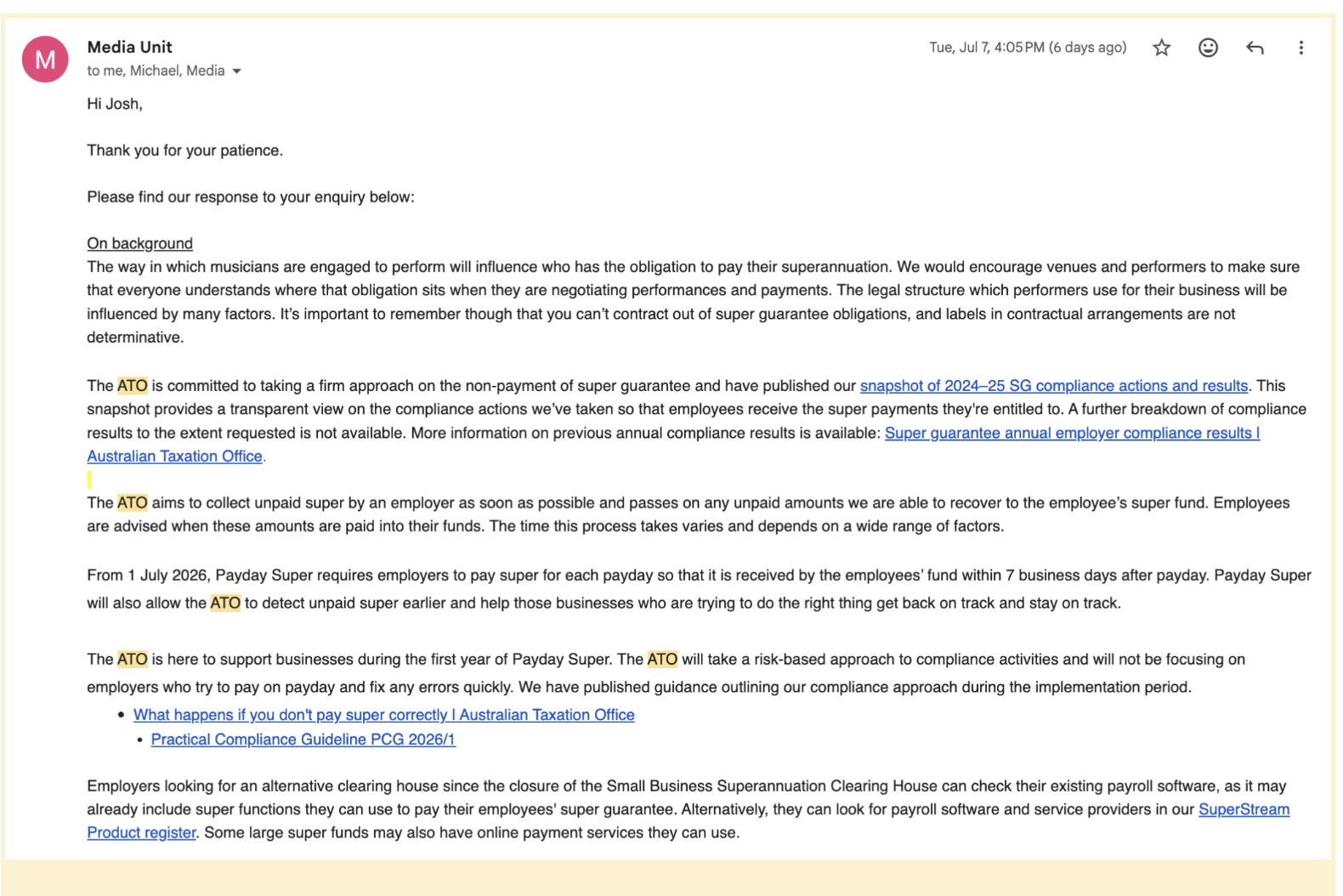
I put MWM‘s actual scenario to the ATO: a duo or band where one performer holds the ABN, invoices the venue for the full fee, and privately splits the rest, the exact structure most working musicians are booked under. Does the venue’s super obligation cover both performers, or does it shift to the one issuing the invoice?
The answer, on background, restated the general principle rather than the specific case: “The way in which musicians are engaged to perform will influence who has the obligation to pay their superannuation … You can’t contract out of super guarantee obligations, and labels in contractual arrangements are not determinative.”
True as far as it goes, but it didn’t touch the mechanism.
Whether a contract defining “the Artist” as the whole group binds the venue regardless of who invoices, whether a disclaimer clause can limit that liability, and whether incorporating lets a group avoid the obligation to its own members entirely, all went unanswered.
The enforcement questions fared worse. How many audits has the ATO run on live music or hospitality venues in the past three years? A venue-specific breakdown “is not available.”
Does a single missed payment trigger a penalty under the first year’s compliance guideline, or only repeated non-compliance? No answer. How long does a musician wait between lodging a complaint and getting paid? “Varies” and “depends on a wide range of factors.”
The one concrete answer: with the clearing house shut, a small venue should check its payroll software or search the ATO’s SuperStream product register.
They’ll confirm the general law applies. They won’t say how it applies to the way musicians are actually booked, how often it’s enforced, or how long someone waits if it isn’t.
Performers left backstage in consultation gig
Before Treasury designed Payday Super, it ran a public consultation, four weeks, March into April last year. I obtained the internal paperwork through a Freedom of Information request, FOI 4112, Treasury’s own ministerial submission to the Treasurer laying out exactly who was consulted.
One hundred and sixty-six written submissions. Six industry roundtables. Eight separate stakeholder meetings. Treasury names, in writing, exactly which groups were in the room: large and small business employers, digital service providers, employee unions, super fund trustees, clearing houses, onboarding services.
Not once across thirty-one pages is there a mention of musicians,
performers, the arts, or entertainment. Not the Media, Entertainment and Arts Alliance. Not Live Performance Australia. Not APRA AMCOS. Nobody.
Treasury designed a law handing a seven-business-day deadline to every venue, club and festival in the country that books a band, and the consultation process appears to have run without a single person from that industry in the room.
Oops, somebody noticed
Buried in the same document, under a heading about “non-traditional forms of payroll,” an unnamed stakeholder flagged this exact problem during consultation: contractors, the submission notes, “may be paid through accounts receivable, not currently aligned to the employee payroll for contribution calculation and payment.”
That is close to exactly the Newcastle Jazz Club’s booking problem, described in a government document, over a year before the festival got cancelled because of it. It went nowhere.
MWM has filed a fresh FOI request with Treasury asking who raised that comment and what happened to it, and a separate request with the ATO asking whether it has done any internal analysis of what this law does to musicians specifically, and how many of these venues it has actually audited.
Nobody in Canberra appears to have asked the music industry a single question before building this law, which is a striking omission given the industry generates $10.76 billion a year for the country.
Who’s prepared to point the bone?
I widened the question to four more organisations: when a venue pays one invoice for a group booking but several people perform, who’s actually on the hook, and is anyone checking?
The Media, Entertainment and Arts Alliance didn’t answer who’s liable. It redirected to its campaign for a $250 minimum performance fee. Hostplus, the super fund most musicians are likely to be with, declined to comment, with no reason given. Live Performance Australia and the Australian Hotels Association didn’t respond at all.
One changed the subject. One declined outright. Two said nothing. Not one addressed what happens to a volunteer committee caught between a law like this and a booking system that was never built to comply with it.
What happens next?
The special general meeting on 30 August is where Newcastle finds out whether the club has a future at all. Both FOI requests are still going in. I’ll report back the moment either lands.
A thirty-seven-year festival is gone. Nobody can say who is next.
Artists brace as AI, the greatest theft in history, swamps us now

Josh is a journalist, musician and cameraman who is working with Michael West Media to develop The West Report and other visual content across major social media channels, as well as researching and writing articles.