

The dominance of listed bank stocks could be coming to an end, and investors should look elsewhere for better returns following a dive in the value of Australia’s biggest institution, a global asset manager warns.
The economic conditions that made the big banks the default trade for a generation of investors – disinflation, falling interest rates, unbroken housing credit growth, and benign provisioning – have reversed, according to VanEck.
Inflation remains persistent, interest rates are rising and banks have had to set aside more capital for credit provisions in case their loans go bad, the manager said in its annual Australian Equities Outlook released this week.
There are also concerns changes outlined in the 2026/27 federal budget could deter property investing.
On Wednesday, Commonwealth Bank of Australia shares suffered their biggest-ever single-day loss.
The stock dropped 10.4 per cent to $153.67 after CBA missed its third-quarter earnings forecasts because it had to set aside another $300 million for credit provisions.
CBA shares bounced back a bit on Thursday and Friday but still finished at just $159.40, down 9.4 per cent for the week and slightly in the red year-to-date.
“If you look at the Australian banks, the way they’ve been priced, certainly their valuations have been out of line with international counterparts for a long time period,” VanEck head of investments Russel Chesler told AAP.
“Banks have been priced to perfection. The market’s really expecting them to continue delivering really strong results.
“Any sort of disappointment is going to weigh heavily on the banks, and we’ve seen that now.”

Some of the reasons behind CBA’s share price fall could also be due to the 2026/27 budget handed down by Treasurer Jim Chalmers on Tuesday.
“I think the market is expecting that with the changes to negative gearing, you’re likely to see fewer investors coming into the (property) market, less borrowing from an investment perspective into property,” Mr Chesler said.
That could hurt the banking sector’s mortgage businesses, but it remained to be seen, Mr Chesler noted, as negative gearing would still be allowed for new builds.
Regardless, VanEck believes there’s more opportunity in the Australian Securities Exchange’s mid-cap companies, which it defines as companies in the ASX100 (or top 100) but not the ASX50.
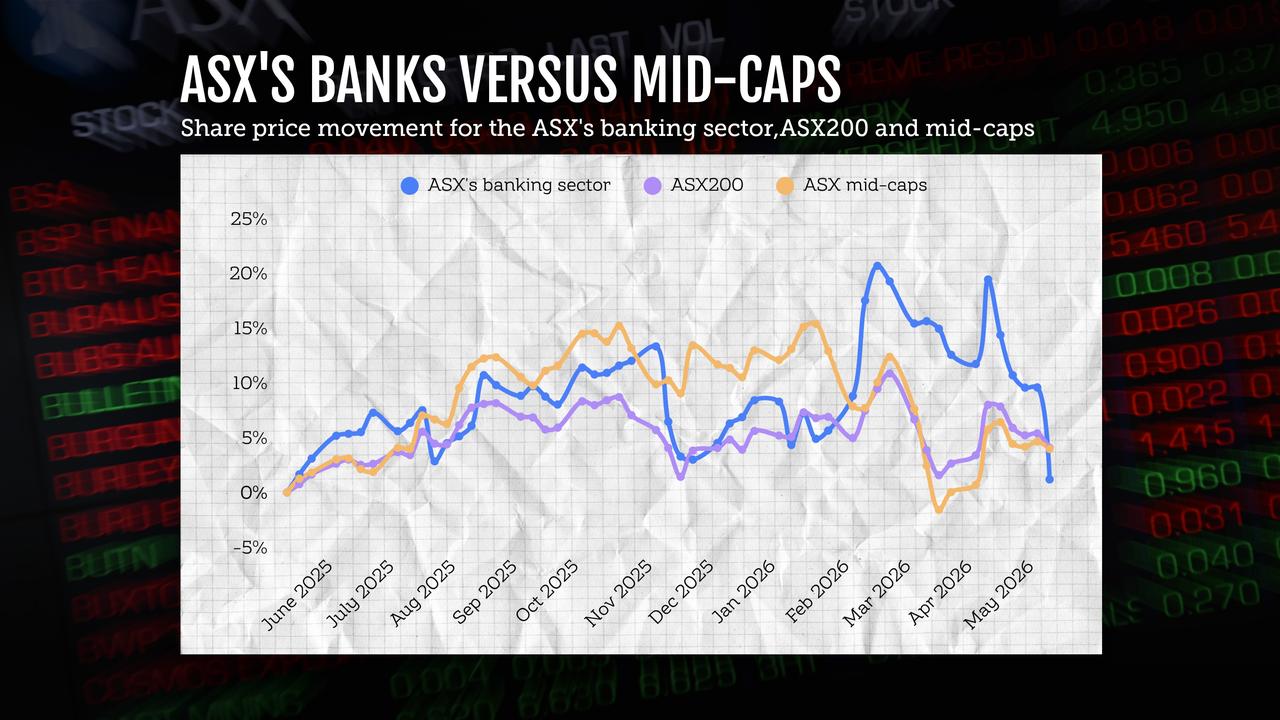
Mid-caps were a standout this earnings season, delivering the strongest surprises, VanEck’s outlook report says.
They also trade at a lower valuation, Mr Chesler said.
“So from our perspective, we think there’s value in them,” he said.
VanEck is also a fan of what traders are referring to as HALO companies – “heavy assets, low obsolescence” – businesses that have cash flows tied to real-world demand and supported by long-lived infrastructure.
Mr Chesler pointed to Queensland rail freight operator Aurizon, toll road owner Transurban and Telstra as companies whose pricing power and asset quality are likely to ensure they do well in an environment where interest rates remain higher for longer.

Australian Associated Press is the beating heart of Australian news. AAP is Australia’s only independent national newswire and has been delivering accurate, reliable and fast news content to the media industry, government and corporate sector for 85 years. We keep Australia informed.