
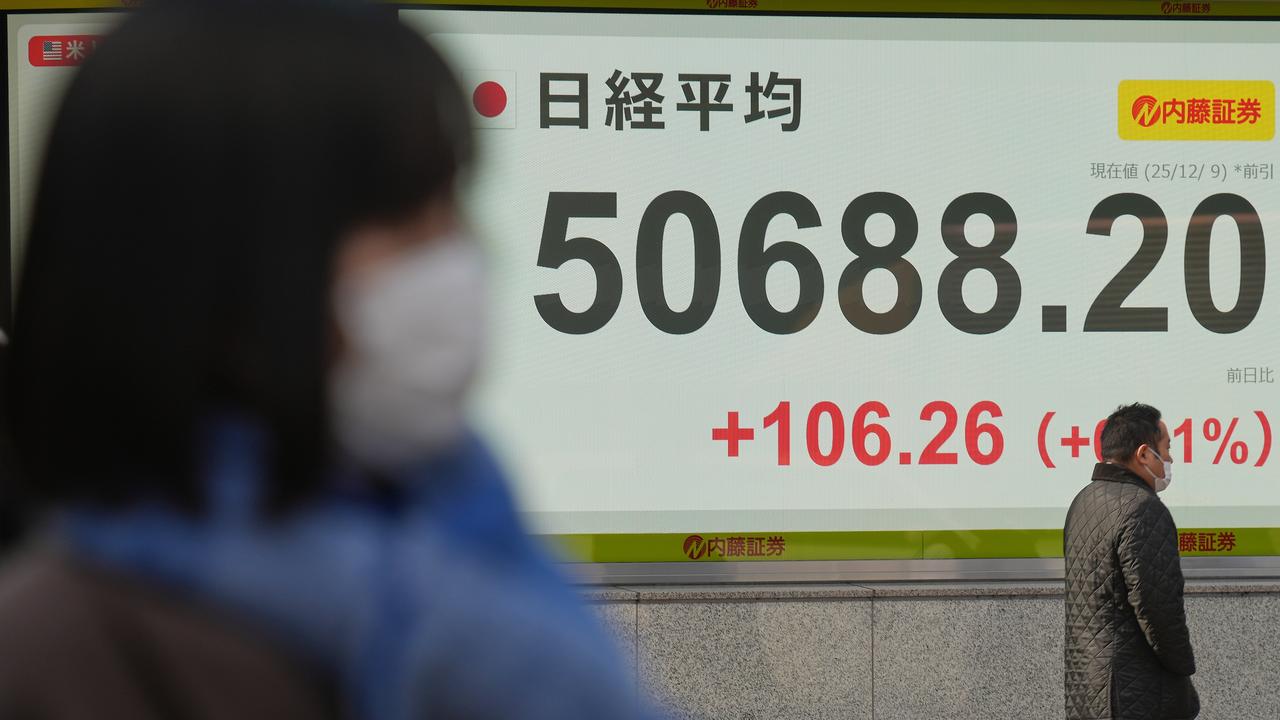
Asian share markets rebounded on Friday as a turnaround in tech lifted Wall Street, leaving investors counting down to a likely hike in interest rates from the Bank of Japan that could cause waves for currencies and bonds.
Sentiment also got a boost from a shock slowdown in US consumer price inflation to 2.7 per cent, though analysts cautioned the data were clearly distorted lower by the government shutdown and could not be taken at face value.
Pricing for the Federal Reserve moved only marginally with a rate cut in January implied at just 27 per cent, while March nudged up to 58 per cent from 54 per cent before the data.
Markets imply around a 90 per cent chance the BOJ will raise its rate a quarter point to 0.75 per cent later on Friday, with much resting on the outlook for further tightening ahead.
Investors are wagering on just one further move to 1.0 per cent in 2026 and any hint of more could offer much-needed support to the embattled yen, but also pile pressure on government bonds.
“The policy rate is still in stimulatory territory and there is a case for further BOJ policy normalisation,” argued analysts at CBA in a note.
“Core inflation has remained above the BOJ’s 2.0 per cent target in the past two years, and the sharp weakening of the yen in the past two months will also add to inflation.”
Figures out Friday showed Japan’s core CPI rose at an annual pace of 3.0 per cent in November, unchanged from the previous month.
For now markets were content to follow Wall Street’s lead and Japan’s Nikkei rose 0.6 per cent. South Korea climbed 1.2 per cent encouraged by stellar results from chipmaker Micron Technology.
MSCI’s broadest index of Asia-Pacific shares outside Japan added 0.2 per cent.
S&P 500 futures and Nasdaq futures were flat after bouncing overnight.
Bond markets gave a cautious welcome to the US CPI numbers as 10-year Treasury yields held at 4.126 per cent, some way from the recent 3-1/2-month top of 4.209 per cent.
Japan’s 10-year yield stood at 1.980 per cent, matching a recent 18-year high.
Overnight, British bonds had taken a hit after the Bank of England cut rates as expected but only after a very tight 5-4 vote. Policymakers also signalled caution about the pace of future easing and another cut is now not fully priced in until June.
The European Central Bank was even more hawkish as it held rates at 2.0 per cent and signalled a likely end to the easing cycle. Markets imply only a minor chance of a cut for all of 2026.
Central banks in Sweden and Norway also held steady, though the latter left the door open to one or more cuts.
The hawkish turns caused brief spikes for the pound and euro but both quickly settled back. Sterling was idling at $US1.3378 ($A2.0230) , with the euro steady at $US1.1725 ($A1.7730).
The dollar was little changed on the yen at 155.60 , well within the recent range of 154.34 to 156.96.
In commodity markets, gold was stuck at $US4,333 ($A6,552) an ounce , still short of its October peak of $US4,381 ($A6,625). Silver ran into profit-taking after its meteoric run, but palladium and platinum remained in demand.
Oil prices were underpinned by the possibility of further US sanctions against Russia and the supply risks posed by a blockade of Venezuelan oil tankers.
Brent edged up 0.2 per cent to $US62.04 ($A93.81) a barrel, while US crude rose 0.2 per cent to $US58.35 ($A88.23) per barrel.

Australian Associated Press is the beating heart of Australian news. AAP is Australia’s only independent national newswire and has been delivering accurate, reliable and fast news content to the media industry, government and corporate sector for 85 years. We keep Australia informed.