
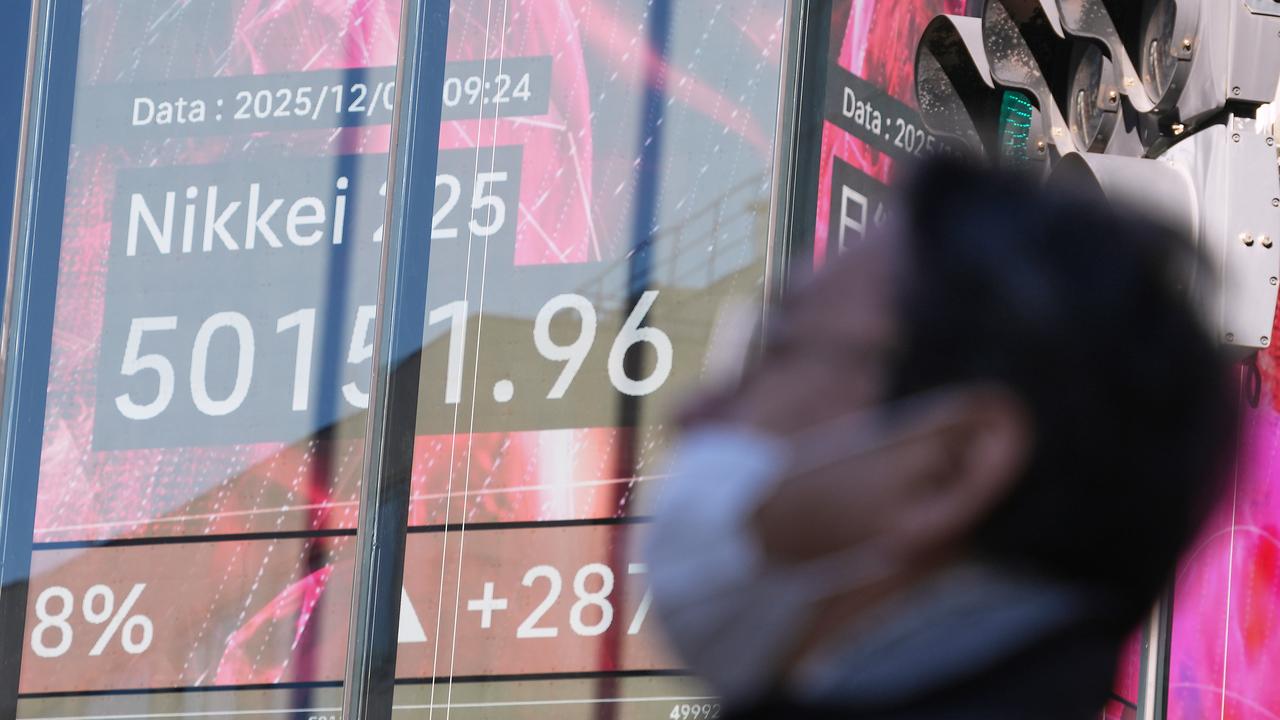
Japan’s Nikkei skidded on Friday, wiping out this week’s gains amid an otherwise subdued Asian session, after weaker-than-expected spending data underscored the scourge of inflation as bets grew that the Bank of Japan would hike interest rates.
The Nikkei 225 fell 1.5 per cent and was on track to end the week mostly flat. MSCI’s broadest index of Asia-Pacific shares outside Japan was off 0.1 per cent but was still set for a gain of 0.5 per cent for the week.
Data showed household spending in Japan unexpectedly fell the fastest in nearly two years in October, as inflation ate into people’s spending power. The yield on 10-year Japanese government bonds hit 1.94 per cent early in Asia, its highest since mid-2007.
The benchmark yield was on track for a 13.5 basis point rise this week, marking the steepest five-day climb since March, but recent strong auction results suggested the cheap bond prices are drawing buyers into the market.
“In previous cycles, moves of that size would have rattled markets. Instead, demand strengthened,” said Nigel Green, chief executive at deVere Group.
“Capital flows are shifting, long-standing expectations are being tested, and portfolios built around permanently cheap yen now face a very different world.”
The yen was last steady at 155 per dollar, well above its 10-month low of 157.9.
A quarter-point rate hike from the Bank of Japan later this month is now being priced at 75 per cent, after Governor Kazuo Ueda told investors on Monday the central bank would weigh the “pros and cons” of raising interest rates.
Sources told Reuters that the Japanese government is prepared to tolerate a hike in December.
In other markets, stocks are mostly steady to end the week. Australia’s resources-heavy shares were little changed. Hong Kong’s Hang Seng index lost 0.5 per cent, while South Korea’s shares climbed 0.7 per cent.
In foreign exchange markets, the dollar steadied overnight after falling for nine straight sessions as traders awaited US inflation data that could sway a split Federal Reserve.
The dollar was off 0.1 per cent on Friday to 99 against its major peers, and down 0.5 per cent for the week.
The US personal consumption expenditures (PCE) price index for September is due later in the day – an outdated reading given the release has been delayed by the US government shutdown. Forecasts are centred on a 0.2 per cent rise in the core measure, leaving the annual rate unchanged at 2.9 per cent.
The US non-farm payrolls report will not be released on Friday. Data on Thursday showed jobless claims dived last week, assuaging concerns of a sharp deterioration in the labour market, but that might be due to the Thanksgiving holiday.
Fed funds futures are pricing nearly a 90 per cent chance of a cut next Wednesday. It could be the most contentious decision ever for the Federal Reserve. As many as five of the 12 voting members have publicly said they oppose cutting rates further.
“Tariffs have stalled the improvement in inflation this year, but we remain convinced the disinflationary framework is intact,” said analysts at ANZ.
“That framework includes a softening labour market, moderating wage growth, well-anchored longer-term inflation expectations … We think the data will support an FOMC rate cut next week.”
Treasury yields slipped a little on Friday after rising the previous day. Two-year Treasury yields slipped one basis point to 3.519 per cent, having risen five basis points overnight, while the 10-year yield fell two bps to 4.092 per cent, after gaining five bps overnight.
Brent crude futures were flat on Friday and were set to end the week largely unchanged.
Spot gold prices were set to finish the week 0.8 per cent lower at $US4,198 ($A6,344) per ounce.

Australian Associated Press is the beating heart of Australian news. AAP is Australia’s only independent national newswire and has been delivering accurate, reliable and fast news content to the media industry, government and corporate sector for 85 years. We keep Australia informed.