
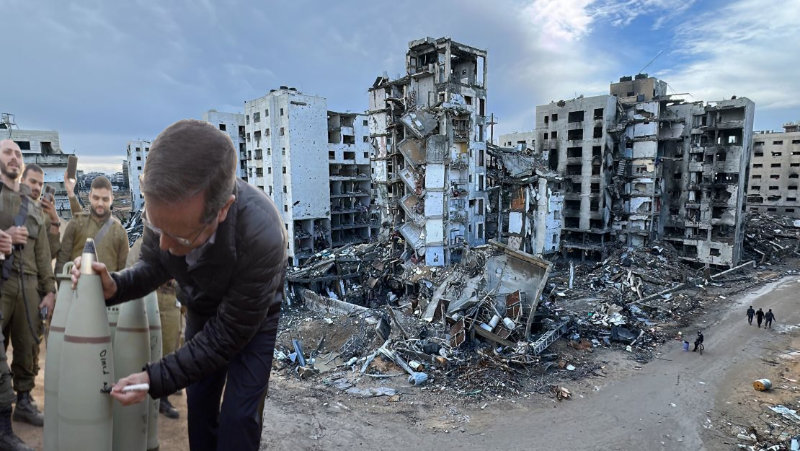
Israel’s President, Isaac Herzog, is due to arrive in Australia next Sunday. Why is a foreign Head of State asked to help heal an Australian community after an Australian tragedy? Andrew Brown.
Australia is being asked to accept something extraordinary as if it were normal. Who invited Isaac Herzog in the first place, and why did Anthony Albanese say yes? Presented to us not as diplomacy, not as geopolitics, not as a strategic signal, but as “healing”.
Before we swallow that story, one question needs to be put on the table and left there until someone answers it.
Where does this community’s allegiance align? Australia or Israel?
The visit is being sold as reassurance for Jewish Australians after the Bondi attack. And yet the reassurance on offer does not come from Australia at all. It does not come from Australian civic leaders. It does not come from Australian law or Australian institutions. It does not come from Jewish Australian faith figures, nor even from Israeli rabbinical leaders rooted in this country and this community.
It comes instead from a foreign head of state, and that single choice does more than any speech. It quietly rewrites the relationship between citizenship, faith, and state power in Australia.
So ask the obvious questions. Who requested this visit? Who lobbied for it? Who thought it was wise to import a foreign political figure into the emotional aftermath of Bondi? And why did the Prime Minister say yes?
Why did Albo say yes?
If the purpose is truly pastoral, then the choice makes no sense. The visitor is not a rabbi. Not a spiritual leader. Not an interfaith presence. Not a community counsellor. He is an Israeli president. A political figure. The constitutional face of a foreign state. Politics, not pastoral care. Power, not solace.
That is the first truth we are being asked not to notice, but the second truth is even more uncomfortable.
For years, Australians have been hammered with a single instruction, delivered with the confidence of a moral rule. Judaism is a religion. Israel is a state. Zionism is a political ideology. Keep them separate. Do not conflate. If you blur those lines, you will be accused of prejudice, sometimes fairly, sometimes strategically, but always loudly.
That instruction has been enforced through the culture. In media commentary. In parliamentary speeches. In complaints processes. In campaigns to delegitimise critics who would not repeat the approved formula with sufficient reverence.
Fine. If separation is the principle, then separation must hold when it matters most. Especially when grief is raw, and symbols do their sharpest work.
But at the precise moment symbolism matters most, the separation is abandoned. Not by critics. Not by social media hotheads. By the state itself.
At a moment of Australian grief, it is not faith that is summoned. It is the Israeli state.
Its president is elevated as the symbolic consoler. Its presence is framed as essential to the healing of Jewish Australians.
This visit does not merely blur the line between Judaism and Israel. It erases it. Publicly. Institutionally. With government endorsement of inviting a man who, according to Labor Friends of Palestine, doesn’t pass the character test for a Visa application:
- ‘A person does not pass the character test if … the Minister reasonably suspects that the person has been or is involved in conduct constituting … the crime of genocide, a crime against humanity, a war crime, a crime involving torture or slavery or a crime that is otherwise of serious international concern; whether or not the person, or another person, has been convicted of an offence constituted by the conduct…’
- ‘A person does not pass the character test if … in the event the person were allowed to enter or to remain in Australia, there is a risk that the person would …incite discord in the Australian community or in a segment of that community…’
Migration Act 1958, Section 501
 Loading...

 Reload document
  Open in new tab
 🚨New development 🚨
The Jewish Council of Australia, ANIC – the nation’s peak Muslim body – and the Hind Rajab Foundation have filed a criminal complaint against the Israeli president.https://t.co/iOhYch3dIo
— deepcutnews (@deepcutnews) January 29, 2026
Judaism vs Israel
You cannot spend decades demanding that Australians keep Judaism and Israel separate, then place an Israeli head of state at the centre of an Australian tragedy and expect the public to maintain the fiction.
You cannot demand absolute separation when critics speak, then collapse that separation when power needs a stage.
That is not an oversight. It is a choice, and it leads to the real debate Australia has been pushed to avoid.
If Jewish Australians are Australians of Jewish faith, then their safety, grief, and belonging are matters for Australia to address. Australian law. Australian civic leadership. Australian institutions. Or, if faith is the organising principle, rabbis and religious leaders who actually carry pastoral authority. They are not matters for a foreign head of state. Not for an overseas government inserting itself into an Australian tragedy.
The moment a foreign political leader is presented as necessary to healing, the issue stops being faith and becomes allegiance.
And allegiance is not some abstract thing in Australia. It is demanded constantly. Migrant communities are told, again and again, that Australia comes first. That loyalty must be singular. That old countries are left behind. That this nation, its laws, its institutions, and its flag are the sole point of civic attachment.
Except here, the rules bend. Here, the separation we are warned never to breach is breached from above. Here, the state quietly endorses the idea that
Jewish identity in Australia is incomplete without Israeli political authority standing behind it.
That is why this visit is divisive. Not because Australians lack compassion. Not because antisemitism is not real. It is real, and it should be crushed without hesitation. The division comes from the double standard. The division comes from importing a foreign political symbol into Australian grief, then scolding Australians for noticing what that symbol implies.
And once Israel is positioned as the emotional guarantor of Jewish life in Australia, the logic runs further, whether anyone likes it or not.
Why does responsibility stop at speeches? Why does it end in symbolism?
Why is the Australian taxpayer funding security, policing, protective infrastructure, and now a full diplomatic visit, while the implication being advanced is that Jewish safety here is inseparable from the Israeli state? If Israel is to be treated as the natural guardian, then why is Australia carrying the entire material cost?
The Prime Minister has not merely allowed a diplomatic courtesy. He has endorsed a narrative. One that collapses the very separation it claims to defend.
One that institutionalises the question of allegiance while pretending the question is offensive to ask.
It is not offensive. It is civic. It is democratic. It is necessary. So ask it clearly, without malice and without fear.
Who asked for this visit? Why did the government agree? And what exactly are Australians being told, in symbols rather than words, about where allegiance is supposed to lie?
Because if the answer is Australia, this visit makes no sense.
And if the answer is Israel, Australians deserve honesty about what has just been done in their name.
Andrew Brown is a Sydney businessman in the health products sector, former Deputy Mayor of Mosman and Palestine peace activist