


Thousands of patients are stuck in hospital beds in a system that focuses more on who pays than on what benefits the unwell. Claudia Weisenberger reports.
One person has been in a Queensland public hospital for more than 1,000 days. They are not sick. They were medically cleared to go home. They cannot go home because the support they need to live safely in the community has not been funded.
They are not alone.
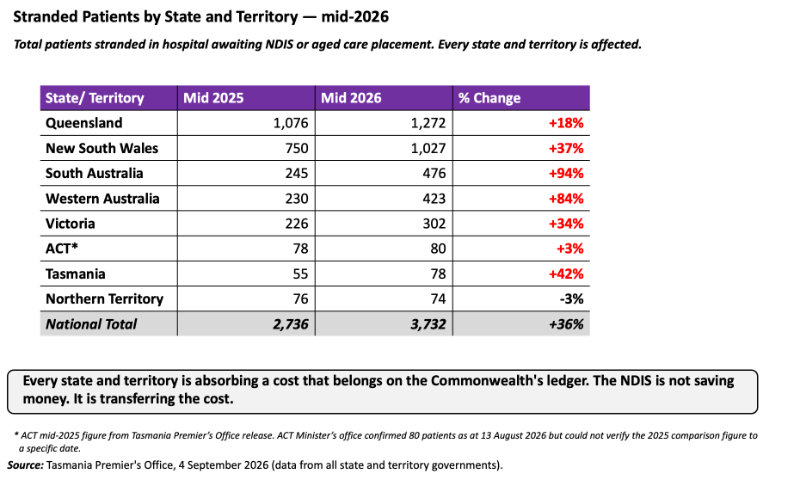
More than 3,700 Australians are stranded in public hospital beds
— medically cleared to leave, unable to go. That is enough people to fill Australia’s largest hospital — the Royal Brisbane and Women’s Hospital — more than three times over.
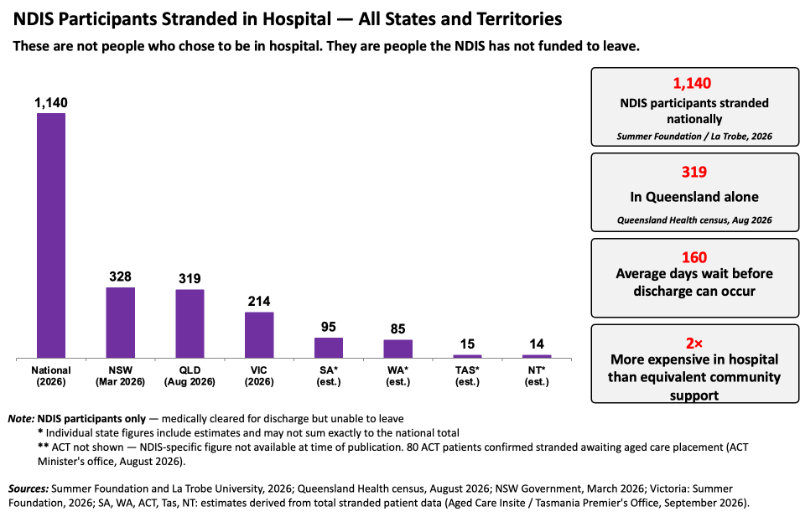
Most are older Australians waiting for aged care placement. Approximately 1,140 are NDIS participants — younger people with disability who should be living in the community with appropriate support.
The cost does not appear on the NDIS or aged care budget. It transfers to the states. And from October 1, 2026, the Commonwealth cut the NDIS supports that might have kept some of these people out of hospital altogether.
The numbers
In 2022, then-NDIS Minister Bill Shorten warned that hospital bed block was costing state hospital systems about $1.5B a year. His government acted — by late 2022 average discharge times had fallen from 160 days to 33 days. But the total number of stranded patients kept growing. By mid-2026, it had more than doubled.
Today, a hospital bed costs between $2,000 and $3,500 per day. The NDIS funds round-the-clock community support at approximately $1,765 per day. It is cheaper to fund someone to live at home than to keep them in a hospital bed.
The NDIS is not saving money. It is transferring the cost.
State by state
In NSW, stranded patients surged from 871 in March 2025 to 1,276 in March 2026 — a 46 per cent increase in one year, with one in eight emergency department-accessible beds blocked. NSW Health projects the figure will reach 1,700 by June 2027.
In SA, 488 older patients are stranded in hospital beds waiting for aged care — up from just 60 in October 2022, a 693 per cent increase.
“That number of aged care patients waiting for a bed,” said Minister Boyer, “is about the same as the number of patients at the Lyell McEwin Hospital — one of our largest metro hospitals.”
In Victoria, a June 2026 census identified 214 NDIS participants who were clinically ready for discharge but unable to leave hospital. In Melbourne, a woman named Leila waited nearly 18 months in hospital after a stroke before disability support finally allowed her to go home.
The Summer Foundation’s CEO Di Winkler was direct: “The number one reason NDIS participants remain in hospital for months and years is because the process that the NDIS goes through is just too slow.”
Western Australia recorded an 84 per cent increase in stranded patients between mid-2025 and mid-2026 — the largest proportional rise of any jurisdiction. In July 2025, the Royal Darwin and Palmerston Hospitals declared Code Yellow — a capacity emergency — for the first time, with aged care bed block cited as the key cause. NT Health Minister Steve Edgington said 70 additional beds could be freed immediately if Commonwealth-funded aged care were available.
Queensland has the highest number of stranded patients nationally — 1,437 as of August 2026, including 1,118 aged care patients and 319 NDIS participants, costing the state $3.6 million every single day.
In the ACT, 80 patients were confirmed stranded as of August 2026, according to the ACT Minister’s office.
In Tasmania, Neal Rodwell — general manager of North West Support Services in Tasmania — told ABC Radio on September 16 that three men he has known for more than 25 years were stranded in hospital, unable to leave because the NDIA would not fund the support hours they needed: “The NDIA has become the barrier. I’m gravely, gravely concerned. If the situation went on for more months,
I think there is a very real risk that people would lose their lives.
Federal vs State
The Commonwealth funds the NDIS and aged care. The states run hospitals. When the Commonwealth does not fund the supports a participant needs to leave hospital — whether an aged care place or an NDIS package — the participant stays in a state bed. The state pays. The Commonwealth claims a saving.
In June, NSW Health Minister Ryan Park stated, “‘Every day, 1,300 patients are unable to leave our hospitals because they are waiting for a Commonwealth aged care or NDIS placement. The NSW Government is effectively subsidising the Commonwealth in its duty to provide aged care places.”
At the Health Ministers Meeting in Sydney in September 2026, every state and territory called for immediate Commonwealth action.
SA Minister for Health and Wellbeing, Blair Boyer, said the country needed 10,000 additional aged care beds each year — last year it received just 800. The Commonwealth had previously offered $2B ring-fenced specifically for aged care discharge pathways.
The states rejected the restriction. The Commonwealth says the states chose beds over solutions. The states say the Commonwealth’s underlying failure to fund aged care and NDIS support is the real problem. Both are right.
Neither position is getting anyone home.
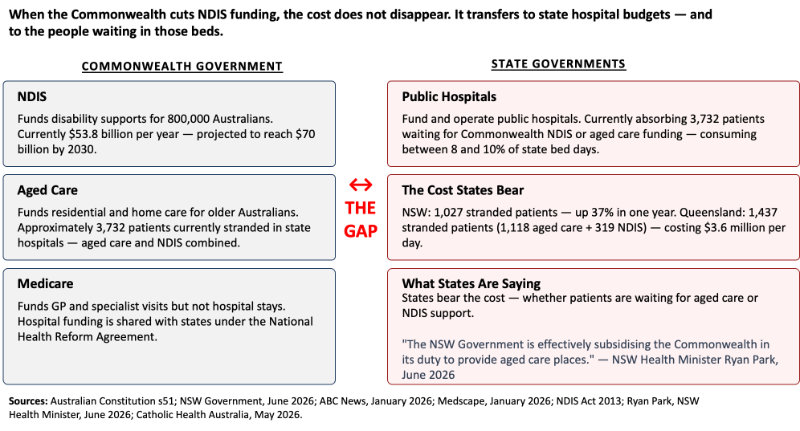
On 17 September, the NDIA stated that from 1 October 2026, community participation budgets will be cut by 50% and daily living skills budgets by 10%. These are the supports that keep people with disability living at home. The decision is not reviewable. No individual reasons will be given.
The cost that doesn’t disappear
A hospital is not a home. Long stays strip people of their routines, their relationships and their independence.
For people with disability, prolonged hospitalisation can cause functional decline, increased behavioural distress and loss of community connections that take years to rebuild — if they can be rebuilt at all. This is called institutionalisation.
This is what the NDIS was designed to prevent.
Four years ago, this was called a priority. Discharge times improved briefly. The number of stranded patients more than doubled. On October 1, the Commonwealth cut disability support budgets by up to 50% — the supports that keep people out of hospital, and state hospitals will absorb what the NDIS will not fund.
They are not blocking the system. The system is blocking them.
Inside Job. How former insiders and corporateers are cashing in on the NDIS

Claudia Weisenberger is a management consultant with deep experience in pharmaceuticals, hospital transformations, and strategic due diligence across four continents. She combines sharp analysis with hands-on execution.