


Changes to the NDIS have unintended consequences, shifting patients and costs to other parts of the health system. Claudia Weisenberger reports.
The NDIS Act requires that supports be provided in a way that respects the dignity of participants and their families.
On 17 September 2026 — the day before Minister Jenny McAllister told the National Disability Summit that participant plans should reflect support needs rather than postcodes — the NDIA published a notice on its website.
“Starting from 1 October, some NDIS support budgets will be reduced over the coming 12 months.”
“It will reduce participant budgets for two support categories:
-
- Social Economic and Community Participation
- Improved Daily Living Skills.”
These are the categories that fund the therapy, community access and skill development that keep people living in their homes rather than hospital beds or aged care facilities.
MWM spoke with three NDIS clients who have had their funding drastically reduced. Three funding decisions. The same process. The same pattern. The NDIS may have saved money in each case, but these clients’ needs have not disappeared and must be met (and paid for) elsewhere.
Seth*
Seth is 11 years old. He has autism, ADHD, sensory processing challenges and significant behavioural regulation difficulties. His mother is his primary carer. She cannot maintain employment due to his care needs. She has no meaningful informal supports. Family relationships have broken down.
Across six different support categories, the reason given for refusing each one was identical — copied and pasted, word for word: ‘it is reasonable to expect your informal supports, like family and friends, to provide this support.’ His mother’s carer impact statement ends: ‘Without urgent intervention and increased supports, there is a real risk that Seth’s care needs will exceed what I can safely manage.’
Clinical evidence submitted on Seth’s behalf identified significant functional impairments, severe caregiver burden, increasing support needs and substantial risks associated with relying on informal supports. Multiple requested support categories — including CORE funding and behaviour support — were refused.
The primary reason given in the planning phone call was that these supports were the responsibility of informal supports such as family and friends. His current plan provides 12 hours of Level 2 Support Coordination across the entire year.
His previous plan funded approximately $45,000–$48,000 in supports per year. His new plan funds $19,048.94, a reduction of almost 60%.
Anthony*
Anthony is 50 years old. He has Parkinson’s disease and an intellectual disability. He uses a wheelchair and cannot do anything independently. His family was required to submit clinical evidence from five specialists — an occupational therapist, a physiotherapist, a speech pathologist, a dietitian and an Augmentative and Alternative Communication specialist, who assesses the needs of people who cannot communicate verbally.
At current NDIS rates, those assessments cost more than $6,000 to produce.
The clinical team recommended two-to-one support for all transfers, showering and dressing — because Anthony cannot bear his own weight and one worker cannot safely manage the physical demands. Three months of longitudinal data collected by his support workers confirmed that two staff were required every morning and every evening without exception. The NDIA funded a different model.
The NDIA determined Anthony did not require active overnight support. His clinical team said he did. His clinically prescribed nutritional supplements — required because he cannot safely swallow standard food — were classified by the NDIA as grocery items and refused. An internal review has been lodged.
The NDIA’s decision record states the information provided did not demonstrate the supports were ‘likely to be effective and beneficial.’ Five specialists said otherwise.
Shaun*
Shaun is 42 years old. He has autism, an intellectual disability and epilepsy. He has worked at the same supported employment service for more than 20 years, packing pencils alongside other workers with disability. His parents Graham* and Karen*, now in their early 70s, have been his primary carers throughout his life.
His NDIS file contains errors in his disability profile that overstate his functional capacity, directly contradicting his clinical assessments. The NDIA has confirmed in writing it cannot locate evidence to support the entries. The Administrative Review Tribunal directed the case be fully reassessed.
The new plan was built on the same disputed decisions anyway — confirmed in writing by the NDIA planner.
He now receives 24 hours of support coordination per year — less than four minutes per day. The errors in his file remain uncorrected.
A flawed process
The pattern described above is not confined to these three cases. ABC News reported in September 2026 that a 26-year-old woman who had rebuilt her life after a spinal cord injury had her therapy hours cut by two-thirds against the written advice of every specialist involved in her care.
The decision record did not address a single clinical recommendation, but relied on a semi-automated process that fails to meet a client’s needs in many cases.
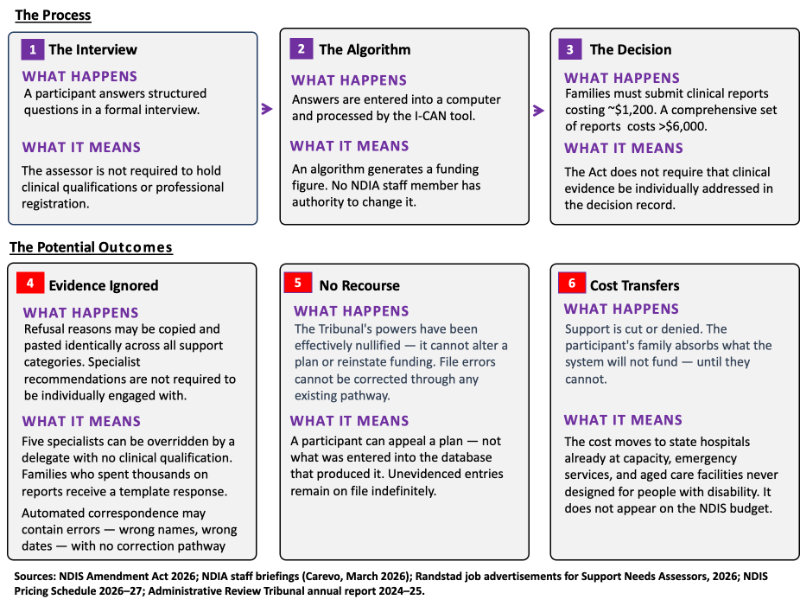
Granted, the NDIS reforms are not without basis. The NDIS was growing at more than twice the rate of GDP growth and, without intervention, Minister Jenny McAllister has stated it would reach $70B per year by the end of the decade.
The question is not whether reform was necessary. It is whether the method chosen — automated decisions in which no clinician is required, no individual evidence is assessed, and no staff member can override the result — is delivering reform, or transferring the cost and the responsibility
to carers, families and state health systems that were never designed to carry them.
The automation produces other errors too. Formal NDIA correspondence about one participant in this article referred to him by the wrong name and dated a future tribunal hearing as having already occurred. When the family raised their concerns, they were referred back to the same review process they had already exhausted.
The NDIA closed the complaint, stating there were no further actions available.
No review, no transparency
The decisions are not reviewable. Nor will individual participants receive individual reasons for the reduction to their specific plan. DARU, the Tribunal that might once have challenged it, has had its powers effectively nullified.
The cost does not disappear when the NDIS stops funding it. It transfers — to state hospital systems already at maximum capacity, to emergency services, to families who absorb it until they cannot, and to aged care facilities that were never designed for people like Anthony, or Shaun, or Seth.
* Not their real names.
NDIS: how they dudded the disabled and duchessed the corporations

Claudia Weisenberger is a management consultant with deep experience in pharmaceuticals, hospital transformations, and strategic due diligence across four continents. She combines sharp analysis with hands-on execution.