


Large multinational corporations are taking over health services funded by NDIS and Medicare. Disability advocate Sam Connor examines policy settings and ownership structures reshaping the sector.
Australian taxpayers fund a large share of disability and health services. Over the years, Australian allied-health professionals have built thousands of local practices – occupational therapy, speech pathology, psychology, physiotherapy, paediatric therapy and rehabilitation services.
Now these practices are being bought, bundled up and
sold to the highest bidder
as private equity and large corporate groups – many owned by overseas investors – are seeking to profit from consolidation and ‘economies of scale’.
In some places, the same buyer has swallowed multiple clinics and services in the same region. The signs stay up. The clinicians stay. Families may have no idea that the local practice they have used for years has been sold, or that the ‘competitor’ down the road now has the same owner.
And much of the money keeping these businesses alive comes from Australian taxpayers through the NDIS, Medicare and other public programs. In other words, public money is being used to fund essential services and then allowing the businesses delivering them to be consolidated into offshore-owned corporate assets.
That means fewer genuinely independent providers, less real competition, more power concentrated in fewer hands and Australian taxpayer money ultimately flowing to overseas investors. APM is a good example.
APM – from small business to multinational
Source: APM
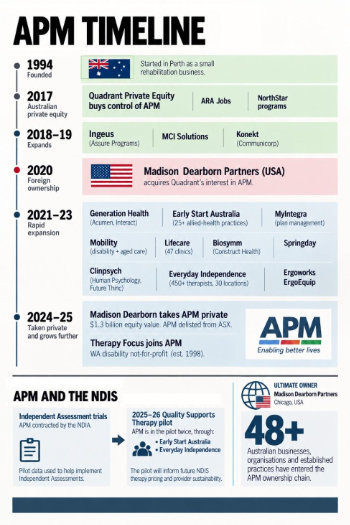
APM began in Western Australia as a small occupational rehabilitation business. It expanded by buying companies including Konekt, Early Start Australia, MyIntegra, Lifecare, Biosymm and Everyday Independence.
Those purchases gave it a massive footprint across employment services, rehabilitation, early childhood, allied health, plan management and NDIS supports.
Then APM itself was sold. In 2024, US private-equity firm Madison Dearborn Partners took control in a deal valuing the company at about $1.3B.
That means that Australian businesses, many heavily reliant on taxpayer-funded systems, were rolled into one large group and ultimately placed under US private-equity ownership.
APM now employs more than 16,450 people worldwide, after rolling up at least 23 businesses since 2015, according to its own corporate timeline.
What’s next?
The next stage is worse.
The big providers, including some bad old names people with disability hauled up the Disability Royal Commission, are not just buying into the market; they are actively being invited by government to help define it. This includes “Life Without Barriers” and “Yooralla” which were both subject to harsh criticism at the Royal Commission.
When you look at the policy context, it is genuinely terrifying.
The Morrison government commissioned the Australian Social Impact Investing Taskforce, chaired by Michael Traill AM, to build a larger market for impact investment in Australia and
mobilise institutional and private capital for ‘social-policy objectives’.
In 2022, Anthony Albanese personally asked the taskforce to update and resubmit its report. Labor subsequently committed $100 million to establish the Commonwealth Outcomes Fund.
It sounds innately reasonable, especially when you couch it in terms like ‘social investment’ and ‘philanthropy’. But what it means is using government programs and taxpayer money to create investment opportunities for banks, billionaires, super funds and other private investors in disability, housing, employment and social services.
It also points to a broader shift towards commissioning, data, financial incentives and centrally defined results.
For big, well-capitalised corporations, that creates opportunity. They can carry regulatory costs, absorb cash-flow shocks, employ tender teams, collect and analyse data and participate in pilots or commissioned programs. Small clinics, sole traders and specialist practices often cannot.
Smaller practices under threat
For those who have built niche or specialist services, including providers in regional areas, the ugly choice can become: be bought out, work for a large company
or close the doors for good.
Muriel Cummins, president of the Occupational Therapy Society for Hidden and Invisible Disabilities, says those smaller practices need to be protected.
“Small and medium-sized allied health practices hold a deep well of skill, expertise, innovation and quality, and are embedded in local communities serving NDIS participants throughout Australia.
“Frequently, they are led by highly experienced clinicians dedicated and tailored to identified need.”
And yet the people government is choosing to hear from tell a very different story.
As part of its current reforms to NDIS pricing and regulation, the NDIA is running an invitation-only ‘Quality Supports Program’. More than $45m has been allocated across therapy, Supported Independent Living (SIL) and support coordination pilots to selected providers to help the agency ‘assess the costs and characteristics of quality service provision and inform future price settings’.
The SIL trial alone involves 44 hand-picked providers and forms part of more than $25m allocated across the SIL and support coordination pilots, with providers selected through a restricted, invitation-only grant process.
Of the 67 organisations currently selected across the three invitation-only Quality Supports pilots, at least 21 are or have been members of Ability First Australia, Alliance20 or the industry’s Ability Roundtable benchmarking network. In the Supported Independent Living pilot alone, that is at least 18 of the 44 selected providers.
The $54B question. NDIS compliance looms – 247,000 providers yet to be registered
Those selected ‘quality’ providers include large consortiums of wealthy charities, two APM businesses, organisations repeatedly hauled before the Disability Royal Commission and providers that have received compliance notices from the NDIS Quality and Safeguards Commission.
They also include United Disability Care.
United Disability Care
United Disability Care was previously linked to businessman John Margerison, a long-time friend and business associate of former NDIS minister Stuart Robert. Margerison left Australia around the time that he was summoned to appear before a parliamentary inquiry examining Services Australia and NDIA contracts.
That financial connection is not just history.
United Disability Care’s 2025 accounts say its old DJ Property loan was refinanced and a new vendor-finance loan directly from John Margerison commenced on 1 April 2025. It is unsecured, carries 10% interest and runs until 2035.
Roger Emmerson, who chaired United Disability Care during the Margerison period, remains a director today. His wife, Fran Ward Emmerson, was reported to be Stuart Robert’s preferred successor for the federal seat of Fadden.
United Disability Care is now one of the providers being paid to help the NDIA identify the costs of ‘quality’ SIL and inform future pricing.
Quality vs quantity
It is easy for corporations and investors to sell the lie that through block funding and economic rationalising, efficiencies can be made for government. They rarely mention loss of quality or the large profits made by the corporations themselves.
Nor should the cost structures of large providers become the benchmark for a sector that still includes small specialist practices, sole traders and participant-directed supports.
Australia needs robust safeguards, fair pricing and accountable providers. It also needs policy settings that protect small practices, preserve participant choice and prevent essential disability services from becoming simply another portfolio of assets for sale.
As people with disability are removed from the NDIS and support is cut, including for people with very high support needs, restricting choice over support like essential therapies, showering and intimate personal care seems especially cruel.
Muriel Cummins agrees.
“A level and fair playing field in disability market reform is essential to sustain access to these practices for disabled Australians,” she said.
Australia deserves better than this.
Inside Job. How former insiders and corporateers are cashing in on the NDIS
Samantha Connor AM is a disability rights activist, writer and former President of People with Disability Australia. A wheelchair user with decades of experience in disability advocacy, she writes about the NDIS, disability policy, government accountability and human rights.