


Potential gap between what retirement village operators charge residents and the actual cost could hit retirees for up to $138 million, retiree rights advocate Les Scobie writes.
Residents at retirement villages operating under Victoria’s Retirement Villages Act 1986 (RV Act) are being charged more for village maintenance and management — the service charge — than what the law requires.
This occurs where operators deny residents the statutory right to choose to pay a service charge from two separate values — the service charge as proposed by the operator, or an independently calculated benchmark value.
According to the legislation, residents are not required to pay a monthly service charge higher than this independently calculated, CPI-compounding benchmark value — unless the residents agree to do so (except for the first year. The service charge is based on the operator’s estimated operating costs for maintenance and management of the village for the new village year; the benchmark value compounds each year using the % change in the Australian Bureau of Statistics Table 9 Melbourne CPI index.
The RV Act protects residents from runaway fee increases with the right to choose to pay either the operator’s proposed service charge, or where the benchmark value is lower, a service charge at the lower benchmark value. However, many operators deny this statutory right to choose, resulting in unsuspecting
residents paying a service charge higher than their statutory obligation.
The statutory process for each year is shown in the chart below. Critically, each year’s benchmark value is calculated from the previous year’s benchmark value — not from the previous year’s service charge.
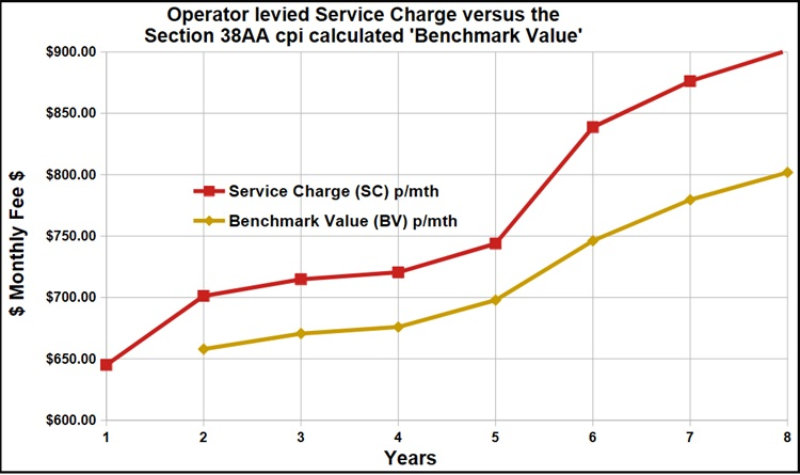
Comparison of the operator-proposed service charge vs. the CPI-compounding benchmark value.
The service charge is based on the operator’s estimated costs of maintaining and managing the village for the coming financial year.
The benchmark value, which begins in the second year and compounds annually according to a prescribed CPI formula, is calculated independently of the operator’s proposed service charge. It is a statutory control on the service charge — not the service charge itself.
Guidance undermining legislation
Consumer Affairs Victoria (CAV) publishes a plain-English guidance under the heading “Increasing maintenance charges”. It states:
“A retirement village can only increase the amount of their maintenance charge annually in accordance with increases in the consumer price index (CPI).”
“A bigger increase is only allowed if it is approved by a special resolution passed at a meeting of residents.”
The difficulty is that this explanation appears to conflate the maintenance charge with the adjusted maintenance charge — two distinct statutory concepts.
The consequence is potentially significant. Residents can be misled into a belief that the service charge itself can simply be increased annually by CPI, rather than understanding that the operator’s proposed charge must be tested against the independently calculated section benchmark.
If that distinction is overlooked,
residents may lose the benefit of four important protections.
- Residents are entitled to an independently calculated benchmark under section 38AA(2). Beginning in the second year, that benchmark advances annually according to the specified Melbourne CPI index, regardless of what the operator proposes to charge.
- Under section 38(2), the operator’s proposed service charge must be tested against that benchmark each year. It should not simply be accepted because the operator’s proposed increase is no greater than CPI.
- Section 38(2) protects residents from a proposed service charge exceeding the benchmark. Critically, this can apply even where the operator’s increase from the previous year is itself no greater than CPI.
- Section 38(4) gives residents the right to reject a higher service charge and instead pay a service charge at the lower benchmark value.
Any authority granted to an operator to charge above the benchmark applies only for that financial year. The mechanism under sections 38(2) and 38AA therefore resets each year. A previous year’s authority does not, of itself, create a permanent entitlement to charge above the newly calculated benchmark.
Retirement villages: the most complicated finance contracts in Australia
The cost of confusion
There is a further issue where operators forecast increases above CPI for particular costs, such as wages, rates or taxes. For those portions, resident approval is not required.
This creates another potential exposure for residents. Because this issue is not included in the modelling discussed below, the actual financial impact could be greater than the figures presented.
My modelling applies sections 38(1), 38AA, 38(2) and 38(4) to a village of average size — 87 units — with an average service charge of $645 per month.
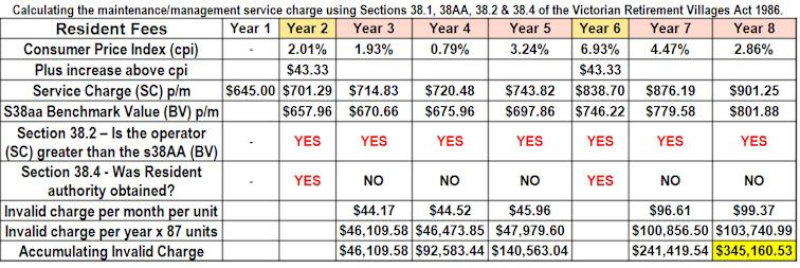
Comparison of the operator-proposed service charge vs. the benchmark value. Average size data drawn from the 2025 Retirement Living Council/PwC Retirement Census.
Where the CAV interpretation is used instead of the statutory benchmark mechanism, the financial impact on residents compounds rapidly. Residents in an average-sized village would
pay more than $345,000 above the amount they are legally required to pay.
This would represent the type of outcome the RV Act’s consumer-protection provisions are intended to prevent.
Push for clarity
Fellow reform advocate Lawrie Robertson and I secured Victorian Opposition support for an amendment to rename the CPI-compounding “adjusted maintenance charge” to better reflect its function as the section 38(2) benchmark or control value.
Opposition MP David Davis told the Legislative Council the amendment was designed to clarify the terminology and make the system easier for residents to understand.
The State Government defeated the motion, with Housing Minister Harriet Shing arguing, “A departure from existing language may cause avoidable confusion among current residents.”
However, this is not merely a semantic issue. Confusion about the relationship between the two figures can have significant financial consequences.
The modelling puts the potential impact at more than $345,000 for an average-sized village. With more than 400 retirement villages operating in Victoria under the same legislation, a simple extrapolation produces a potential statewide impact of approximately $138 million.
Although that figure is an extrapolation, it illustrates the scale of the problem where the statutory benchmark mechanism is misunderstood and incorrectly applied.
For older Victorians living in retirement villages, this is not an academic debate about terminology. It is about how much they are required to pay for the maintenance and management of the operator’s village.
Fees for no service. Arcare class action puts rapacious aged care operators on notice

Les is a long-time advocate for reforms to the Retirement Village industry for the benefit of Australian retirees.