
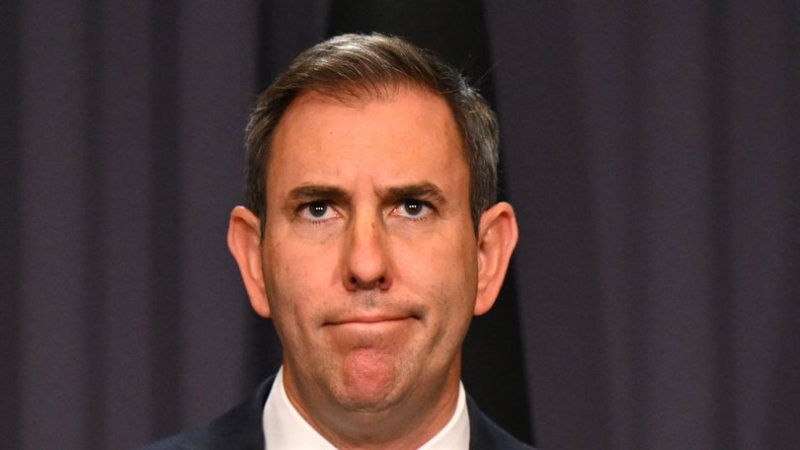

As widely expected, the Reserve Bank raised its interest rate by another 0.25% points today, just in time for Jim Chalmers’ next budget. Michael Pascoe reports.
The headline is the RBA’s third rate hike in a row, the board voting eight-to-one this time, while business is shouting that the economy is cooling, but the story is the little extra pressure the bank is placing on next week’s Federal budget.
Just don’t be fooled into thinking the Albanese Government is responding with anything bold or game-changing. I’ll come back to that.
The RBA’s May statement on monetary policy (SMP), released a week before the budget, is the bank’s traditional method of getting its economic forecasting retaliation in first. While the bank and Treasury sup from the same Joint Economic Forecasting Group bowl, each adds its own twist, with the latter obviously more likely to reflect the government’s preferences.
The RBA message, or at least the message as it is perceived and relayed by the commentariat, is the usual mantra of needing improved productivity while warning of sticky inflation. As always, the bank ducks and weaves when it comes to anything that might be considered fiscally prescriptive, staying in its monetary lane.
Government spending to slow
Yet the SMP forecasts growth in public demand – government spending – to slow in the more difficult time ahead. From an expectation of 3.7% growth this financial year, the RBA tips 3.1% for calendar 2026, 2.8% for the new financial year and 2.1% for 2027-28.
Dwelling investment, you know, solving our biggest economic challenge, is forecast to turn south from growth of 3.8% this financial year to just 1% for the new financial year and to be negative 1.1% in 2027-28. As opined here before, housing is the root of our “cost of living” and inequity stories.
The bank’s latest forecast is a weaker economy, rising unemployment and inflation staying above its mandated range for the next year despite an assumed 60-point increase in interest rates. The first 25 of those points were duly delivered.
That’s despite the RBA’s assistant governor economic, Sarah Hunter, spelling out that there was nothing monetary policy could do about the twin impacts of Trump’s war: weaker GDP growth and higher inflation.
The one hopeful aspect of Governor Michele Bullock’s media conference was an indication that another rate rise isn’t a sure thing. She would not go as far as agreeing to being at a “wait and watch” stage, but the question of what happens next is open.
Ms Bullock said the board regards the new cash rate of 4.35 per cent as being “a bit restrictive”. Sarah Hunter earlier told journalists the bank regarded 4.1 per cent as being “neutral”, albeit at the higher end of neutral.
Continuing to tighten, as the money market expects, is forecast to deliver a CPI of 2.4% in June next year – a smidge below the middle of the RBA’s mandated target – with the bank’s preferred trimmed mean measure down to 2.6% in December 2027.
Curiously, the bank forecasts the wage price index to be steady at 3.2% for the next 20 months and it
doesn’t expect the unemployment rate to worsen much until the 2027-28 financial year.
The (relative) optimism about unemployment being 4.3% this Christmas and 4.4% next June strikes me as being at odds with the most timely information, rather than older numbers in the rear-view mirror.
The investor view
While the RBA board was making its interest rate decision and the Governor was selling it, down the road at the Macquarie investment conference, the message is that yes, times are getting tougher.
And the bank’s most recent business liaison is giving the same warning. As always, business tells the bank, and it reports that “the labour market is a bit tight” but now “hiring intentions have recently moved lower”.
“The share of firms now reporting plans to keep headcount stable in the year ahead is well above its long-run average, and the share of firms expecting lower headcount has lifted,” the SMP states.
What will Albo do?
So, with that message plus Trump’s international crisis plus a large parliamentary majority plus a dysfunctional opposition, is Labor seizing the opportunity for real change, to snap out of Albanese’s incrementalism?
Short answer: No.
Don’t be fooled by the rolling headlines about what might or might not be the proposed capital gains tax and negative gearing changes. Whatever they end up being next Tuesday night,
they don’t add up to major reform that will change our economy or solve our housing crisis.
You don’t have to be an old professional sceptic to suspect we’re being played by all the hints, drops, denials, suggestions and winks over CGT and NG. It’s a government at work spinning a lot out of not all that much.
Yes, a couple of iniquitous aspects of our tax system are likely to be adjusted for the better, and that’s nice, but it’s not big bickies and, when sold as addressing the housing affordability crisis, the horse has substantially bolted and won’t be corralled again by this minor reform.
Depending on the final details, it should help first home buyers bidding for existing housing a little but make no difference to the people most in need – the 1.4 million households receiving Commonwealth Rental Assistance, effectively subsidising private landlords, a testimony to the policy crime of multiple governments in substantially abandoning public housing.
And CGT, NG and tightening up family trusts are just the low-hanging fruit of tax reform, policy changes that have been sold by others and steadily bought by the electorate over the past decade, not the hard stuff that Timid Tony Albanese isn’t game to touch. Heavens, it seems he’s not even prepared to fix the offshore gas PRRT rorting when there is massive public support for at least an element of windfall profit tax.
The AFR’s Phil Coorey wrote ($) a perceptive column last week on Labor using osmosis for tax reform, following rather than leading the electorate. In part:
“The adviser claimed, hand on heart, that the government had spent the months leading up to the budget making the case to pare back the discount, along with the negative gearing concessions, and the detail would soon follow.
“In reality, it has done nothing of the sort. Instead, it has left all the heavy lifting to the Greens, independents, the media, economists and other various advocates, all while hiding behind disingenuous talking points such as ‘no decisions have been made” and thus the ‘policy remains unchanged’.
“It was the same malarkey we were fed last term when the government decided to break an election promise and redistribute the stage three tax cuts. Everyone and their aunty knew what was going on but until the very moment the cabinet signed off on the change, ‘no decision has been taken’ and ‘the policy remains unchanged’.”
Real tax reform, getting serious about improving Australia’s outlook and intergenerational equity, means a full package that would end up benefitting the nation but annoy just about everyone.
It would have to tackle broadening the GST, working with the states on universal land tax, tackling the ridiculous generosity of franking credits for people who don’t pay tax, reducing income tax rates and, yes, fixing the gas exporters PRRT fiddle.
Only the last of those qualify for “osmosis”. The rest would take ticker and spending political capital.
But that’s another story.

Michael Pascoe is an independent journalist and commentator with five decades of experience here and abroad in print, broadcast and online journalism. His book, The Summertime of Our Dreams, is published by Ultimo Press.