
It happens every day somewhere in the world; the killing of innocents by war mongers, mass murderers or terrorists. When it is close to home, it affects us so much more. What will we learn from the Bondi tragedy, Kim Wingerei asks?
Once again, a nation mourns the tragic loss of innocent life from violence perpetrated by damaged, callous and brutal men with an axe to grind, assault guns in hand.
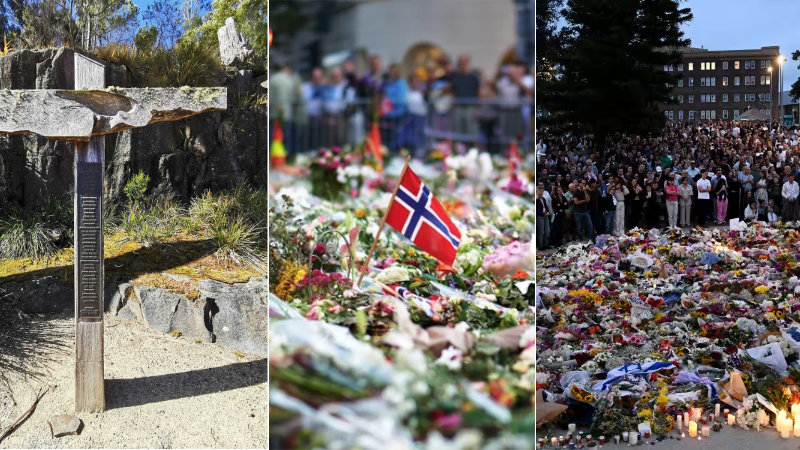
The Bondi massacre has inevitably conjured up memories of an even worse atrocity committed by a single man in Port Arthur in 1996. For this ‘Auswegian’, it also evokes the mass murdering rampage by another lone gunman on a small peaceful island in a lake north of Oslo, Norway, in July 2011. I happened to be visiting at the time, farewelling my ailing mother, who passed away a few weeks later.
Three events, four gunmen, 127 innocents shot dead, 360 sustaining physical injuries; and innumerable more – bystanders, families, and friends – to suffer from the trauma for the rest of their lives.
In Port Arthur, the victims were mostly tourists and the motive a personal grievance; in Oslo, they were mostly youngsters getting together for a weekend of political debate; at Bondi, Jews who were peacefully celebrating Hanukkah, the “Festival of Lights”.
What sets the three events apart is how the public reacted, how media reported it, and how governments responded.
Someone to blame
Identifying a scapegoat when tragedy befalls us is common and understandable human behaviour. Blame serves as a coping mechanism, provides an illusion of control (“if we find a culprit, we can prevent it from happening again”), and helps us unite in the face of adversity.
Port Arthur came as a shock to a nation that believed itself immune from such events. A shock exacerbated by the lack of a relatable motive, just a madman who had acquired weapons and knew how to use them for maximum deadly impact.
Online news was still in its infancy, and reporting was done by well-resourced newsrooms inclined to check the facts first.
There was the inevitable criticism of police failures, but the overwhelming reaction was that of universal solidarity with the victims, and blame was squarely on the murderer. Prime Minister Howard had complete political support for the stricter gun laws and gun amnesty that followed. How they have since been watered down is another story.
Bondi Shooter revelations leave blood on the hands of politicians, police, ASIO
In Norway, there was a similar reaction to the unfathomable killing frenzy, but calm leadership and factual reporting took precedence, quelling unnecessary hysteria and panic before it could take hold.
A later inquiry found that the police had taken too long to respond, while recognising the challenge faced by a local police force that had rarely encountered a murder investigation, let alone terror on a scale not seen since World War II.
The Oslo perpetrator was soon found to be a right-wing extremist and white supremacist who hated the very existence of the Workers Party Youth League members gathered on the island. An enemy within with strong political overtones, but with no following to speak of outside the dark recesses of internet chat rooms. That helped the nation to cope and to unite around Prime Minister Jens Stoltenberg’s words,
the proper answer to the violence is more democracy, more openness, but not naivety.
It was a sentiment echoed by New Zealand Prime Minister Jacinda Ardern after the Christchurch mosque shootings in 2019, which killed 51 and injured 89 Muslims. It remains the worst act of terror committed by an Australian in modern times, but people rallied around the victims; nobody called for revenge against Australians.
The immediate aftermath of the Bondi massacre already stands in stark contrast to Port Arthur, Oslo and Christchurch. The guns of the two mass murderers had barely ceased firing before the internet exploded with the absolute certainty that they were Muslims shooting Jews.
It proved to be true, but the brave man who tried to disarm one of them was also Muslim, a fact ignored by many of those already determined to use the tragedy to fuel the fire. AI-generated exaggerations and misinformation on social media were rife.
Blame was to be apportioned, and hell was to be paid. Not just by the perpetrators, but by anyone believed to be antisemitic, and Muslims in particular.
An enemy defined in such broad terms is not only convenient, but sets the stage
to further amplify hate and division, and deflect the narrative away from other atrocities.
Weaponising tragedy
It took Benjamin Netanyahu less than a day to blame Prime Minister Albanese, saying he had failed to heed the warnings of increased antisemitism in Australia.
Much of the mainstream media bayed for political blood, too, as did opposition politicians. Former Treasurer Josh Frydenberg used the stage in front of a mourning crowd to link the tragedy not just to October 7 and Hamas, but to those who dare walk in protest against Israel’s ongoing genocide in Gaza.
That the Bondi murderers are believed to have links with ISIS, a terror group well known to be opposed to Hamas, has been conveniently ignored by the loud voices calling for broad retribution and government action.
Relaxed gun control has also been used to apportion blame on governments, and both Albanese and NSW Premier Chris Minns have been quick to declare they will act on that. However, as Malcolm Turnbull pointed out, history has shown that terror by lone gunmen is a risk that legislation, intelligence bureaus or police cannot be expected to fully curtail in a free society such as ours.
Not to mention how two of the largest and most advanced intelligence and law enforcement organisations in the world, the CIA and FBI, were unable to prevent 9/11, the consequences of which are still felt today, including by Muslims everywhere they travel.
Hate begets hate, and words matter. Prime Minister Anthony Albanese is stuck between the rock of resisting the voices of hatred and the hard place of reason. For now, he seems to have chosen the soft route, legitimising those who want to use tragedy to further a political agenda of more division.
Yet, for the hardliners, he can’t ever do enough, as indicated by the disheartening boos at his presence at Sunday’s Bondi vigil.
Port Arthur led to gun control, which likely has saved lives. Oslo brought a country together, strengthening democracy by reinforcing its core value of openness. Bondi may lead to better gun control, but also more invasive surveillance and policing, an unprecedented assault on free speech through curbing the right to protest, and, if Antisemitism Envoy Jillian Segal gets her way,
enshrining into law one type of hate speech as somehow being worthy of more attention than others.
Those who ignore history will always repeat its worst lessons. Hate speech itself is not what we should fear. It is how we react to it and how we deal with the enemy within that will either define us, help us to heal, or break us further apart.
Albo bows to media, Israel pressure, moves on antisemitism, free speech

Kim Wingerei is a businessman turned writer and commentator. He is passionate about free speech, human rights, democracy and the politics of change. Originally from Norway, Kim has lived in Australia for 30 years. Author of ‘Why Democracy is Broken – A Blueprint for Change’.