
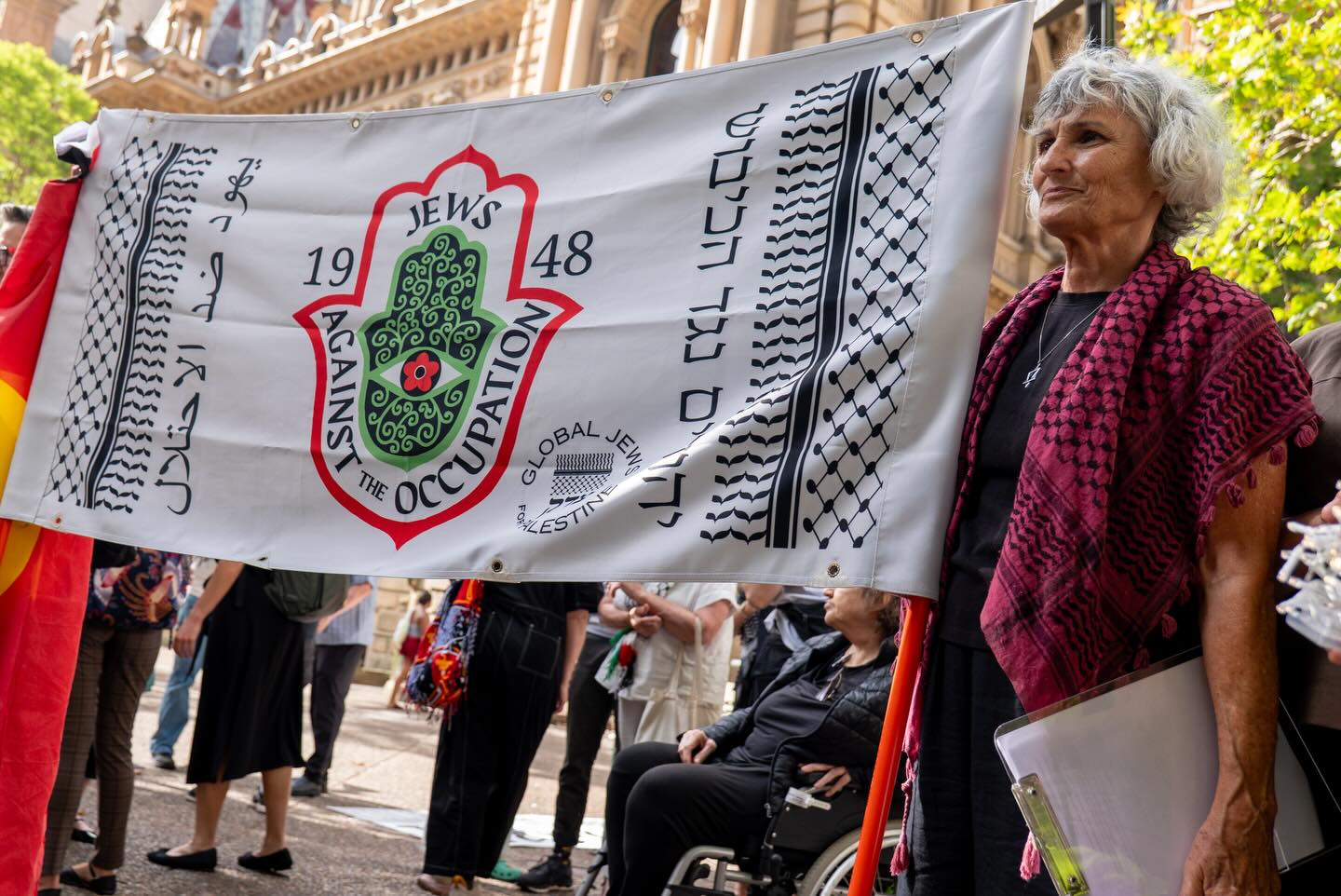
The Minns government is refusing to respond to questions on Mossad-linked security armed on Sydney streets as Premier rushes through sweeping anti-protest powers in the aftermath of the Bondi massacre. Stephanie Tran reports.
The Terrorism and Other Legislation Amendment Bill 2025 – bundling draconian restrictions on public assemblies with gun law reforms – was passed at 3am on last night after NSW Parliament was called back for an emergency sitting.
A first consultation draft was circulated to members around midday on Sunday. The final bill was provided less than an hour before it was read into parliament on Monday.
Police powers to outlaw peaceful political assembly
At the centre of the legislation is a new power allowing police to ban protests and other public assemblies for up to three months following a ‘declared terrorist incident’.
The Bill creates a mechanism known as a Public Assembly Restriction Declaration (PARD), which can be issued by the NSW police commissioner or a deputy commissioner, with the concurrence of the police minister, within 14 days of a terrorist incident being declared
Once a PARD is in force, protests and other public assemblies in designated areas cannot be authorised under NSW’s long-standing “Form 1” system, which is designed to facilitate cooperation between police and protest organisers and to protect participants from prosecution for obstruction offences.
Police would have the power to direct protests to disperse and to prevent new assemblies from forming, even where no unlawful conduct is occurring.
The PARD can be extended in successive 14-day blocks,
for a cumulative maximum of 90 days. While industrial action is expressly exempt, the power applies to all other forms of political assembly.
Under the bill, participants in an assembly held in a PARD-designated area would lose the legal protections normally afforded to authorised protests and could be exposed to criminal liability for obstruction and related offences. Police move-on powers that are ordinarily restricted during authorised assemblies could also be used to compel protesters to disperse.
The legislation also expands police powers to require protesters to remove face coverings if officers reasonably suspect the person has committed, or is likely to commit, an offence.
Minns ducks questions on arming CSG
These measures come after Minns said he was in discussion with Community Security Group (CSG), a Jewish security group with ties to Mossad, about allowing members to openly carry weapons at events.
David Ossip, the President of the Jewish Board of Deputies, is the sole director of Paliguard Pty Ltd, the corporation that operates CSG.
Ossip publicly condemned the Sydney Harbour Bridge march and welcomed the protest ban.
“Public protest cannot become a licence to threaten or terrorise minority communities,” he said.
A former CSG member interviewed by Deepcut News said the organisation had long functioned as an informal recruitment channel for Israeli intelligence agencies, describing what they characterised as an “open two-way line of communication”.
“CSG has a long history as a recruiting ground for Israeli intelligence agencies,” the former member said.
MWM put questions to the Premier about what due diligence the Minns government has undertaken to ensure that individuals granted licences to carry firearms are not perpetrators of war crimes in Gaza citing comments by UN Commission of Inquiry on Palestine and Israel commissioner Chris Sidoti, who told the National Press Club that, in light of the commission’s finding that Israel has committed genocide in Gaza, “anyone who has served in any arm of the Israeli military in Gaza should be treated as a suspect, investigated and, if necessary, prosecuted”.
The Premier’s office did not respond.
‘Completely prohibit’ assemblies
Introducing the Bill, the NSW police and counter-terrorism minister, Yasmin Catley, said the government’s position was that police needed the power to prohibit assemblies outright in the aftermath of a terror attack.
“We say that in the wake of a terrorist incident, the critical power to provide is the ability to completely prohibit the authorisation of any public assemblies to ensure public safety,” Catley told parliament.
She argued that large public gatherings in the aftermath of an attack could inflame community tensions, expose participants to risk, obstruct emergency responses and become targets themselves.
“A public assembly held to express support for or to denounce a particular community or group … could further inflame tensions and give rise to risks to public safety,” she said.
Coalition demands harsher penalties
Despite the breadth of the new powers, the opposition argued they did not go far enough.
The Liberals proposed a series of amendments that would have introduced explicit criminal offences for organising or participating in a protest during a restriction period, mandatory fines for participants, jail terms of up to five years for organisers, stricter mask bans, and legislated approval criteria emphasising “social cohesion” and economic impacts.
Shadow Attorney General Alister Henskens warned that without tougher penalties, protests could resume immediately.
“If this Bill is passed by this parliament today and tomorrow, there will be nothing to stop a pro-Hamas protest or assembly on Bondi Beach at the end of the week,” he said.
Under the opposition’s proposal,
organisers would face up to five years’ imprisonment,
with participants automatically fined $1,000. All of the opposition amendments were voted down in the lower house.
Blaming peace protesters
The new laws come amid repeated statements from the premier, Chris Minns, conflating pro-Palestinian protests to social division and violence following the Bondi attack.
Minns has suggested phrases such as “globalise the intifada” could be targeted in future hate speech reforms.
AAP journalist Farid Farid asked Minns to clarify what he was referring to when describing “violent imagery” at the protests.
“I mean the violent imagery I’m referring to is the stuff I see in Hyde Park, it has consequences in our community. I’m not going to go into the ins and outs of it but it does have an impact,” Minns responded.
Opposition leader Kellie Sloan went further in parliament, directly linking weekly Gaza protests to the attack.
“When protesters were allowed to descend on our city each week and scream ‘From the river to the sea’, ‘Globalise the intifada’, we should have known then,” she said. “When hate becomes normalised in a nation, how can we possibly believe there is any outcome other than what we saw last Sunday?”
‘Politicising grief’
Activist groups have already flagged that they will launch a constitutional challenge against the laws.
Critics say the government is conflating peaceful protest with terrorism and using a moment of national grief to crackdown on democratic rights.
“For the NSW Premier, a top priority in responding to the Bondi massacre was to make sure that, for the moment at least, there could be no more peace marches in Sydney – or marches of any kind, on any issue,” University of Sydney academic, Dr Nick Reimer wrote in MWM.
“His proposals should make the blood run cold.”
In her second reading debate speech, Greens MP Jenny Leong said bundling gun reforms with protest restrictions and conflating peaceful protests with the terror attack was “truly worrying”.
“That the New South Wales Labor government has chosen to put all of the reforms together is disappointing. It is not in the interest of our democracy nor our society, and it will not help heal the pain and fissures in our communities,” she said.
“Peace comes from when people have all of their civil liberties and their human rights protected and promoted. Removing the collective rights of people to engage in non violent, peaceful protest in the state of New South Wales is a very disappointing use of this tragic event.”
Leong condemned attempts to blame Sydneysiders who protested against Israel’s war in Gaza for the Bondi attack.
“It is important to call out those who seek to blame Sydneysiders who have engaged in peaceful protests opposing a genocide for the abhorrent antisemitic actions of two violent, mass-murdering men in Bondi,” she said.
Jewish Council of Australia executive, Dr Naama Blatman called on the government to “not politicise our grief”.
“We call on the Minns government and members of the NSW parliament not to politicise our grief and not to capitalise on our tragedy, not to pass laws that stifle our freedoms and punish us for our commitment to justice,” she said.
Minns’ protest ban: breathtakingly racist, authoritarian, and must be resisted

Stephanie is a journalist with a background in both law and journalism. She has worked at The Guardian and as a paralegal, where she assisted Crikey’s defence team in the high-profile defamation case brought by Lachlan Murdoch. Her reporting has been recognised nationally, earning her the 2021 Democracy’s Watchdogs Award for Student Investigative Reporting and a nomination for the 2021 Walkley Student Journalist of the Year Award.