

Earlier this week Defence Minister Richard Marles announced a big reform in Defence Procurement. Except it wasn’t a big reform, rather a rearranging of deck chairs. Former senator Rex Patrick reports.
And the needle returns to the start of the song …
On 22 June 2000, then Minister for Defence John Moore approved the establishment of the Defence Materiel Organisation (DMO), a single organisation that was to be charged with the responsibility of acquisition and through life support of equipment and systems used by the Australian Defence Force.
But the DMO didn’t work.
On 01 April 2015, then Minister for Defence Kevin Andrews announced that he had accepted the recommendations of a Defence First Principles Review and that the DMO would be disbanded – it wasn’t working – and that its functions would be transferred to a new Capability Acquisition and Sustainment Group (CASG).
But the CASG didn’t work.
On 01 December the Defence Minister, Richard Marles, announced he was merging CASG, Defence’s Guided Weapons and Explosives Ordinance Group and the Naval Shipbuilding & Sustainment Group into a single organisation to be called the Defence Delivery Agency (DDA).
DDA won’t work
Dumb Ways to Buy: Defence “shambles” unveiled – former submariner and senator Rex Patrick
Rearranging deck chairs
During the week Marles sought to assure that there would be no job losses as a result of his reforms and, in an absolute admission that all he was doing was rearranging the deck chairs, he advised that existing public servants who worked for Defence would simply be transferred over to the new agency.
The biggest problem that Defence has, and which Marles doesn’t have the ability to solve, is the fact that the very senior uniformed people who are running Defence acquisition, while undoubtedly being good war-fighters, don’t have the experience in project management to understand that it is risk that brings down projects.
You would not take an experienced project manager and assigned them command responsibility of a warship, and you should not take a warship captain and assign them responsibility for a large project. But the latter is exactly what happens inside Defence.
Political risk (political change), economic risk (pressure on budgets), management risk (inexperience) and technical risk (novelty, uncertainty and complexity) – that’s what causes projects to go off the rails.
Changing the label on the front door of the equipment procurement office won’t do a thing to get better value-for-money or reliable capable equipment for our defence force.
E.G. AUKUS
AUKUS is classical Defence risk taking.
It’s not a hidden fact that the United States is not building enough Virginia class submarines to meet US Navy needs, let alone supply the Royal Australian Navy with some. The US Government’s AUKUS review report is now with the Australian Government. The Minister is talking up the contents, albeit in very general detail.
If the US were honest, they’d tell us to do something different.
But with $1.6 billion already paid to the US Department of War and another billion dollars set to be gifted to the US in the next couple of weeks, the temptation would be difficult.
Senate Estimates this week was instructive. When Senator David Shoebridge read from the evidence given by Lord Case, the Chair of ‘Team Barrow’ (the organisation entrusted with ensuring the town of Barrow is able to support the UK’s and AUKUS submarine build needs) telling the UK Parliament he was not happy with his team’s progress, Vice Admiral Jonathon Mead indicated he did not know about it.
Experienced project managers spend their time looking for bad news – looking for risk that is materialising. That doesn’t seem to be happening. ‘Talking’ AUKUS is the order of the day, not ‘walking’.
Rudd talking the AUKUS talk in Washington, but is the US walking?
Real change
If Marles knew what he was doing he would look to the culture in Defence procurements.
No more ‘special’ or ‘expensive monolithic’ projects.
Defence needs to develop a force optimised first for Defence-of-Australia and second for near regional security (and conduct other work from that order-of-battle). It needs to focus on proven designs/capabilities when fulfilling Defence Force needs.
This is something that has been recommended to Defence in the past, in the 2003 Kinnaird Review and the 2008 Mortimer Review. They are not new ideas; they are old ideas ignored.
Even those not currently interested in Defence need to be a little bit interested. Putting national security imperatives to one side, so much public money is spent on Defence.
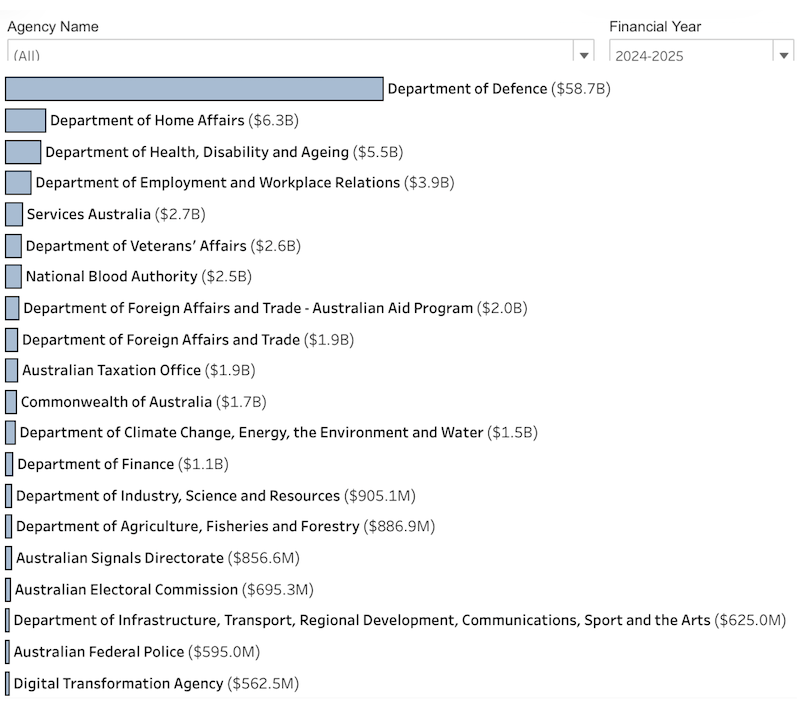
Defence Contracts compared to other Agencies (Source: AusTender)
One of the most telling signals that nothing substantive will come from Minister Marles’ announced changes came when Senator Shoebridge asked the question of Defence Secretary Greg Moriarty will the new ‘National Armament Director’ come from outside the current organisations?
There was no way Moriarty was going to answer that question. He employed bureaucratic doublespeak and avoided a direct answer. The secretary is an experienced public service hand, and will want someone in the seat that he can ‘guide’.
Marles needn’t worry too much though. He has what he needs – a dodge over failing projects for the rest of the parliamentary term, and possibly the next as well. “All those problems were caused by the old system,” Marles will say.

Rex Patrick is a former Senator for South Australia and, earlier, a submariner in the armed forces. Best known as an anti-corruption and transparency crusader, Rex is also known as the "Transparency Warrior."