

Two courts, nine years apart, have said the same thing: look at the work, not the paperwork. Both times, the trail runs back to BHP’s Mt Arthur coal mine. Michael West.
On September 9, 2026, just one week ago, the High Court handed down a decision about who counts as a coal miner in Australia. The decision has import for the long-winding feud between BHP and disabled coal miner Simon Turner, and has BHP’s solicitors at MinterEllison scrambling for a defence as the Turner matter heads back to court.
In Coal Mining Industry (Long Service Leave Funding) Corporation v Orica Australia, the High Court held that the test for who is covered by the coal industry’s long service leave scheme – and by the Black Coal Mining Industry Award – depends on the work the employee actually does, and not on what business the employer is in.
Two employer ‘limbs’
The statutory definition of “eligible employee” has two limbs. The employer limb asks whether the worker is employed in the black coal mining industry by an employer engaged in that industry. The location limb asks whether the worker’s duties are carried out at or about a place where black coal is mined and are directly connected with the day-to-day operation of a black coal mine.
The critical words, Chief Justice Gageler and Justice Jagot held, are “by an employer engaged in the black coal mining industry” – and the fact that those words appear in the employer limb but not in the location limb.
Their Honours held that the phrase “employed in the black coal mining industry” referred only to “the nature of the activities in fact carried out by the employee”, and not to the overall industrial or business character of the employer.
Simon Turner, who broke his back working as a coal miner at Mr Arthur in 2015, has been fighting BHP for compensation. BHP and its solicitors MinterEllison dragged this publisher into court earlier this year for reporting on the Turner case. They have never had to file a defence to Turner’s claims and the proceedings were muzzled by the Judge.
“I’m sorry but …” BHP v coal miner Simon Turner delayed again
MinterEllison continues to threaten MWM in other defamation proceedings relating to their client, the controversial liquidator Richard Albarran. The matter is related to the BHP matter insofar as another party is also associated with both MinterEllison matters and is also being threatened by MinterEllison.
What you do, not what the employer says you do
The consequence of the High Court decision is stated in terms. The substantial industrial or business character of the employer’s overall activities is irrelevant to the location limb. And the 2010 Award applies to coal mining employees under the location limb irrespective of the status of their employer.
Orica had argued the opposite:
that because its business was explosives rather than coal mining, its ‘shotfirers’ fell outside the scheme. Their Honours held that accepting that argument would undermine the fundamental conceptual underpinning of the legislation.
The appeal was allowed with costs. Orica was represented by MinterEllison.
The Mining and Energy Union intervened, and its submissions on the legislative and award history proved decisive – neither the primary judge nor the Full Court had had the benefit of them.
The earlier decision too
Nine years earlier, a judge of the Federal Circuit Court had reached a similar conclusion about the same mine: Mr Arthur.
In Construction, Forestry, Mining and Energy Union v Hunter Valley Energy Coal Pty Ltd, delivered on July 18, 2017, Judge Altobelli examined a labour hire arrangement at BHP’s Mt Arthur Coal mine from early 2015. Hunter Valley Energy Coal was the mine holder and a BHP entity. Chandler Macleod Group (CMG) supplied the labour.
The worker had signed her contract not with CMG but with Ready WorkForce (A Division of Chandler Macleod) Pty Ltd.
Hunter Valley Energy Coal, represented by Herbert Smith Freehill, argued that this mattered. Its contention was that because the worker’s contract was with Ready Workforce rather than CMG, she was not an employee of the labour hire company it had actually contracted with.
His Honour rejected that claim.
The Court reasoned that there was no evidence of any contractual relationship between Ready Workforce and the mine operator at all. So, if the worker was not there under the CMG contract, there was no basis on which she could have been working at the mine.
The only way to make sense of what the four parties had actually done, the Judge held, was to characterise the worker’s employment contract as being with CMG and not Ready Workforce.
Despite this, BHP and MinterEllison continued to claim that Ready was Simon Turner’s employer because it was in a trust deed. Despite the Deed being faulty and, according to Turner, signed under duress.
MinterEllison threatens journalist again, BHP still suing coal miner
The Judge noted that the Ready Workforce contract itself described that company as a division of CMG. He found the worker’s belief that she was working for CMG entirely plausible, and said that if CMG intended otherwise it should have been far clearer in what he described as an unequal contract.
He recorded that the payslips, the letterheads and the PAYG summaries were all in CMG’s name. (As was the case with Simon Turner.)
He concluded that “the reality of the situation is not reflected in the written documentation”.
Union in the thick of it
One thing must be said plainly about this case: the union lost it. The adverse action claim failed, because the Court accepted the evidence of the production supervisor as to his actual reasons for the decision, and the statutory presumption in Section 361 was displaced.
The judgment is not saying that anyone was mistreated at Mt Arthur. What it is, is a considered finding by a Federal Circuit Court judge – on the same mine, in the same period, on the same corporate structure, against the same BHP entity, that the Ready Workforce paperwork
did not reflect who the employer actually was.
Simon Turner’s two settlement deeds name Ready Workforce as his employer.
The appellant who won the recent High Court case in September was Coal LSL, the statutory corporation that administers the coal industry’s portable long service leave scheme.
The respondent in the 2017 case was BHP subsidiary Hunter Valley Energy Coal Pty Ltd.
Both of them are now respondents in Turner v Chandler Macleod Group Limited & Ors – and both are arguing that the appeal of a former Mt Arthur haul truck operator should not be heard at all.
In other words, they have an evidence problem,
contending one truth in one case, and another truth in another case.
The man in the truck
Simon Turner drove haul trucks at Mt Arthur in the Hunter Valley. He was not employed by BHP. His labour was supplied to the mine by Chandler Macleod Group, one of the country’s largest labour hire firms, a big client of BHP and a respondent in the Turner proceedings.
He was injured. He was eventually classified ‘Totally and Permanently Disabled’. He has spent the years since trying to establish, through courts and tribunals, a proposition that ought to be simple:
a man who drove a haul truck at a coal mine was a coal miner.
He is self-represented. The legal profession is not keen to face the might of BHP in the justice system. Turner has no income. He has been before the Federal Court without a lawyer, against BHP, Chandler Macleod, Coal LSL and three law firms.
As BHP wrongly classified Simon Turner’s accident as a public liability claim rather than a workplace injury, he receives no benefits from Centrelink while forced to fight BHP and MinterEllison in court without lawyers. So it is that the MWM community is putting food on Simon Turner’s table while BHP and MinterEllison are starving him.
And the reason for that is not just pure bastardry. It is a pragmatic business to strangle the coal miner’s case because there may be a litany of other claims behind it,
an industry-wide rort and a cover-up.
Insured as something else
At the core of Turner’s case is insurance.
In New South Wales, workers in or about a coal mine are covered by Coal Mines Insurance, a specialist scheme under the Coal Industry Act 2001. CMI provides up to 78 weeks of Accident Pay at full wages. It is not an optional product, and it is not interchangeable with ordinary workers’ compensation cover.
Simon Turner says the company that employed him did not use CMI. It used a general workers’ compensation policy issued by CGU — and that his wages were declared to that insurer at a figure far below what he was actually earning under the Black Coal Mining Industry Award.
Turner was being paid around $400 a week although the Award entitled him to $137k a year. How many other workers are in the same position, underpaid and their
insurance based on far lower rates?
Compensation for an injured worker is calculated on declared earnings. Understate the wage and understate the scheme, and every payment that follows is smaller than it should have been. Turner estimates his own shortfall, across the life of the claim, in the hundreds of thousands of dollars.
Thousands of other coal miners employed across the sector by various employers are in the same boat. The risk to the industry runs into the millions. And this is why Minerals Council of Australia chief executive Tanya Constable has personally displayed sympathy for Turner’s plight while failing to do anything to correct it.
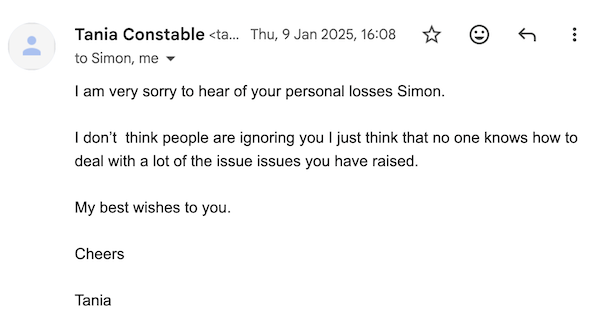
Email by Tanya Constable chief executive of Minerals Council of Australia
The documents
Turner’s case does not rest on his recollection. It rests on paper, most of it generated by the companies themselves, or by regulators:
- Payslips, PAYG summaries and ATO correspondence filed with the Court, which he says show the gap between what Chandler Macleod billed and what it paid and declared
- Coal LSL records identifying his employer by scheme number, while recording his status as casual
- SIRA and mine safety material recording the work he actually performed and where he performed it
- 2015 Fair Work Commission material in which Chandler Macleod’s engagement of its Mt Arthur workforce under the Black Coal Award was in issue, and in which the CFMEU alleged more than 100 employees were being deprived of Award entitlements
- Insurance records in which the same worker appears under a different corporate entity for workers’ compensation purposes than the one shown on his employment records
It is the collision between those documents that Turner says demands a trial rather than summary disposal.
Have BHP and its lawyers MinterEllison misled the court?
Substance over paperwork, twice
Put the two decisions side by side and a single principle emerges.
Justice Altobelli, in 2017, looked through a labour hire structure at Mt Arthur to ask who the worker’s employer actually was, rather than which company’s name appeared on the contract.
The High Court, in September 2026, this month, held that for the ‘location limb’ the employer’s business character is simply irrelevant. What matters, the Court held, is the nature of the activities the employee carried out –
what he actually did for work,
and whether those duties were performed at a black coal mine and directly connected with its day-to-day operation.
Turner’s position is that both cases point the same way. He drove coal haulage trucks at a black coal mine. In his case, that work was directly connected with the day-to-day operation of the mine.
And on the High Court’s construction, the fact that his wages were paid by a labour hire company whose business is supplying labour rather than mining coal does not take him outside the location limb, the Award, or the scheme.
If this is correct, the question of what insurance he should have held, and what wage should have been declared for him, follows from the Award that applied to him rather than from the corporate identity of the company that hired him.
The Coal LSL mystery
There is a further wrinkle.
Coal LSL went to the High Court and won by arguing that eligibility turns on the work performed at the mine and that corporate structure does not displace it. Coal LSL is the fifth respondent in Turner’s proceeding, and has filed an objection to the competency of his appeal.
Whether those positions sit together is now a matter for the Federal Court. It is also a fair question for the public, given that Coal LSL is a statutory corporation whose purpose is to administer entitlements for coal industry workers.
Coal LSL is owned by the Government. Is this perhaps why the Government has been so reluctant to do the right thing, and politicians have been so thwarted when trying to take up Simon Turner’s case?
Are politicians, big business, lobbyists and the union in on the same caper? Is this really what Simon Turner is up against? A large but obscure company tied to mining lobbyists and unions which collects billions in levies on behalf of the government?
Private tax collectors. The billion-dollar secret of the coal industry
BHP’s position
BHP did not employ Simon Turner. But Mt Arthur is its mine; and Hunter Valley Energy Coal Pty Ltd, the respondent before Judge Altobelli in 2017 and a BHP subsidiary, is a respondent in Simon Turner’s proceedings today.
Under the services contract governing the supply of labour to the site, the host is entitled to require evidence of insurance currency, to refuse site access for non-compliance, and to withhold payment. Every worker deployed to the mine was tracked through BHP’s enterprise systems.
The question for BHP is a narrow one: did it verify what insurance its labour hire contractor held for the people driving trucks on its lease, and if it did, what did it find?
BHP has refused to respond to MWM questions about the Simon Turner matter, as have its solicitors from MinterEllison, preferring instead to sue both Turner and the publisher of MWM in court.
Did Chandler Macleod Group Coal Mines Insurance (CMI) for workers supplied to Mt Arthur Coal, and on what basis were wages declared to its insurer?
How many others are there?
Turner is one man. The obvious question is whether he is the only one.
Chandler Macleod has supplied labour to the Australian mining sector at scale for more than a decade. If the arrangement Turner describes were to be applied just to him – as an individual anomaly – that is one thing.
If it was the standard arrangement for labour hire workers at black coal mines, the numbers become a matter of national significance.
Billions of dollars are at risk.
Neither Chandler Macleod nor BHP has said which it was. Nobody has counted. That, rather than any estimate, is the point: the companies hold the records, and the records have never been examined in open court.
Chandler Macleod may argue that before the Coal Industry Amendment Act 2018, labour hire firms were not expressly required to hold CMI.
Turner’s answer is that a 2017 Federal Circuit Court decision found Chandler Macleod to be the employer of coal mine workers at Mt Arthur, not merely a supplier of them. And once a company is the employer of workers at a coal mine, section 31 of the Coal Industry Act 2001 makes CMI mandatory.
Where the case stands
Turner’s proceedings have been subject to suppression orders from the beginning. BHP and its parties have demanded confidentiality, and the Court has obliged. Sweeping orders were made. Publication of certain material remains permanently prohibited.
The appeal itself is under attack. All four respondents have filed objections to the competency of the appeal — that is, they say there is no valid appeal for the Court to hear. Their objections, together with Turner’s own applications, were listed for hearing on 10 September 2026.
That hearing did not proceed. Turner has been unwell.
On September 9, Justice McDonald vacated the hearing, reserved the costs thrown away, and required Turner to file medical material. The respondents have since proposed that the applications be decided on the papers, without any oral hearing at all.
Turner has refused.
He says the High Court’s decision in Orica bears directly on the issues, and that he intends to say so out loud, in open court, in front of a judge.
This story explains the fuss over one man’s claim for compensation and justice. It also explains the aggressive legal tactics deployed by BHP and the failure of governments to rectify the matter. Simply, it is too big, and potentially too costly to industry, to rectify.
What we don’t know yet is whether the system of justice will allow justice to proceed and compel BHP and MinterEllison to properly defend Turner’s claims in open court.
BHP threatens to pursue journalist and coal miner for costs in court case it brought

Michael West established Michael West Media in 2016 to focus on journalism of high public interest, particularly the rising power of corporations over democracy. West was formerly a journalist and editor with Fairfax newspapers, a columnist for News Corp and even, once, a stockbroker.