


The upcoming budget is expected to changes to the private health insurance rebates for older people. Health insurance industry uproar awaits, Claudia Weisenberger reports.
Last month, Health Minister Mark Butler announced the removal of higher rebate tiers for older Australians with private health insurance. Currently, those aged 65-69 receive a 28% rebate, and those 70-plus receive 32%, compared to 24% for under-65s. The change equalises the rebate at 24% regardless of age, saving an estimated $3 billion over four years to fund aged care improvements.
The industry response was immediate, emotional, and instructive.
Scare campaign
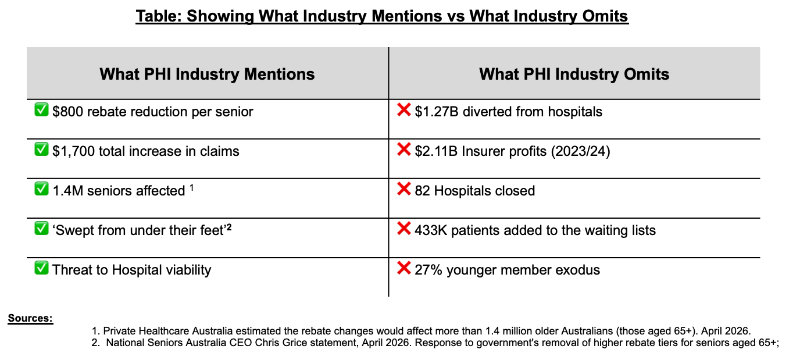
National Seniors Australia predicted premium increases of up to $1,700 annually for couples, a figure combining approximately $900 in normal annual premium inflation with $800 from the rebate reduction.
By conflating routine premium increases with rebate changes, the industry frames the entire cost as government policy. A couple facing a $900 premium increase, as they would have regardless of rebate changes, reads headlines about “$1,700 Labor increases” and assigns blame accordingly.
Private health insurance lobby group Private Healthcare Australia warned the decision would “hurt consumers, impact the viability of private hospitals, and limit health funds’ ability to deliver better patient experiences.” National Seniors Australia CEO Chris Grice described older Australians who have “paid private health for decades” now having coverage “swept from under their feet.”
The messaging is clear: Labor is harming vulnerable seniors who have faithfully paid premiums for decades, at a time when affordability matters most.
Campaign ommissions
The industry expresses concern about $800 annually affecting 1.4 million higher-income seniors, but what receives no comparable advocacy is the $1.27 billion diverted from hospitals annually. The share of premiums reaching hospitals has fallen from 90% pre-COVID to 86.3% currently. Applied to $34.4 billion in annual premium revenue, that 3.7 percentage point drop equals $1.27 billion that no longer reaches patient care.
Secondly, the industry advocats neglects to mention the $2.1 billion in insurer profits. Major insurers posted pre-tax profits of $2.11 billion in 2023-24, record levels achieved while hospital funding shares declined.
Also, between 2020 and 2025, 82 private hospitals shut their doors. The industry warned Butler’s rebate changes would “impact the viability of private hospitals.” No similar warnings accompanied the closures that occurred while insurers posted profits and reduced hospital funding shares.
And finally, no mention of the 433,000 additional patients on public waiting lists, as reported by AIHW. Public elective surgery waiting lists grew 41.6% between 2020-21 and 2023-24. The industry frames rebate equality as threatening public system capacity. The waiting list growth that occurred concurrent with hospital closures and falling hospital funding shares generated no concern.
Industry priorities revealed
When subsidies flow to insurers, the industry defends them as essential to system viability. When hospitals receive a shrinking share of premium revenue, or when younger members abandon the system at a 27% rate (according to APRA data), or when 82 facilities close, the industry does not advocate for subsidy redirection.
The messaging strategy employs seniors as rhetorical shields, framing any subsidy reform as an attack on vulnerable populations.
This framing discourages examination of where existing subsidies flow and what outcomes they produce. The implicit threat is direct: reduce subsidies to insurers, and seniors will suffer premium increases.
Follow the money
Following the money reveals where resources flow. Following the advocacy reveals whose interests those resources serve.
The pattern is clear. When subsidies benefit insurers, they are defended as essential. When outcomes harm hospitals or drive young members away, industry advocacy focuses elsewhere. The rebate debate isn’t about protecting seniors,
it’s about protecting subsidy flows.
The industry’s selective outrage reveals whose interests Australian healthcare subsidies ultimately serve.
The Federal Budget is expected to confirm these rebate changes and detail their implementation. Whether the savings reach aged care as promised, or whether other subsidy structures remain untouched while hospitals continue losing funding share, will test whether allocation priorities shift or remain unchanged.
Private health care. Why community ratings are failing the young

Claudia Weisenberger is a management consultant with deep experience in pharmaceuticals, hospital transformations, and strategic due diligence across four continents. She combines sharp analysis with hands-on execution.