

BHP and MinterEllison are covering up a coal industry insurance scam at the expense of mining workers and NSW businesses insured with icare. Michael West reports.
BHP and its lawyers, MinterEllison, have put Australia’s justice system in a tricky predicament. They have exploited the courts for commercial purposes, via their action against injured coal miner Simon Turner, to cover up an insurance scam.
Australia’s biggest company has been dipping into the NSW government insurance scheme icare to pay workers’ compensation claims instead of using its dedicated coal mining industry fund Coal Mines Insurance (CMI).
This means that all other businesses in NSW, which pay their premiums to be covered by iCare, are effectively subsidising BHP and other coal mining companies, which should be covered by CMI. The scam explains why BHP and its lawyers have been fighting Simon Turner so aggressively in the courts, rather than paying him proper compensation for a back injury incurred in 2015 and theft of wages.
In short, Turner has called it out and they have shut him down.
For the courts, it is an immense dilemma. So far, BHP and MinterEllison have managed to stave off the Turner claim being heard properly in open court. The Court has agreed to their demands to have proceedings silenced, evidence muzzled. This publication was even dragged into the case earlier this year for publishing what they claimed was confidential information.
The question then becomes: if they are covering up Simon Turner’s real employment status and his insurance arrangements, how many other workers are in the same boat? Then, are other coal mining companies operating by the same playbook?
And why?
The why is easy. Ratchet down insurance costs, risk, and exposure to workers’ compensation claims.
and get somebody else to pick up the tab.
Fake companies, fake insurance
This investigation lays out a document trail which exposes the fake worker classifications and fake insurance.
The following graphic shows the anomalies. In its public materials, BHP puts the number of workers at its Mt Arthur mine in the NSW Hunter Valley at 2,000. In a disclosure to the Fair Work Commission, it claimed to cover 794 employees, whereas the State Insurance Regulatory Authority (SIRA) put the number at 271 employees in the same year. That is data *held* by SIRA, not generated by SIRA. It was probably generated by CMI.
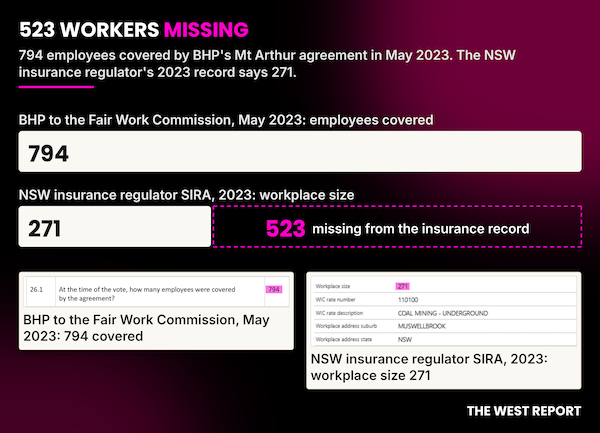
Sources: BHP, Fair Work Commission, data held by SIRA
Simon Turner’s legal claim swings on the fact he was falsely classified as being employed by Ready Workforce (all the relevant documents show he was employed by Chandler Macleod). Turner’s insurance – the little that they did pay him years ago – was picked up by icare (not CMI, which is the coal industry insurer).
“The central point is that Ready Workforce claimed in court to have paid my workers’ compensation, while my original PAYG summary identifies the NSW Government’s Workers Compensation Nominal Insurer [icare] as the entity whose ABN was used to report payments to me,” says Turner.
“Ready Workforce then obtained a $270,913.79 recovery judgment against BHP’s Mt Arthur Coal entity, despite my original employment records identifying Chandler Macleod (as the correct employer).”
MWM has identified a number of other former coal miners whose claims were also picked up by icare, even in one instance the Mining and Energy Union’s National Assistance Fund.
The key – who owns what
The money trail and the industry structure bear out the coal giants’ insurance scam.
icare (Insurance and Care NSW) is the NSW Government agency that acts as the scheme operator and administrator for the Workers Compensation Nominal Insurer, which is the legal entity and single largest workers compensation insurer in New South Wales
The Workers Compensation Nominal Insurer is a public statutory legal entity owned by the NSW Government rather than a private company.
Coal Mines Insurance (CMI), however, is owned jointly by the Mining and Energy Union (MEU) and the lobby group NSW Minerals Council, which is the lobby group for BHP and the other coal mining companies. It was established as a company under NSW statute.
Why is ownership important? Because the operators of an insurance company have a fiduciary duty to achieve the best outcomes for shareholders; therefore, the lower their claims, the lower their costs
and the higher their profits.
“I know of at least six [workers] at Mr Arthur alone during that period of two years [2015 and 2016] who got injured,” said one former coal miner. “When I was injured, people started contacting me. Then there was all the people who went into work and didn’t do anything. They were injured but didn’t do anything.”
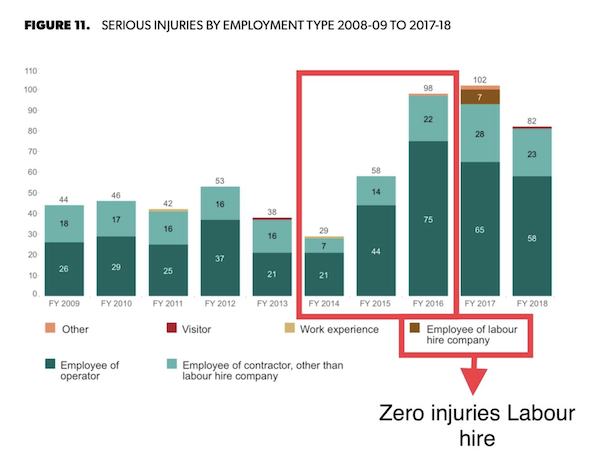
Source: resourcesandgeoscience.nsw.gov.au
Turner broke his back in 2015 driving a coal truck and subsequently discovered he had been classified as a white-collar worker. He points to the issue of ‘under-reporting’ of injuries as well as misclassification of workers: CMI shows zero injuries in 2015-16
“There were 270 Chandler Macleod employees registered (BHP’s labour hire outsource firm) but all up at the mine there was about 2,000 workers,” says Turner. “All insurance costs would have been lower. When they declare employees, they have to declare the payroll.
They were deliberately keeping their claims away from CMI.”
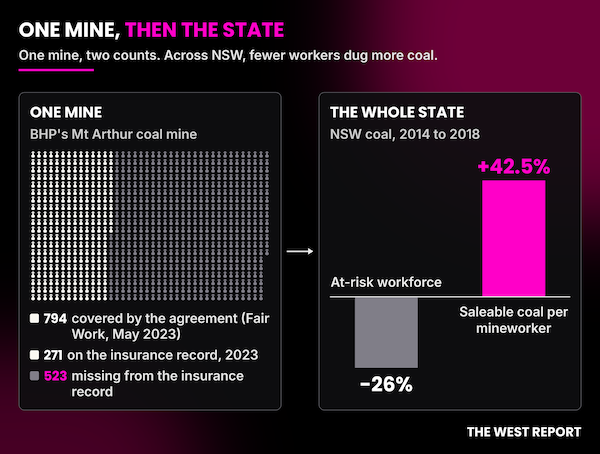
Source: Fair Work Commission, data held by SIRA
Meanwhile, as another former Mt Arthur coal miner points out, although coal mining volumes were up strongly during the period 2014-2018, the reported ‘at-risk’ workforce of coal miners was down 26%.
The legal loopholes
If the ownership of CMI presents a conflict of interest (NSW Minerals Council and MEU 50/50) in that CMI would have a duty to keep premiums low for employers and payouts low for workers, there is a major regulatory flaw in the system.
Correspondence from SIRA to an injured worker shows the regulator does not have compulsory powers, rather a ‘monitoring’ role in respect of CMI. In other words, it is not really a regulator by a bystander.
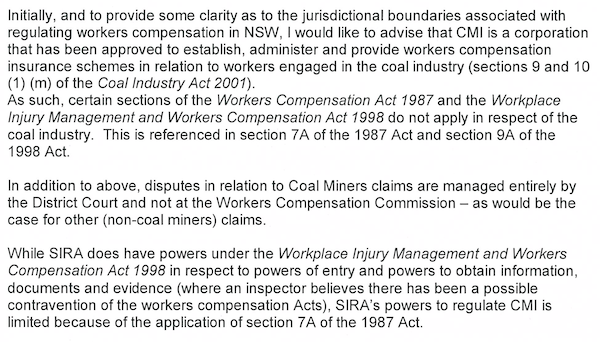
Letter from SIRA obtained by MWM
Why no action?
If the industry regulator is effectively helpless to police the claims being made by coal workers and their payments by CMI why has political action not succeeded in rectifying what is a clear injustice for workers and a grift by large coal companies?
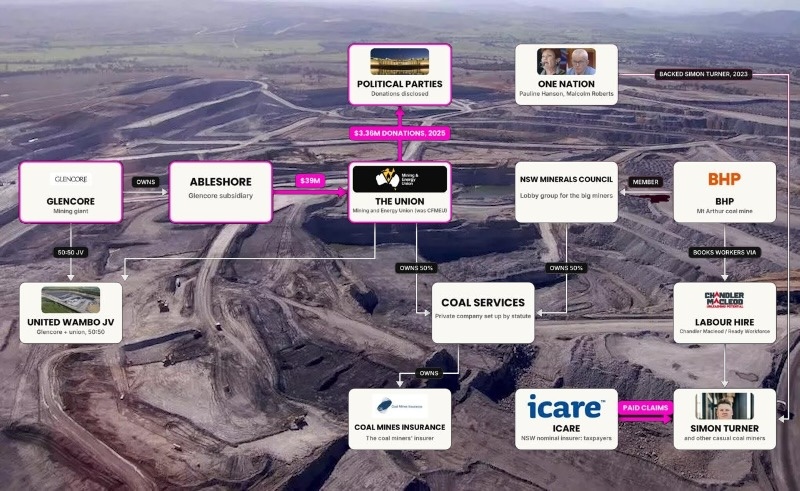
The answer lies, again, in the money trail. The following chart shows the relationships. The MEU is big business; and it is in business with the coal miners, as joint owners of a coal mine with Glencore and in the insurance business with the lobby via CMI.
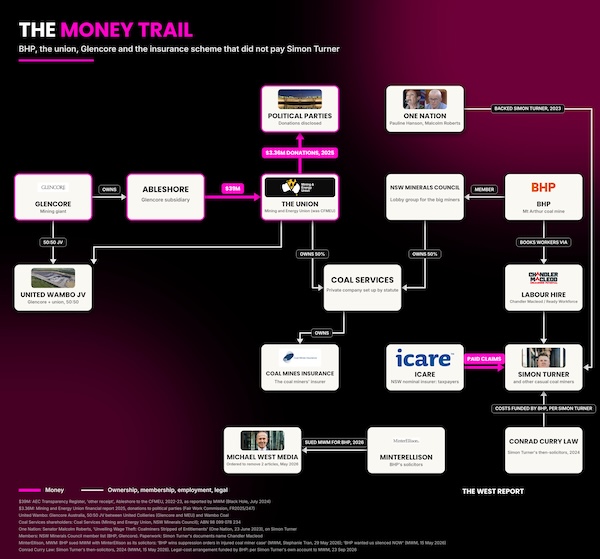
The money trail. Credit: Josh Barnett
Formerly the CFMEU, the MEU has demerged from the troubled construction division and racked up $21m in revenue last year, recorded $164m in assets and is luxuriating in 18m of cash on balance sheet and $45m in term deposits.
It funnelled $3.4m last year to Labor in political donations and had previously disclosed a $39m payment from a Glencore subsidiary, Abelshore. The coal mining companies pay donations to both major parties. There are also serious anomalies in the operation of the state’s long service leave scheme, Coal LSL, which has failed to make super payments to casual coal miners but is sitting on a large stack of investments.
Tip of the iceberg
Former workers contacted by MWM who had found anomalies in their entitlements opted not to speak publicly but agreed the Simon Turner case was ‘tip of the iceberg’. Said one, the pattern is that miners were classified as “not an “employer in the coal industry and therefore not obliged to be indemnified by CMI”.
“From that point in 2014 to July 2018 a significant cohort of injured labour hire employees of Chandler Macleod at Mt Arthur were treated as ‘Office’ employees for the purpose of handling their workers’ compensation, treatments and payments, and were also denied accident pay, as set out in the Black Coal Mining Industry Award 2010”.
Many of the events and people described in this story are historical. Yet the scale of the ‘mismanagement’, which is to describe it euphemistically, is such that it not only invites official investigation on its merits but also that it points to a continuing cover-up and a systemic failure whose ramifications yet affect the sector today.
In the least, there should be a NSW government inquiry
into the structure of an industry which has failed to comply with its legal requirements on a broad scale, but also the loopholes in regulation, persisting to this day, which have allowed this to happen.
Then there is the greater threat that power and money have co-opted the legal system in shutting off justice to workers who have been injured and robbed of wages. The Turner matter is headed back to Court next month and, if historical performance is any guide, BHP and its lawyers will ask the court to suffocate the matter again and bury the evidence.
They have put the pressure for their bad behaviour on the judges.
High Court: look at the work, not the paperwork. Is BHP looking?

Michael West established Michael West Media in 2016 to focus on journalism of high public interest, particularly the rising power of corporations over democracy. West was formerly a journalist and editor with Fairfax newspapers, a columnist for News Corp and even, once, a stockbroker.