
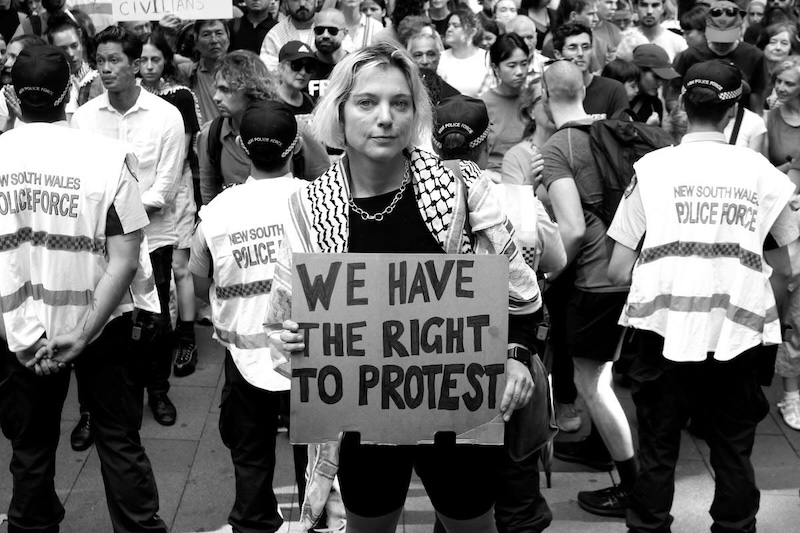
Town Hall was not an isolated event, rather the end point of a longer process to redefine dissent as risk, writes Andrew Brown.
Power does not begin with force. It begins with permission. By the time the baton is raised, the public has already been prepared to accept it.
What occurred in Sydney was not an isolated incident. It was the outcome of a pattern that has developed over time, across government, policing, and much of the media.
Not through a single decision. Not through a single headline. Through accumulation.
Through language, framing, and repetition, through what is emphasised, and what is not.
Over time, a narrative is constructed.
That certain protests are volatile. That certain voices carry risk. That some forms of dissent require control. Once that narrative takes hold, the threshold for force shifts. It begins with claims.
The Opera House claim
October 8, 2023. The protest at the Sydney Opera House. A chant is reported. “Gas the Jews.” It leads coverage. It defines the moment.
Days later, police indicated that the chant was not clearly confirmed in available footage, with alternative interpretations suggested (NSW Police statements reported by ABC News and The Guardian, October 2023). That clarification did not lead. It did not travel as far.
The first impression holds.
This is how narratives are formed. Not by what is ultimately established, but by what is first repeated.
The Sydney Harbour Bridge claim
Claims emerge in moments of shock. They are reported quickly and amplified widely. Later, details are revised or remain contested. But the revision rarely carries the same weight as the initial framing.
Over time, association becomes embedded.
Large-scale demonstrations, including the Harbour Bridge march, have been framed in some coverage through the lens of antisemitism or extremism.
Peaceful protest is recast as potential threat.
Separate acts of violence are then discussed in proximity to protest movements. An incident here, a rally there. Placed alongside each other often enough, they begin to feel connected.
Association replaces evidence, and correlation begins to feel like a cause.
Media framing moves to policing
On October 9, 2023, the Sydney Opera House was illuminated in the colours of the Israeli flag (NSW Government directive, widely reported across Australian media). No equivalent gesture followed as Gaza was subjected to sustained bombardment.
Visibility is not neutral. It signals which events are prioritised, and which are not. Framing does not remain within media. It moves into policing.
In parts of Sydney, individuals displaying Palestinian symbols, even on t-shirts, have been treated as potential risks, met with arrest, restraint, and strict bail conditions (NSW Police operational actions reported in SMH, ABC, and court proceedings, 2024 to 2025).
The threshold for intervention shifts.
Expression becomes suspicion, and presence becomes risk.
Suddenly, a public order issue
From that point, protest is no longer treated primarily as dissent. It is treated as a public order issue.
And public order demands control.
Data is used to reinforce this shift. More than one thousand antisemitic incidents have been reported (Executive Council of Australian Jewry annual report, 2024). The figure is presented as evidence of an escalating threat.
But reported incidents are not criminal findings. Police data points to far fewer charges. Fourteen in total (NSW Police data reported via media and parliamentary references).
The larger number travels further.
The number that shapes perception as language escalates.
Graffiti as terrorism
Graffiti in Sydney’s east is described as terrorism, the most serious classification available (NSW Police public statements, 2024).
In the same period, incidents such as machine gun fire into homes across western Sydney are treated as criminal matters (NSW Police incident reports, widely covered in media).
Same city. Different framing. Framing determines fear, and fear determines response. Policy follows.
And the money
Strike forces are expanded. New offences are introduced. New laws are enacted (NSW Parliament legislation relating to protest restrictions and public order, 2024 to 2025).
An additional $32.5m dollars in funding is allocated (NSW Government budget announcements linked to antisemitism response measures).
Urgency is emphasised.
Responses to Islamophobia emerge later, with less prominence and less immediacy (NSW Government response timelines and funding allocations).
What is treated as urgent and what is not becomes part of the pattern.
The shift extends into law.
Expanded police powers. Broader discretion. Lower thresholds for intervention. Measures introduced as temporary responses begin to take on a more permanent character.
As NSW Labor MLC and barrister Stephen Lawrence warned in parliament, the implications extend beyond enforcement (NSW Legislative Council Hansard, 2025).
“In that scenario, we could potentially be in 1978 Mardi Gras territory… violence may occur, protests may be ended that are non threatening and fundamentally inconsistent with free speech and the right to free association and assembly.”
This was not an external critique. It was a warning from within: “It is us, not the police, who will decide by passing this bill… to remove the pressure valve of protest, to create a pressure cooker.”
When protest is constrained, pressure does not disappear. It builds: “A dystopian vision, if I’ve ever heard one… This could go so wrong.”
Regulating speech
Language itself becomes a site of control. Phrases are interpreted at their most severe. Meaning is fixed by authority, not by context.
The shift is clear. From regulating conduct to regulating speech. And once the state defines meaning, it defines the limits of dissent. That framework does not remain abstract. It arrives in the street.
On the night in question, more than 3,500 police officers were deployed across Sydney for an expected crowd of approximately five to six thousand people (NSW Police operational deployment figures reported across media coverage). A significant proportion were drawn from riot units.
The ratio alone raises questions.
This was not a response to unfolding violence. It was a posture adopted in advance.
I was there.
A large crowd gathered. It was peaceful. People listened. Many began to leave. But then movement was restricted.
Exits narrowed. Crowds were contained. Pressure built, and force followed.
Pepper spray was deployed into dense groups. Police lines advanced. Mounted units pushed through the crowd. I saw elderly people and children affected by pepper spray. I saw young people struck while on the ground.
There is video footage of a young girl who, after being initially sprayed, suffered a seizure and was sprayed again while convulsing. I filmed a couple in their seventies whose faces and eyes were burning from pepper spray. I helped wash their eyes as they tried to leave.
Video footage shows a young man struck repeatedly during an arrest, more than eighteen times, while restrained.
Muslim men, led by Sheikh Wasem Chakari, had sought (and been granted) permission to pray in a designated area away from the main thoroughfare. While in prayer, they were approached by police, physically removed, and thrown aside.
My 83-year-old mother had left the rally early. As she attempted to reach the ferry, she was pushed into a moving crowd. She fell. Her wrist was fractured, and she sustained a prolapsed disc in her back.
These are not abstractions; they are physical consequences.
Herzog across town
At the same time, inside the International Convention Centre, Israel’s President, Isaac Herzog, was addressing a formal event under extensive police protection.
Two gatherings, in close proximity.
One secured and protected by NSW Police, the other contained and brutalised by NSW Police.
That contrast is visible and raises a simple question.
Whose safety is prioritised, and whose dissent is controlled?
Authority depends on consistency. On the belief that the same standards apply. When that belief fractures, so does trust. And when trust erodes, authority weakens.
Not suddenly. Gradually.
Normalised
Through repetition. Through framing. Through choice.
For a government that speaks of social cohesion, these choices risk producing the opposite.
Because power does not present itself as force. It is normalised, one step at a time. Which brings us to the underlying question.
Who benefits?
Because patterns like this are not accidental. They reflect alignment.
When protest is reframed as threat, governments gain room to act. Expanded powers face less resistance. Policing thresholds shift.
When dissent is associated with risk, criticism can be marginalised rather than answered. And when media narratives emphasise fear,
complex issues are reduced to threat and response.
But there is also a more specific set of interests at play. Over the past two years, well-organised advocacy groups aligned with the Israeli state have consistently called for tighter restrictions on protest, broader definitions of unacceptable speech, and stronger enforcement against pro-Palestine demonstrations.
Those calls have not remained at the margins. They have been amplified, reported, and engaged with at the highest levels of politics and media. In several cases, they have been reflected in policy settings, policing approaches, and public messaging.
Cui bono?
This is not a claim of central coordination. Power does not operate through a single actor. It operates through convergence.
Government interest in control, media interest in narrative, with advocacy pressure applied to both. Each reinforces the other.
The result is a narrowing of dissent. Gradual. Justified. Normalised. Until it appears reasonable.
And then necessary, which leads to a final question.
If force is applied not in response to violence, but in anticipation of it, then the decision has already been made. Not in the street, but in the framing that came before it.
So what, exactly, is being protected? And whose interests are shaping that protection? Because once the boundaries of dissent are set this way, they do not remain fixed. They expand.
And history suggests they rarely expand in favour of those without power.
Prosecution or persecution? Charges dropped against Bondi ‘F*** Israel tee-shirt man
Andrew Brown is a Sydney businessman in the health products sector, former Deputy Mayor of Mosman and Palestine peace activist