

Over the last 12 months, the Indonesian Rupiah has dropped by 15% against our dollar, making Bali cheaper, but fewer tourists are arriving. Duncan Graham reports.
The Indonesian economy is in trouble; a falling rupiah the symptom of increased debt, less investment and a drop in foreign income from tourists kept away by the Iran war; with a fair bit of nepotism thrown in, muddying the waters of governance.
A smidgeon over a year ago, it was easy for innumerate travellers to cope with Indonesia’s cumbersome six-digit small change. The Aussie dollar swapped for about 10,000 rupiah, so local prices could be understood by knocking off the last three zeros and pushing a decimal point.
A Rp 25,000 coffee at a Bali warung roadside stall would damage the wallet by $2.50, no handphone calculator needed. But with the rupiah tumbling faster than a re-entering spacecraft and getting just as hot at 12,300, and that cuppa is $2.03. That’s serious devaluation, recalling the monetary crisis of 1998 that felled the 32-year autocracy of the second President Soeharto and started the Revolution.
As former PM Paul Keating recalled:
“Developments in Indonesia affect Australia indirectly as well, because what happens there will determine—not simply shape or mould but determine—how quickly and peacefully the rest of Southeast Asia can develop.”
Indonesia has the largest economy in the region and ranks seventh in the world by GDP. Its annual growth rate usually tops five per cent. Financially, it negotiated Covid well, though not the present strife, which is multi-factorial.
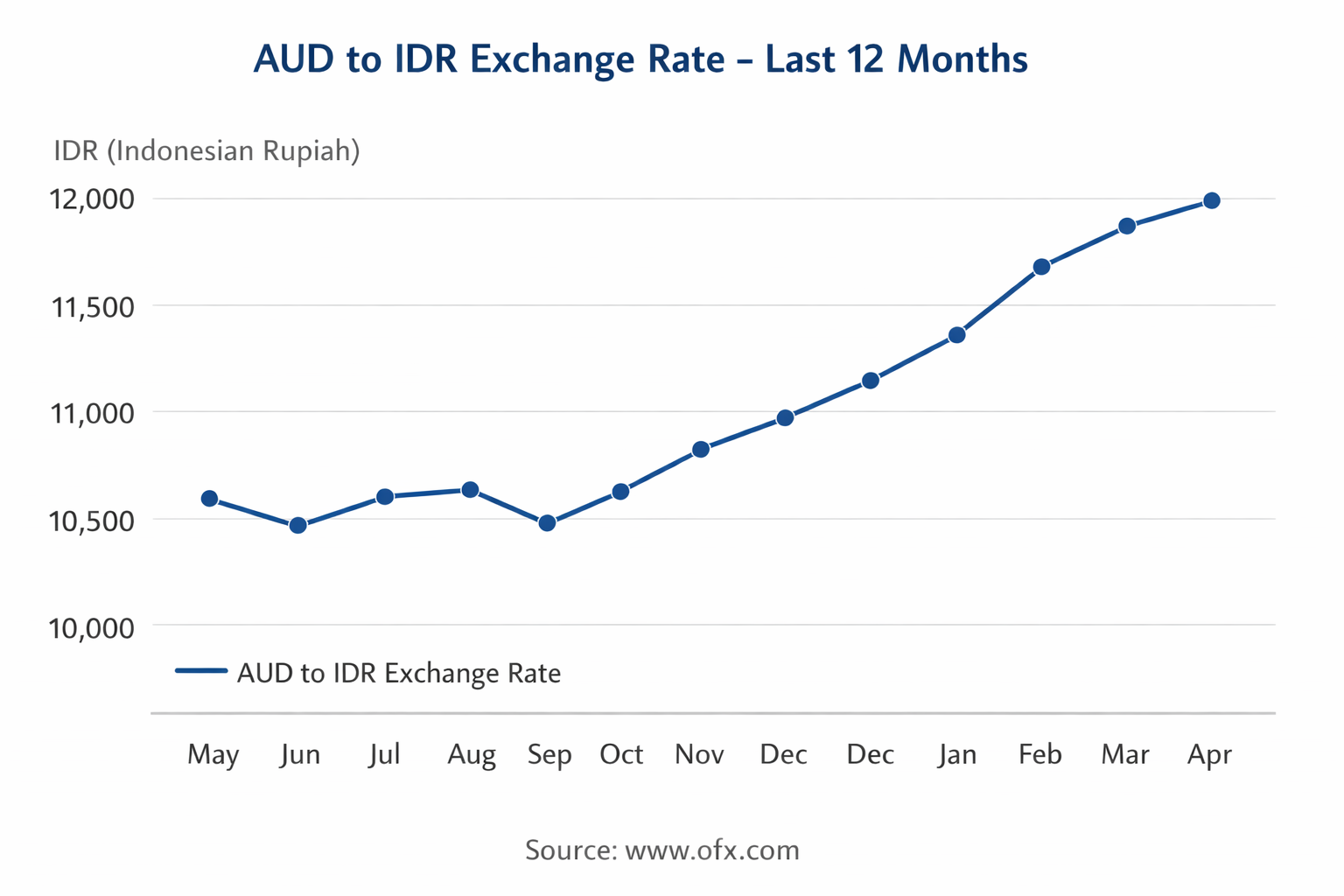
The current rupiah plunge is lousy for the locals, but great for the tourists – if they can be found.
Where are the crowds?
Once the Iran War started, the big long-haul jets that bring European holidaymakers to Bali didn’t connect their aerobridges – 64 flights were cancelled in the first week of the conflict.
More than 8,000 had to postpone their travel. Most had been booked on routes with layovers in Doha, Abu Dhabi, and Dubai before heading to the US and Europe.
European tourist arrivals are now down by about 800 passengers a day to an island where the economy relies on outside tourism.
What’s gone sour? The Forbes business barometer ranks the rupiah as fifth among the world’s ten weakest currencies. Outraged partisan politicians and local economists have rushed out with excuses and claims of public service debt, but the reasons are complex.
The IPB Uni in Bogor, West Java, is considered one of Indonesia’s top campuses. Germany-trained economist Dr Deniey Adi Purwanto is more lucid than most.
He blames “investor concerns with the government’s fiscal policy”, particularly the $US 24.5 billion free school meals project already covered by MWM earlier this month.
“Indonesia’s dependence on imported goods and services is weakening the rupiah. This causes a current account deficit, which increases the demand for foreign currency to finance imports.”
Capital inflows are supposed to cover deficits. Investors are a skittish lot and flee from economies in turmoil. That pushes down exchange rates – a sort of self-fulfilling prophecy.
The US reciprocal tariff policy also impacted:
This move triggered global trade tensions and put pressure on Indonesian exports.
However, these are template reasons, largely universal and hitting many other nations. There must be something extra and special for Indonesia to cop the big hit.
The triple whammy curse
There is – the ancient triple-whammy curse of the Republic, known to every adult as KKN and needing no translation:
Korupsi, Kolusi, Nepotisme.
This is where things get hairy.
The undergraduate line about “a thousand economists laid end to end and never reaching a conclusion” isn’t just a joke, so consumers impacted by fiscal issues need to do thorough research.
The biggest in the business is Morgan Stanley Capital International. The NY-based investment research firm “provides stock indexes, portfolio risk and performance analytics, and governance tools to institutional investors and hedge funds.”
It’s the barometer that big money taps to check the fiscal climate. Do they need brollies or sunnies?
MSCI reacted to news that Indonesia’s external debt had risen to just under $US438 billion by thinking aloud about downgrading the country from emerging market to frontier market status.
The stock market heard the muttering and fell nearly seven per cent – a claimed loss of $US80 billion.
Prabowo’s business tycoon younger brother, Hashim Djojohadikusumo, was reported as telling the ASEAN Climate Forum at the Jakarta Stock exchange that the government “received four letters from MSCI highlighting concerns in Indonesia’s capital markets,” adding:
“The President was extremely angry about what happened, especially because the nation’s honour was at stake and many retail investors suffered losses.
“For Mr Prabowo, the dignity of the republic is paramount. That’s why he will monitor the capital market very closely.”
That assurance didn’t cheer anyone, even after the exchange CEO “stepped down” (or was escorted down the elevator), along with two senior officials at the Financial Services Authority. The cops were called.
The police said they’d “frozen bank and securities accounts belonging to several stock brokerage firms worth approximately $US40 million, as part of an investigation into alleged insider trading and market manipulation.”
Another factor impacting Bali real-estate investment in particular is increased (and long overdue) enforcement of often confusing building regulations. It’s meant a significant slowing down of new projects, with one source telling MWM transaction volume is down 40% from a year ago.
Prabowo Inc
The President’s brother, Hashim, is not in the Cabinet but is accepted as a spokesman for his big Bro. He’s also known as “the principal financial backer of both Prabowo’s political ambitions and business ventures.”
Family ties don’t stop with siblings. Last year, Prabowo appointed his nephew, Thomas Djiwandono, as Deputy Minister of Finance, and this year, he nominated him as Deputy Governor of the Bank of Indonesia.
The market men put their hands in pockets, jangled their keys, and stared at the ceiling, wondering “what the move may signal about the exercise of political influence over monetary policy.”
Thomas’ elected younger brother, Budisastro Djiwandono, was given oversight of foreign affairs, accompanying Prabowo on overseas trips. Two other nephews, a niece, and an ex-wife are also in positions of power.
Commented the Asia Sentinel business magazine: “The pace and scale of this expansion … have prompted warnings from civil society groups that Indonesia may be entering a period in which political power and commercial influence
are becoming dangerously intertwined within the president’s own family.
The Suharto playbook
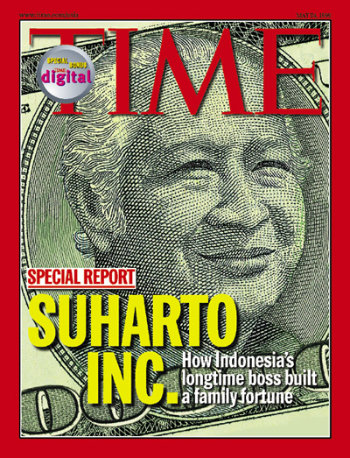 This was the model of governance used by Prabowo’s former father-in-law, the second President Soeharto. In 1999, Time magazine reported a four-month investigation that covered 11 countries, concluding:
“Nine billion dollars of Soeharto money was transferred from Switzerland to a nominee bank account in Vienna. Not bad for a man whose presidential salary was $1,764 a month when he left office.”
Now he’s been made a national hero by his former son-in-law.
Together, these issues are extra factors in the rupiah’s fall by failing to create a cushioning aura of trust and making foreign investors feel comfy.
Police investigations into the stock exchange scandal are apparently continuing, with reports of 70 people being interviewed. Prabowo getting angry about his nation’s honour and reputation hasn’t helped police with their inquiries.
Before he took office, Prabowo railed against graft and promised reform. Last year, he gave a desk-thumper from the throne:
“On behalf of the Indonesian people, I warn all elements in all institutions: immediately correct yourselves, immediately transform yourselves, because the state will take action.
“We will get rid of those who are not loyal to the country without hesitation, without favouritism, regardless of family ties, political party, or ethnicity … eradicating corruption will be a priority agenda of my administration.”
Although the government’s grip on critics is tightening, it hasn’t got to academic throats. Yet.
Commented Dr Phil Ridho Al-Hamdi from the Muhammadiyah Uni in Yogyakarta:
“Prabowo’s speech was not much different from his predecessor’s.
The fact is, corruption still occurs everywhere, from the central government to the villages.
“A leader’s speech must be supported by concrete actions, not just rhetoric (and accompany) exemplary behaviour from state officials, from the president and vice president to ministers … …. anti-corruption demonstrated through daily behaviour.”
If the world is waiting for change in the way Indonesia does business, it will need more than a packed lunch.
Carney vs Albanese. Redefining Australia’s place in the world. And Indonesia?

Duncan Graham has a Walkley Award, two Human Rights Commission awards and other prizes for his radio, TV and print journalism in Australia. He now lives in Indonesia.