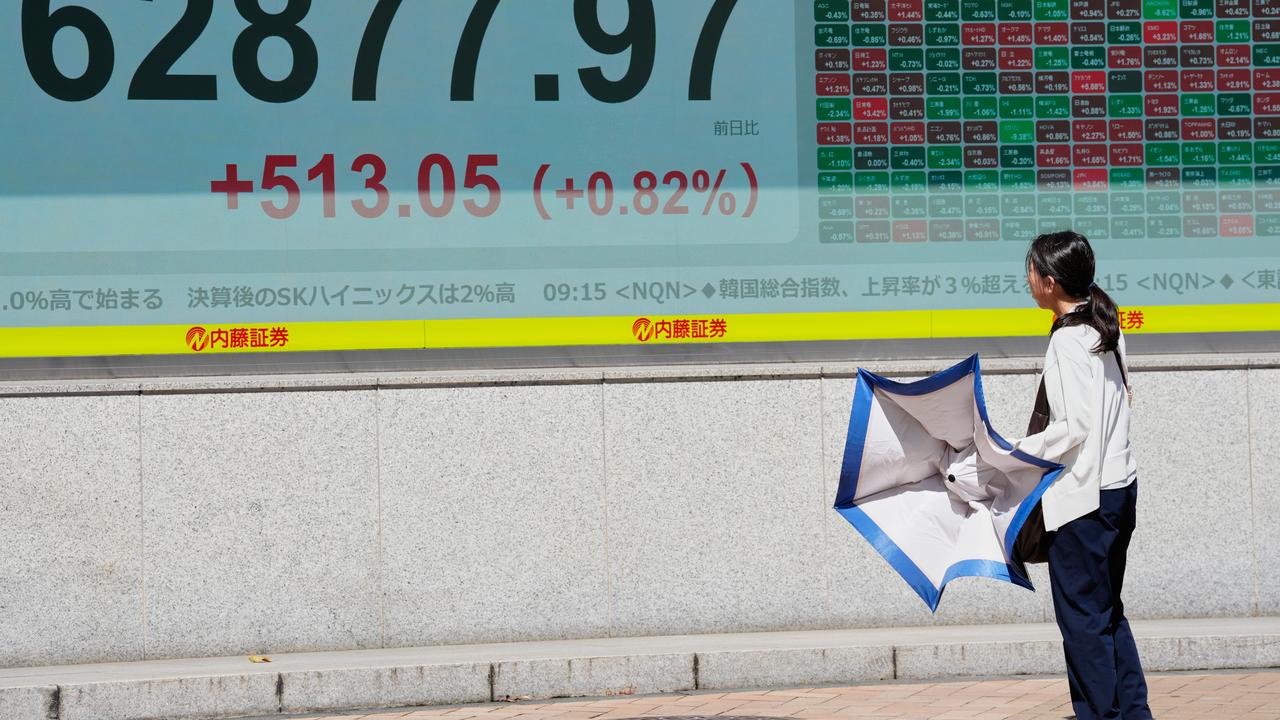
Asian markets rallied hard with Wall Street on Friday as South Korea’s battered market made a record comeback, stirring hopes that the recent selloff in AI-linked assets may be running out of steam.
The yen was also firmly in the spotlight, holding some distance away from a 40-year trough after suspected coordinated intervention from various authorities, which came ahead of the Bank of Japan’s (BOJ) rate decision later in the day.
Long-end US Treasury yields held near 19-year highs while short-end yields eased, steepening the curve as doubts grow over the Federal Reserve’s ability to anchor inflation expectations.
South Korea’s Kospi leapt 14 per cent shortly after the open on Friday, reversing steep losses from earlier in the week.
Japan’s Nikkei similarly advanced 5.0 per cent and MSCI’s broadest index of Asia-Pacific shares outside Japan rose 3.0 per cent.
That followed surges in AI heavyweights Microsoft and Amazon overnight, lifting chip stocks broadly after upbeat earnings and forecasts from the pair eased concerns over hefty capital spending.
“Both the earnings as well as the sentiment are kind of coming back a bit after the really overexaggerated move in the earlier part of the week,” said Fabien Yip, a market analyst at IG.
“The AI demand story didn’t really decelerate, it seems like it’s still sustainable. So the selloff that we saw… is maybe the market overreacting to some of those concerns around (capex spending).”
Despite Friday’s turnaround, the Kospi was still set to lose 24 per cent in July, marking its largest monthly loss since 1997.
The wild swings in the market had prompted South Korean authorities to rein in the leveraged products that have wreaked havoc and wiped out the savings of some retail investors.
“(The market sentiment) is fragile around the AI debate,” said Ji Young Park, senior EM equity portfolio manager at Amundi.
“The market performance has been narrow in Asia ex-Japan, mostly related to AI… given the sharp correction we’ve had across the markets that have AI exposure, we believe we are close to the end of this prolonged volatility.”
Nasdaq futures were up 0.87 per cent and S&P 500 futures added 0.29 per cent. In Europe, EUROSTOXX 50 futures advanced 0.57 per cent, while FTSE futures and DAX futures rose 0.4 per cent each.
The yen was 0.6 per cent weaker at 160.51 per dollar, reversing some of Thursday’s 2.4 per cent surge after Japan intervened in the foreign exchange market to haul the currency away from 40-year lows.
In a rare move, South Korea’s foreign exchange authorities also conducted dollar-selling intervention on Thursday, while the Nikkei reported that US authorities also conducted so-called “rate checks”, pointing to a possible coordinated intervention.
“The brutality of the move – USD/JPY falling from near-164 to sub-160 in a sharp jolt – is as poignant as the timing, just ahead of today’s BOJ meeting,” Vishnu Varathan, head of APAC macro strategy at Mizuho, said of Thursday’s sharp rise in the yen.
“The timing is no coincidence. Clearly the authorities are pre-emptively warning or insuring against JPY selloff on an expected BOJ hold.”
A trader, who declined to be named because they were not authorised to speak to the media, said dollar/yen liquidity was thin on Friday due to nerves over further action from authorities.
The strength in the yen in turn kept pressure on the dollar, leaving the euro perched near an over one-month high at $US1.1518 ($A1.6383), while sterling bought $US1.3456 ($A1.9140), holding to most of Thursday’s 0.7 per cent gain.
Oil prices edged slightly higher as tensions in the Middle East persisted.
Brent crude futures were up 0.4 per cent at $US89.38 ($A127.13) per barrel, while US crude rose 0.3 per cent to $US83.84 ($A119.25) a barrel.
A drone strike on gas vessels in Egypt’s Mediterranean port of Damietta signalled a potential new front in the US-Iran war, raising the prospect of threats to navigation through the Suez Canal, one of the last remaining export routes for Saudi oil.
“The striking feature of the market reaction is that energy prices did not panic despite the deterioration in the conflict,” said Rodrigo Catril, senior FX strategist at National Australia Bank.
Elsewhere, spot gold was down 0.2 per cent at $US4,094.28 ($A5,823.64) an ounce.

Australian Associated Press is the beating heart of Australian news. AAP is Australia’s only independent national newswire and has been delivering accurate, reliable and fast news content to the media industry, government and corporate sector for 85 years. We keep Australia informed.