
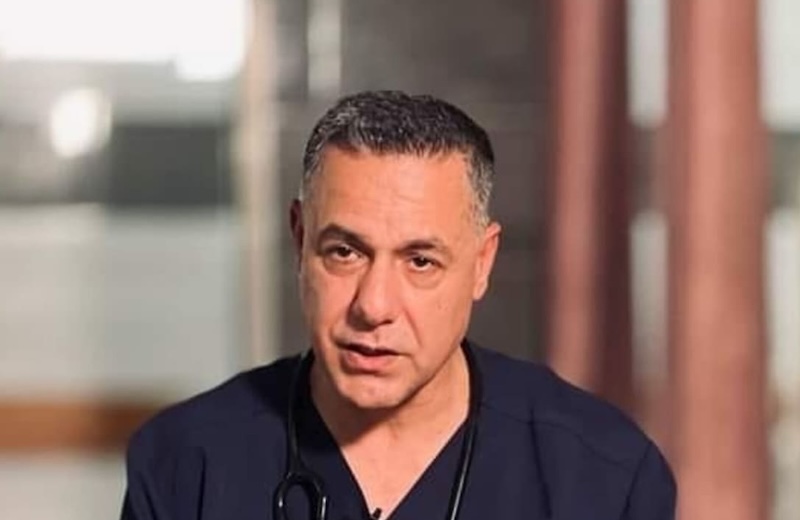

In Australia we investigate doctors who talk about Gaza. In Israel they beat one with an iron hammer. Dr Hussam Abu Safiya believes he is about to die in an underground cell. By Andrew Brown.
There is a doctor in an underground Israeli prison who believes he is about to die.
His name is Dr Hussam Abu Safiya. He is 53. He is a paediatrician. He ran Kamal Adwan Hospital in northern Gaza and held it together through a siege that lasted 85 days, filming himself pleading for help while the health system collapsed around him. He stayed with his patients.
Then Israel took him. That was 27 December 2024.
More than 555 days later he has not been charged with anything. No trial. No tested evidence. He is held under Israel’s law on unlawful combatants, a device that permits indefinite detention on secret material.
Tortured
On 10 June he appeared before Israel’s Supreme Court by video link, handcuffed, pale, with marks resembling lash wounds on both arms. The court rejected his appeal anyway.
According to his lawyer, Nasser Odeh, guards then stormed his cell at Ganot Prison and attacked him with an iron hammer and batons. On 24 June he was moved to Rakefet, an underground section of Nitzan Prison. Odeh says he has been beaten daily since.
Odeh visited him on 2 July. Guards brought Abu Safiya in with his hands and feet bound, ringed by masked officers. The lawyer barely recognised him. Injuries to his head, his eyes, his ears, his neck. He could not breathe properly. He could not stay upright.
Then he said the words no civilised country should be able to ignore.
“They brought me here to kill me. I don’t see myself surviving. This is the end.”
The Israel Prison Service calls the allegations false and entirely without factual basis.
Held without charge
Even Israel’s own Supreme Court is not content with that answer. After Physicians for Human Rights Israel warned that his life is in immediate danger, the court ordered the state to respond by Tuesday to a petition it had stalled since April. The petition seeks the release of 14 Palestinian doctors from Gaza, all held without charge.
Fourteen.
Sit with the arithmetic. One doctor. Eighteen months. Zero charges. One hammer.
Now come home.
This month Michael West Media published my investigation into AHPRA’s adoption of the International Holocaust Remembrance Alliance definition of antisemitism. AHPRA regulates nearly one million Australian health practitioners.
Doctors. Nurses. Psychologists. Paramedics. Pharmacists. The people we trust to tell the truth about suffering.
Chilling effect. A million health workers at risk if they criticise Israel
More than 1,400 practitioners and over 60 organisations objected, warning the IHRA framework would chill health workers who criticise Israel or describe what is happening in Gaza.
Days earlier the British Medical Association, representing more than 200,000 doctors, rejected the definition for exactly that reason. Britain’s doctors saw a muzzle. Australia’s regulator saw policy.
Then came my interview with Dr Muhammad Mustafa. Dr Mo. An Australian doctor back from Gaza. Surgery without adequate anaesthetic. Children with catastrophic wounds. Theatres lit by torches. Members of his own family killed.
And what did Australia give him when he spoke about it? Complaints and professional scrutiny. A quiet warning that there may be consequences for saying too much.
Dr Mo. Gaza doctor in Australia on consequences of AHPRA decision
So let us be precise about the comparison, since precision is supposedly what the IHRA definition protects.
In Gaza, Israel deals with a doctor’s testimony by removing the doctor. In Australia, we deal with a doctor’s testimony by processing the doctor.
One system breaks the body. The other files the complaint.
The paperwork differs. The purpose does not.
Silence.
For two years we have been lectured that words are the danger. That a doctor’s social media post threatens community safety. That Australian medicine urgently required a politically contested definition to police what its practitioners may say about a foreign state.
Fine. Take these people at their word. Then where are they?
The real threat
A paediatrician reports being assaulted with a hammer after eighteen months in detention without charge. Where is the joint statement? Where is the emergency press conference? The politicians who can produce outrage within the hour when a slogan is chanted at a rally have managed nothing for a doctor who says he is being beaten to death.
Apparently the great threat to medicine is an Australian registrar with opinions about international law. Not the guards. Not the hammer.
Perhaps the organisations that campaigned for AHPRA will now campaign for independent medical access to Dr Abu Safiya. Their machinery is formidable. This would take one afternoon.
I am not holding my breath.
Because silence is not always the absence of politics. Sometimes silence is the politics.
Australia should demand immediate independent medical access to Dr Abu Safiya and to every Palestinian health worker held without charge. AHPRA should explain why, at this exact point in history, Australian medicine needed a framework capable of making practitioners think twice before describing what Israel does. And every group that campaigned for that decision should face one question.
You told us this was about protecting doctors. Prove it.
Dr Hussam Abu Safiya is still alive. He has never been charged. We know his name. We know where he is being held.
History will remember who spoke.
It will remember the silence longer.
“Intolerable pressure”. Inside the Israel lobby campaign to coerce regulators on antisemitism
Andrew Brown is a Sydney businessman in the health products sector, former Deputy Mayor of Mosman and Palestine peace activist