
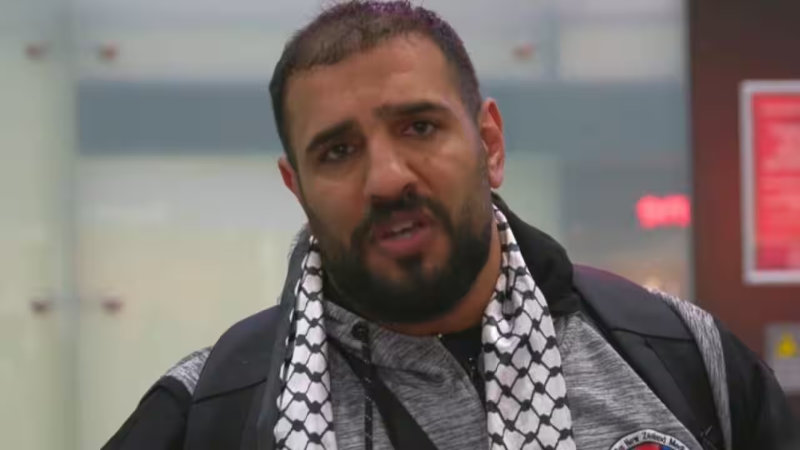

Dr Mohammed Mustafa has lost dozens of relatives in Gaza, killed, tortured, raped, their homes destroyed. Andrew Brown spoke to him.
Aka. Dr Mo, Mohammad Mustafa, has spent much of the past two years telling Australians about it, and it has cost him. His specialist training has been frozen. He has been hit with professional complaints, private complaints, harassment and threats.
Now, the body that decides whether he keeps practising medicine has adopted a definition that he believes makes telling the stories of his experiences even more dangerous.
Last week, the Australian Health Practitioner Regulation Agency (AHPRA) adopted the IHRA definition of antisemitism as a reference tool, announced jointly with the Prime Minister’s Special Envoy, Jillian Segal.
Chilling effect. A million health workers at risk if they criticise Israel
Mustafa, known to many as the Beast from the Middle East, is one of Australia’s most prominent medical voices on Gaza. We asked him what the decision means for doctors.
The cost is already real
He does not frame this as his burden alone. “Those consequences are real, and they are something many healthcare workers now quietly weigh before speaking publicly,” he told us. The fear runs deepest for people like him, who have buried family and watched a state he is now being warned about destroy the homes he knew.
“If someone in my position can wonder whether expressing grief, anger or criticism of the state responsible could expose them to regulatory consequences, then others will inevitably self-censor.”
The United Nations and its independent experts have described what is happening in Gaza as genocide. Against that, Mustafa says, the silence asked of doctors is obscene. “We are not speaking about abstract politics. We are speaking about mass civilian suffering, attacks on hospitals, on healthcare workers, on patients.”
A solution looking for a problem
The numbers do not support the case. Between October 2023 and February 2024, AHPRA received 63 complaints about social media posts on the conflict. More than 70% were closed. Two practitioners faced potential action.
So what is the definition for? “If AHPRA’s own data shows the overwhelming majority of complaints were dismissed, it suggests the existing framework was already working,” Mustafa said.
It’s difficult to argue there was a regulatory gap that needed filling.
His worry is that the definition trades clarity for fear. “Doctors will begin asking themselves not, am I speaking truthfully, but, could this be read in a way that leads to a complaint? That changes behaviour, even when no disciplinary action follows.”
The doctors most exposed are Palestinian, Jewish, Israeli and Arab practitioners speaking about wars that have torn through their own families. “We should be encouraging honest, evidence-based discussion, not building an environment where people censor themselves.”
The process is the punishment
Ask Mustafa what happens to a doctor who posts that hospitals in Gaza are being bombed, and he does not reach for the worst-case finding. He reaches for the machinery. “The punishment doesn’t have to be a finding against you. The process itself becomes the punishment.”
A doctor may be vindicated in the end. Before that comes the complaint, the investigation, the legal bills, the reputational damage, the career frozen for months or years. “I know that because I’ve lived it. Whether the complaint succeeds becomes almost secondary. The message to every other doctor is clear,
look what happens if you speak.
That is how a chilling effect works, he says. It does not need mass discipline. It needs fear. And the doctors going quiet are not retreating from politics. They are retreating from medicine. “Hospitals destroyed. Healthcare workers killed. Children operated on without anaesthesia. Those are medical facts doctors have a duty to name.”
Out of step with doctors elsewhere
The timing is hard to ignore. Days before AHPRA moved, the British Medical Association, representing more than 200,000 doctors, voted to reject the IHRA definition and demanded the NHS revoke it, warning of a chilling effect on its own members.
Australia’s regulator walked the other way, adopting the framework in the same breath as it claimed to be reviewing the weaponisation of complaints.
A political document vs a medical register
What troubles Mustafa most is not Segal, or any individual. It is the principle. A policy reaching almost a million practitioners was announced alongside a political appointee with no medical office and without any consultation with the profession.
“Confidence in a regulator depends not just on its independence, but on the public believing it is independent.” Doctors were never asked whether this would change what they feel able to say. “Yet we are expected to practise under it.”
Questions for AHPRA
We asked what he would ask the regulator’s leadership.
“What problem were you trying to solve?”
“Who did you consult? Did you sit down with Palestinian doctors? With Jewish doctors? With the emergency physicians who have actually worked in Gaza?”
What would settle him is not reassurance but a guarantee, in writing, that no doctor speaking truthfully and in good faith will be punished for criticising a state. Without it, he says, the regulator has already changed medicine.
“If the result is that doctors start asking, is it safer not to speak,
then we’ve lost sight of what professional regulation is supposed to protect.
Dr Mo will be one of the speakers at the MWM 10th Anniversary dinner in Sydney on July 18th.
Medicide. Australian healthcare’s tight links with Israel, despite Gaza

Andrew Brown is a Sydney businessman in the health products sector, former Deputy Mayor of Mosman and Palestine peace activist