
The Coalition has reignited the debate about punitive smoker’s taxes, their consequences, and how to stop the tobacco wars. James Martin and Edward Jegasothy look at what the data says.
Something has gone awry with the politics of tobacco control in Australia. Conservative and right-wing politicians have embraced harm reduction. Meanwhile, Federal Labor, the Greens and much of the public health establishment are defending a punitive sin tax and prohibition-style restrictions on less harmful products.
They are even using the same tough-on-crime rhetoric and policies favoured by the most enthusiastic drug warriors: dealers targeting and addicting kids, alarmist and ill-informed ‘gateway’ theories, and ever more resources and powers for enforcement agencies.
When it comes to tobacco control, one aspect at least appears familiar with the Right siding with Big (legal) Tobacco and the Left standing up for health.
But it’s a little more complicated than that. The important question to ask is how progressives came to be so attached to draconian policies in the name of health?
The central policy is an excise of $1.55 on every cigarette, before GST. It is regressive by any definition, and especially so because smoking is concentrated amongst those on low incomes and those with addiction issues. So, in addition to those on lower incomes paying a greater share of their income on this tax than those with higher incomes,
a greater share of the tax revenue is also collected from those on low incomes.
The data tells a different story
The tax is intended to deter smoking by making it more expensive. Yet the decade of the steepest increases in Australian history produced a slower decline than the years before them: in NSW, daily smoking fell about 3.9 per cent a year between 2007 and 2012, and about 1.9 per cent a year over the twelve years that followed.
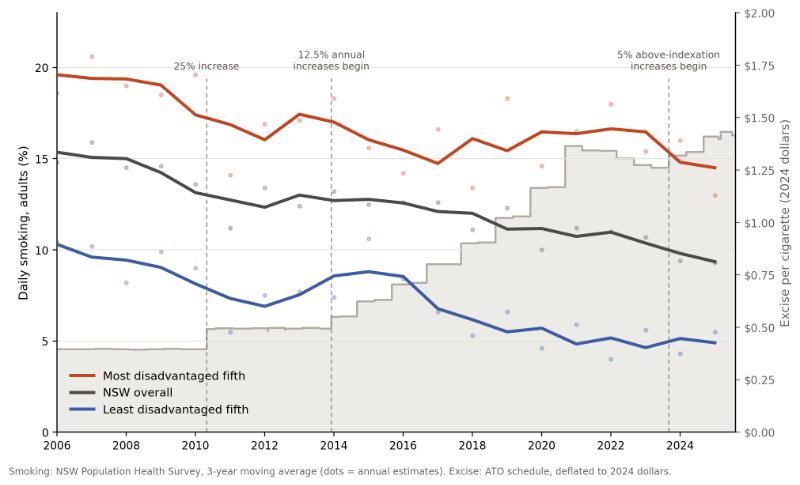
Daily smoking prevalence in NSW, and tobacco excise rates adjusted for inflation.
When the escalation began, its regressive burden was justified on the grounds that those who could least afford it would quit in the greatest numbers.
However, when we put that claim to the test, it falls well short. In NSW, between 2006 and 2025, daily smoking halved in the least disadvantaged fifth of the state. In the most disadvantaged fifth, it fell by about a quarter, and has barely moved since 2012. Even before the illicit market grew, the smoking rate in this group remained at approximately 16% while the excise tripled in real terms.
In other words, the health gains have accrued upwards, while the costs have accrued downwards. There has been no progressive health benefit to offset the regressivity of the tax. Instead, the regressivity has been compounded. The absolute gap between the two groups is 9.7%,
almost exactly where it stood twenty years ago.
Individual responsibility or policy that works
The debate shouldn’t be focused on people paying their own way for their own health burden. These are not the progressive values underpinning our tax or health systems.
Insecure work, financial stress, insecure housing and poor mental health all predict who is more likely to smoke and who is less likely to quit. A price signal to deter smoking is not only ignorant of the material conditions which drive smoking, it also compounds those conditions.
And while the deterrent effect of the tax remains unproven by current evidence in Australia, the demand for cheaper substitutes has continued to grow.
In recent years, this demand has been met by organised crime.
With an estimated 80% of nicotine products now sold illegally, it is criminal operators who decide what nicotine costs and which products reach consumers. They also decide how strong they are, whether they carry health warnings, and whether they are sold to children.
The Health Minister says he won’t surrender health policy to organised crime. In practice, that surrender has already happened.
Tobacco racket. Swedes go smoke-free while Australians light up with criminals
Australia’s world-leading illicit market appeared because policy made it viable and lucrative. Both the growth of the black market for tobacco and the apparent lack of effectiveness of the tobacco tax as a deterrent are evidence that the assumptions underlying these policies were unfounded.
Harm minimisation
In August, a NSW upper house committee found that current excise levels deter people from buying legal tobacco rather than from smoking. Members across the political spectrum, including state Labor and the Greens, all agreed. The committee’s first finding was that harm minimisation should govern the regulation of nicotine.
That is supposed to be the basis of all Australian drug policy: reduce supply, reduce demand, and reduce harm to those who use anyway.
Tobacco control policies have gone beyond abandoning harm minimisation by instead maximising harms amongst those who continue to smoke, and now causing widespread harms to society more broadly. To wit, 305 firebombings, multiple murders, mass extortion of small retailers, hundreds of store closures, and consumer protections that no longer reach most consumers.
These costs fall on states, police, small businesses, and the poorest households.
None of them appears on the ledger of the Commonwealth Treasury, which sets the tax.
Tobacco wars not working
At the Commonwealth level, rather than reflecting on what the data says, we’re seeing a doubling down on enforcement. Raids and seizures, always trumpeted at record highs, must not be mistaken for progress.
Supply reduction is by far the best-funded pillar of our national drug strategy and also has the weakest record. Australia tripled its drug enforcement budget across the 2010s. The result was increased supply and decreased prices for all major drug types. What this, and international criminological research, shows is that when black markets are sufficiently large and well established,
illicit supply flows like water around whatever the state puts in its way.
That anyone would want to repeat this with a market of millions of otherwise law-abiding Australians beggars belief.
Policy costs
Taking harm minimisation seriously involves counting the harms imposed on those who continue to smoke as costs of the policy, not as evidence that the policy is working.
It would also mean giving adults who can’t or won’t quit access to regulated, less harmful products. Currently prohibited nicotine pouches, for example, carry much the same risk profile as the nicotine gums and sprays sold at supermarkets, and adults need that access rather than being told the products are “disgusting”.
It would mean funding cessation support. Crucially, it would mean admitting that secure housing, adequate income support and mental health support are tobacco control measures too.
Denying people less harmful alternatives while taxing them for not quitting
is paternalism dressed up as care,
with more than a whiff of neo-temperance about it. A progressive politics that now defends a levy on the poorest households, while calling for more policing, might ask how it got here.
The answer has less to do with evidence than with the political cost of admitting a mistake. Three hundred and five firebombings and counting, and billions of dollars extracted from Australia’s most marginalised citizens, is a strange price to pay for saving face.
Budget boon for tobacco pirates as police lose battle against cartels

James Martin is an Associate Professor in Criminology at Deakin University. His principal areas of research interest concern illicit markets and cybercrime. He has never accepted any funding from the tobacco or nicotine industries. James has an unpaid advisory role with the nonprofit organisation, Harm Reduction Australia.

Ed Jegasothy is a Senior Lecturer at the University of Sydney’s School of Public Health. His research examines health and welfare policy and the political-economic determinants of health.