


Australia’s smoke reduction policies have failed to reduce smoking while fuelling a black market and huge reduction in tobacco excise revenue. Criminologist James Martin on how Sweden shows the way.
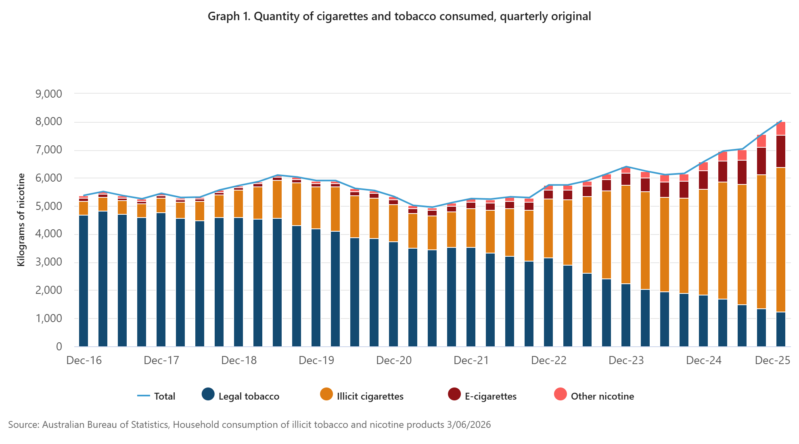
This week, the Australian Bureau of Statistics (ABS) revealed that a staggering 80% of cigarettes sold in Australia were through illegal channels as of December 2025. The wreckage surrounding the black market is sadly familiar: tens of billions in forgone excise, early signs we may be facing the first rise in smoking since the 1990s, and a sustained wave of violence that has produced more than 280 firebombings, alongside homicides, kidnappings and extortion.
In Sweden, a quieter milestone. Daily smoking has fallen to 4.8% of the population, below the 5% threshold at which a country is formally considered “smoke free”. Sweden is now the first Western nation, and one of only a handful anywhere, to get there.
Australia, for all its self-proclaimed world-leading status, is no longer in this company.
The Australian approach
Over the past 15 years, much of Australia’s tobacco control strategy has centred on punishing the legal industry. The premise is encapsulated in the so-called “scream test”, that the best policies are those that industry hates most. This includes plain packaging, graphic health warnings and, above all, tax – now the highest in the world.
But tax does not just fall on tobacco companies – it also falls on people who smoke. An Australian with a pack-a-day habit who wants to buy legal cigarettes now faces an annual bill north of $15,000. And because smoking is concentrated among the disadvantaged (First Nations Australians, the poor, the mentally ill),
it is the least well-off who are hit hardest.
Defenders of high tobacco taxes have a response to this. Disadvantaged smokers, they argue, are more price-sensitive, and so more likely to be forced into quitting than wealthier smokers who can absorb the cost.
However, the evidence runs the other way.
The largest falls in smoking in Australia have been among higher socio-economic groups, while those at the bottom remain smoking at stubbornly high rates, sometimes forgoing food or other essentials to do so. For those who cannot or will not quit, high taxes concentrate harm rather than reducing it, stacking financial ruin on top of the risks of disease and early death.
Of course, forgoing an ever-greater share of one’s disposable cash to the federal coffers is not the only option available to people who smoke, and herein lies the central error: restricting legal supply does not eliminate demand. It redirects it towards even less scrupulous actors than tobacco companies – organised crime.
Most tobacco in Australia is now sold by criminals, at a fraction of the legal price,
creating one of the largest black markets in our nation’s history.
On the government’s own figures, Australians now spend more than $7B a year on illicit nicotine, more than on cannabis, cocaine, heroin and ecstasy combined. Competition amongst gangsters chasing these extraordinary profits is why we’re seeing torched shopfronts and serious violence scattered across suburban Australia, reminiscent of Al Capone and America’s failed experiment with alcohol prohibition a century ago.
Hundreds of millions in additional law enforcement funding have so far failed to reverse this trend, with illicit retailers opening up faster than they can be shut down. Police themselves have told us that we cannot arrest our way out of this problem. Their perspective is backed up by criminological research, which shows that illicit markets of this size and profitability are extraordinarily adaptable and resistant to law enforcement.
Illegal tobacco trade kingpin arrested. Long live king tobacco
The Swedish approach
Sweden chose differently, building its policy around harm reduction rather than coercion. Smokers, the saying goes, come for the nicotine but die from the tar, so Swedish policymakers made their peace with less harmful ways of delivering it: snus, its modern successor, the nicotine pouch, and vapes. Sweden taxes cigarettes, too, but at nothing like our levels. A pack costs less than a third of what it does here, similar to what the black market sells for in Australia.
And still the Swedes quit in droves with demand redirected away from deadly cigarettes towards less harmful alternatives. That should give the tax-and-punish school pause, because it challenges a central assumption of contemporary Australian tobacco control: that prohibitively high prices and other onerous restrictions are necessary to drive people to give up.
Sweden made the less risky options attractive and accessible instead of making the far more dangerous ones ruinous, and it has worked. While Swedish nicotine consumption remains on par with the EU,
Swedes now record the lowest rates of tobacco-related disease and death in Europe.
The vape contradiction
Nowhere is the tension between purity and pragmatism clearer than in the contemporary vaping debate. Australia was an early pioneer of harm reduction and, since the 1980s, it has been enshrined as a central pillar of Australian drug policy. However, in tobacco control circles, “harm reduction” is treated as code for industry capture.
Vapes, like snus and nicotine pouches, are not risk-free, but the evidence that they are far less harmful than cigarettes is very strong.
The government tacitly concedes as much: since 2024, smokers have been legally able to buy a limited range of unpopular vapes from pharmacies, on the logic that they are a legitimate way off cigarettes. Yet the model has failed on its own terms, with fewer than 5% of Australian vapers buying through pharmacies. The rest are sold without consumer protections or age restrictions, with nicotine levels far in excess of those sold in legal markets, and by the same criminal groups who are now firebombing their way across the country.
What sustains our prohibitionist model is an enduring panic about children. No sensible person wants kids taking up nicotine, but the moral panic in Australia has outrun the evidence. The “gateway” theory, that vaping recruits a new generation into smoking, has not survived contact with the data. Around the world,
where vaping is legal, the biggest declines in smoking have been in cohorts taking up vaping in the largest numbers.
The tobacco industry, for its part, came late to less harmful nicotine products and now grasps that its future, at least in the West, lies in selling nicotine without the smoke.
That shift should be welcomed, albeit warily and with a close eye on corporate conduct. The alternative, to reject safer nicotine products simply because the legal industry profits from them, is to abandon nicotine consumers, disproportionately some of our most vulnerable citizens, to early disease and death – an abominable moral calculation.
Nicotine is the 3rd most popular recreational drug in the country, after caffeine and alcohol, and is used regularly by millions of Australians. We cannot simply pass ever more restrictive laws and expect them to go away.
Budget boon for tobacco pirates as police lose battle against cartels

James Martin is an Associate Professor in Criminology at Deakin University. His principal areas of research interest concern illicit markets and cybercrime. He has never accepted any funding from the tobacco or nicotine industries. James has an unpaid advisory role with the nonprofit organisation, Harm Reduction Australia.