

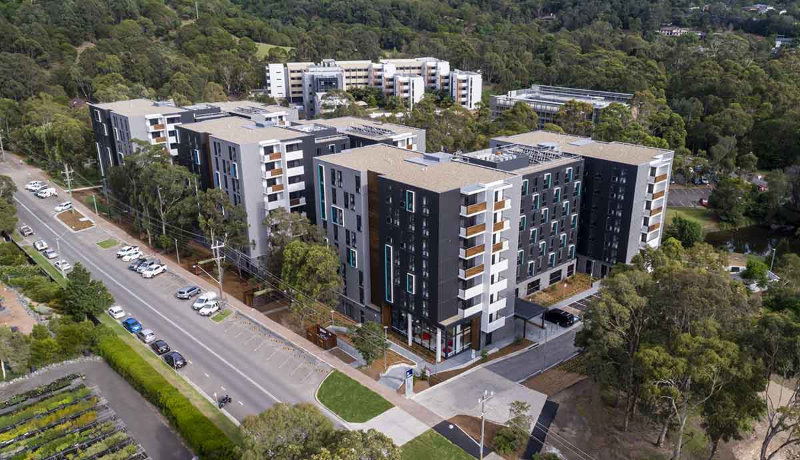

The University of Wollongong paid $500m to terminate a contract to build and manage student accommodation, leaving the university’s coffers short by at least $220m. James Guthrie and Adam Lucas explain.
University of Wollongong was one of the most aggressively enthusiastic early adopters of the neoliberal funding model initiated by the Coalition Government in the 2014-15 budget, when they abolished the Education Investment Fund (EIF).
The EIF was an $11B dedicated capital fund for university infrastructure, and abolishing it pushed toward private capital and Public-Private Partnership (PPP) structures. Not as an innovation, but as a substitute for the public funding the Federal Government had effectively withdrawn for capital works.
Like many other Australian higher education institutions, UOW increasingly turned to real estate development, launching deals for student accommodation, car parks, health hubs, an aged care precinct, innovation hubs, and offshore campuses.
Now, documents obtained by the New South Wales Independent Commission Against Corruption (ICAC) through its investigation of corruption allegations at UOW highlight how UOW’s flagship student housing PPP became at least
a half-billion-dollar financial disaster:
a disaster that was obscured behind a dense “fruit bowl” of accounting and disclosure jargon.
The beginning
In 2014, UOW executed a 39-year public-private partnership for its student accommodation portfolio. The deal granted ‘Living + Learning Partners (L+LP)’, a consortium led by Balfour Beatty plc (UK) with a 50% equity stake, alongside HRL Morrison & Co (NZ) managing PIP Fund’s 50% stake, an exclusive long-term licence to construct, operate, and maintain student housing covering about 800 beds.
This was a finance, build, maintain and operate public-private partnership.
At its inception, the project carried an estimated initial construction cost of $140m. Evidence to the NSW Parliamentary Inquiry described the overall transaction as a $170m deal, with L+LP paying $120m upfront to UOW for the 39-year licence to build and operate the student accommodation.
Under the service agreement, private operators were to be compensated through student rental streams and direct contractual commitments from UOW. Promoted at the time as a UK-inspired, innovative PPP off-balance-sheet mechanism to deliver modern campus infrastructure without expanding university public debt, the arrangement instead locked the university into rigid financial, building, and service obligations for decades.
Critically, the 2014 deed required UOW to pay Contingent Financial Support (CFS) whenever student occupancy fell below base-case projections. The deed effectively guaranteed private investors around 85% of predicted revenues and appears to have offered a 15% annual rate of return.
Collapse and exit
Between 2018 and 2020, UOW paid the consortium about $32m in direct student CFS subsidies, even before COVID. With annual liability estimates exceeding $8m, Balfour Beatty was in severe financial crisis, and problems with the build (a contractor in liquidation), both parties agreed that UOW should exercise early termination on 18 January 2021.
Extinguishing the concession was not a routine operational adjustment. To exit, UOW had to fund senior debt payouts, equity buyouts, interest-rate swap break fees, compensation for foregone future profits, and asset-manager termination charges.
As per ICAC Exhibit 72 (2026), the disbursement cost from UOW to the project partners was approximately:
UOW exit disbursements
| Component | Amount |
|---|---|
| Equity buyout | ~$116m |
| Senior debt payout | ~$215m |
| Interest-rate swap break costs | ~$110m |
| Cancellation and other costs | ~$1m |
| Total exit cost (approx) | $442m |
Adding other termination expenses, the total payments reached at least $500m. To fund the buyout, UOW issued $350m in new long-term debt notes. The student accommodation is on UOW’s balance sheet, valued at $273m.
In short, UOW paid $500m to get out of a deal it said was uneconomical,
borrowing $350m for the privilege of retaining an asset worth $273m.
Cooking the books. Why are universities crying poor despite massive cashflows?
Surge in borrowing costs
UOW Total borrowings surged from $175m in 2017 to over $724m in the early 2020s. Annual interest servicing costs rose to $30m in 2022 and beyond; it still owes more than half a billion dollars. The senior executive teams that had committed the university to a 39-year concession and a half-billion-dollar exit then presented the resulting interest bill as an external constraint.
From 2020, senior executive teams have cited “operational financial distress” to justify several major restructurings, course closures, and the further casualisation of teaching.
Despite the extraordinary scale of the payout, anyone trying to trace the transaction through UOW’s official annual financial statements or press releases encounters what we describe as a
“fruit bowl of words and concepts”.
It took the ICAC hearings to reveal the real magnitude of the malaise. ICAC Exhibit 72 reveals that in UOW’s 2021 Annual Report (Note 34, page 70), the university recorded $273,528,000 under “Current other financial liabilities at amortised cost”.
Combined with a restated service-concession liability of $169,067,000, the accounting obligation totals $442,595,000, consistent with the cash exit figures above. Including other termination expenses, the total cost reached about $500m.
The accompanying notes conceal this stark reality beneath dense definitions. The report invokes complex accounting standards (such as AASB 1059) and technical commentary explaining that:
“The internal rate of return is calculated based on the initial debt, assets constructed and the contractual accommodation payments. The internal rate of return is used to establish the service concession financial liability at the reporting date.”
This language may be technically correct, but it functions as administrative jargon. It makes a straightforward transaction — the university paid out $500m in funds and took on long-term debt to exit a failed 2014 finance, build, and operate PPP — as difficult as possible to understand.
The reporting problems went beyond opacity. In 2021, the NSW Auditor-General issued a high-risk finding against UOW for a $169m prior-period accounting error: the 2020 accounts had improperly omitted termination liabilities.
Restoring accountability
The UOW student accommodation PPP is just one case study in the perils of university neoliberal corporatisation. When public institutions adopt corporate financial structures, they put public assets at risk. Executive leadership can rely on accounting jargon to shield failed material decisions from public scrutiny, but only the private consortium, its advisers, and the executives who signed off win, while students, staff, and taxpayers pick up the bill.
Exposing the $500m termination payout buried in Note 34 of UOW’s 2021 Annual Report and Exhibit 72 from ICAC is a first step. Nevertheless, exposure is not enough. State governments should:
- prohibit serving university council members from holding material financial interests in firms the university engages;
- require plain-English disclosures of PPP exit costs, adviser fees, and related-party arrangements;
- ban the use of non-statutory “adjusted” financial metrics to justify workforce restructuring (sackings); and
- restore genuine staff and student representation on university governing bodies.
Reclaiming Australian public universities requires dismantling these closed governance loops. It also requires governments and the major political parties to hold both university executives and external advisers accountable for the financialisation of higher education and past decisions that have left universities in financial difficulties.
Sacking staff, closing programmes and deleting disciplines is not the answer.
Future Fund earns big returns on extortionate student accommodation

James Guthrie AM is Emeritus Professor in the Department of Accounting and Corporate Governance at Macquarie University. He is the joint founding editor of the Accounting, Auditing and Accountability Journal, which has been consistently ranked in the top five journals in his field.

Adam Lucas is an honorary senior fellow at the University of Wollongong and a founding member of Academics for Public Universities and Public Universities Australia. Prior to working at UOW, he was a researcher and policy analyst in the NSW Cabinet Office and the Departments of State and Regional Development, Aboriginal Affairs and Housing.