

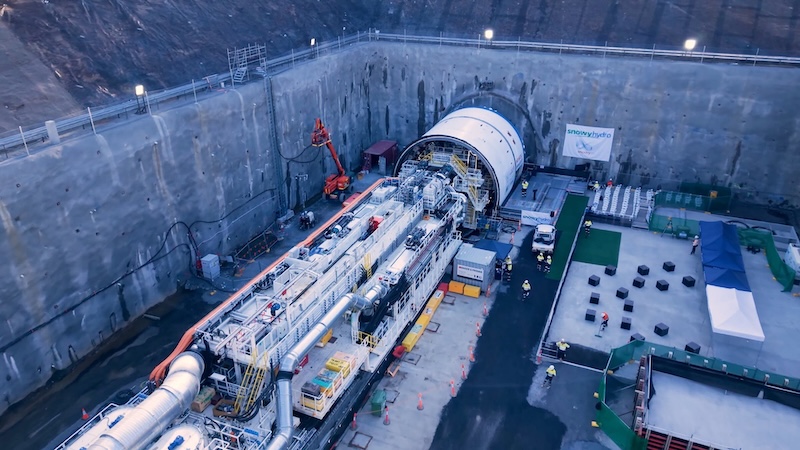

Ministers get monthly updates on cost and schedule performance of major projects, but refuse to share it with the paying public until they announce, “a blowout’s occurred, but we’re now too far in to stop it”. If Rex Patrick wins in the Full Federal Court next month that could all change.
Snowy 2.0
The Government’s just announced a further Snowy 2.0 blowout. From $2B at project announcement in 2017, to $5.5B in 2019, to $12B in 2023, and now $25B.
That new $25B number doesn’t include the $6B share purchase of Snowy Hydro from the NSW and Victorian Government, nor the estimated $6B needed for transmissions lines to get the power from the Snowy 2.0 power station to customers.
The project is now a taxpayer funded $37B financial disaster.
That’s not to say pump hydro projects should not be supported, but for that price we could have had multitude of smaller, more achievable, energy projects collectively delivering the same ‘giant battery’ that Snowy 2.0 is thought of … and with public funds to spare for other services.
Snowy 2.0. A snow-job costing taxpayers twenty times its budget
Performance transparency
The scam of it all is that every month the Government gets a project report from Snowy Hydro stating what the project’s current cost and schedule performance and what the cost and time to completion is.
In April 2023, several months before the blowout went from $5.5B to $12B, I requested access to the Snowy 2.0’s monthly project reports and related ministerial briefs. The Government refused to let me have them because if they gave me them then Snowy Hydro could sue it for ‘breach of confidence’.
It turns out that the Government had entered into a secrecy agreement that meant information sent from Snowy Hydro about Snowy 2.0 was to be kept confidential.
Snowy Hydro performance shrouded in secrecy. The three-step trick.
In the Full Federal Court next month my barristers, Tom Brennan SC and Paul Farrell, will argue (amongst other things) that a government official has no power to enter into a contract that would deny the minister providing project performance information to either the Parliament or to someone requesting it under FOI; and that
if Snowy Hydro attempted to sue the Government
a court would not enforce such contract (even if a Court decided the the matter was justiciable – it might instead say, noting Snowy Hydro is Government owed and controlled, that the Government should sort it out itself).
Snowy Hydro’s proprietary information, such as how their tunnelling machines work, can be kept confidential, but their performance information, such as the fact that one of their tunnelling machines is stuck which will delay the project, can’t be kept confidential.
Far reaching consequence
The court case is not just about Snowy 2.0.
I’ve encountered the issue across several freedom of information request relating to the performance of a range of different projects that are funded by the taxpayer. The Government just says, “nup” and relies on the fact they have a contract they, in betrayal to the public they serve, negotiated and signed to keep that information secret.
You, the public get to pay for a project or service, but the Government and the company delivering the good get to keep the fact that the project or service provision is not going well.
Constitutional argument
My argument before the Court (written in much more detail by my legal team and supported by relevant High Court precedents) goes something like this.
In Australia we have a system of responsible and representative government where ministers have a constitutional
duty to account to the parliament and to the people
for the performance of their portfolios.
A minister is entitled, without interference from a government owned corporation or a private-sector provider, to give any portfolio performance information (such as the performance of Snowy 2.0) to the parliament and to an elector, including an elector who requests information by way of a Freedom of Information application.
The Rule of Law
In a 1915 High Court case, Justice Isaacs (lawyer, Attorney-General, High Court justice and first Australian-born Governor-General) spelt out the subservience of a contract to public policy.
The rule of law as to contracts against public policy is constant – namely, that every bargain contrary to such a social governing principle is regarded as prejudicial to the State, or, in other words, contrary to “public policy” or, as it is sometimes called, “policy of the law,” and the State by its tribunals refuses to enforce it.
He went on to declare in the context of a NSW matter before the Court:
The Courts must … “ascertain, with as near an approach to accuracy as circumstances permit, what is the rule of policy for the then present time. When that rule has been ascertained, it becomes their duty to refuse to give effect to a private contract which violates the rule and would, if judicially enforced, prove injurious to the community.”
The Courts refuse to give effect to such a bargain, not for the sake of the defendant, not to protect any interest of his – indeed, they do not fail to notice that his failure to abide by his agreement sometimes adds dishonesty to illegality – but they refuse to enforce the bargain for the sake of the community, who would be prejudiced if such a bargain were countenanced.
The mechanisms which enable and facilitate our system of responsible and representative government must sit ahead of any contract, including and especially a secrecy contract signed by an official to deliberately shield a government from scrutiny.
Commercial naivety
In response Minister Bowen’s barristers are arguing that the implications of the Court accepting the argument above would be an undermining of confidence for those entering into contracts with the Government, and that would have far reaching obligations.
But officials should never enter into contracts that shield a contractor’s performance from the very public who underwrite the cheques paying for the work.
And if a company refuses to sign a contract for government work that does not protect their performance from the public, the Government shouldn’t contract them.
Competent companies would embrace such an approach because it would wean dodgy and incompetent companies from the taxpayers teat.
Deceiving the Court
Minister Bowen also submits to the Court that he doesn’t need to hand the documents to a citizen under FOI because he can provide it to the Parliament.
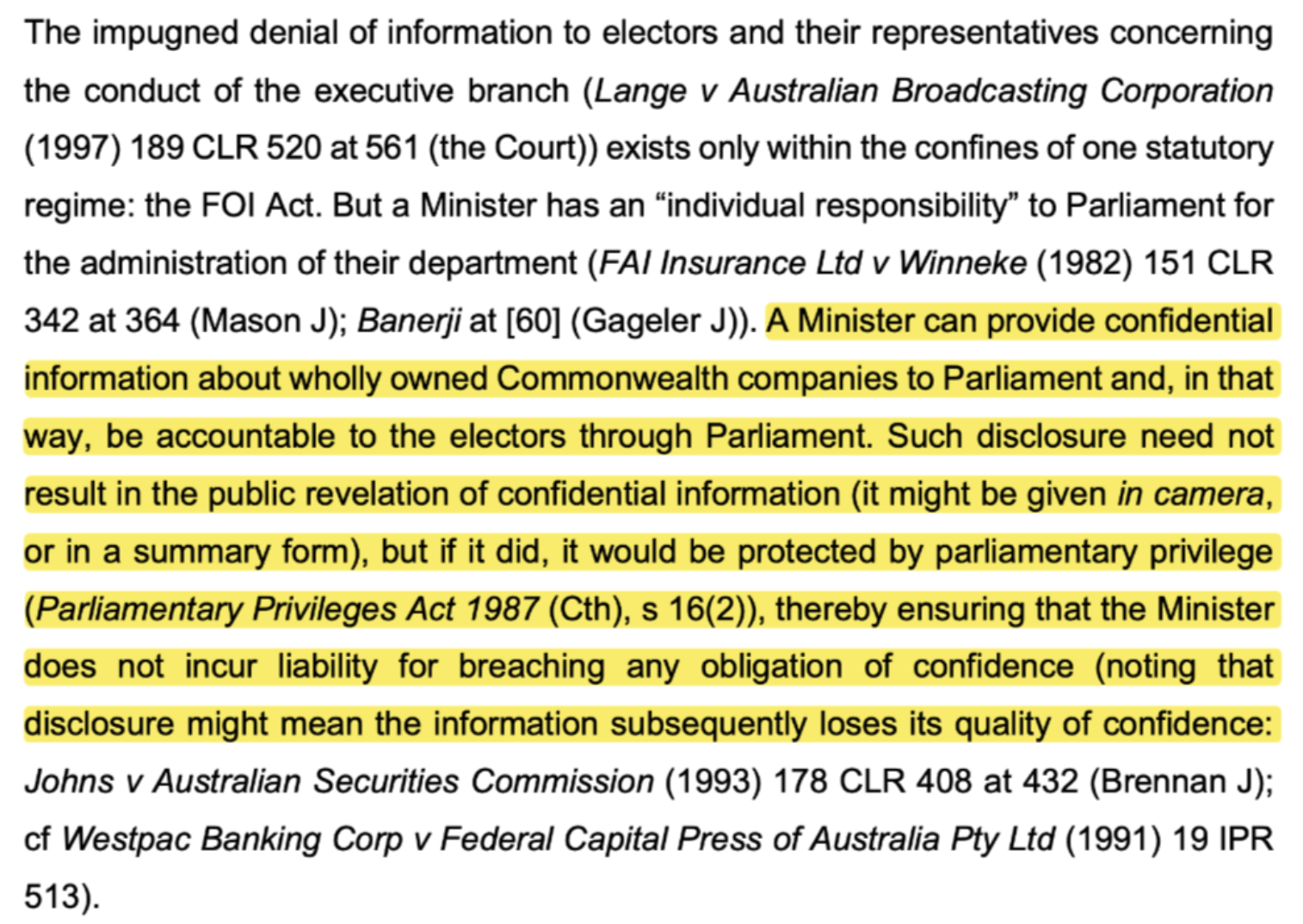
What Minister Chris Bowen told the Court
But that’s disingenuous, at best.
In the 47th Parliament (2022 – 2025) the Senate twice ordered Minister Bowen to hand over Snowy 2.0 documents, and he refused to on commercial grounds. One of the documents Minister Bowen served up to the Senate heavily redacted is the exact same document handed to me heavily redacted in response to my FOI request.
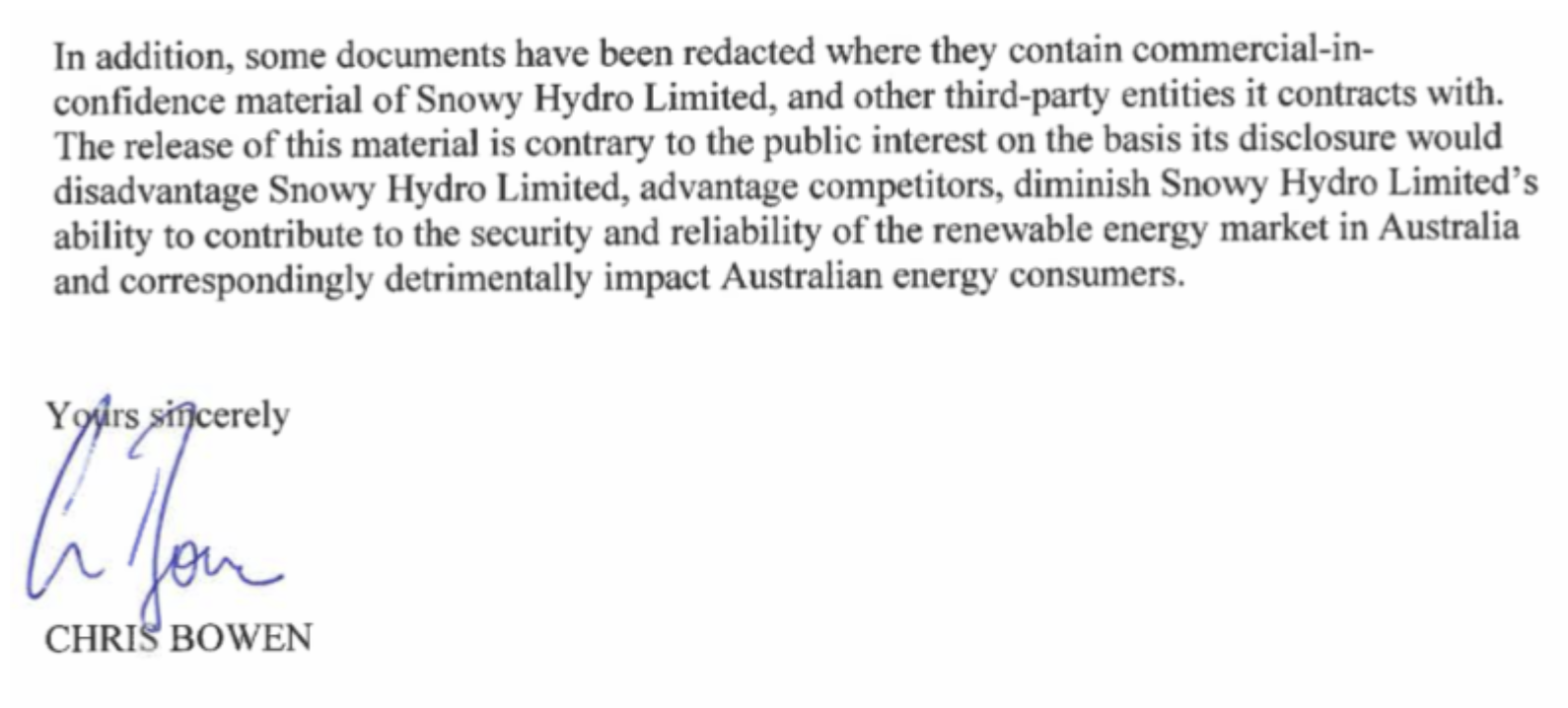
What Minister Bowen told the Senate
The minister tells the Court the public doesn’t need to have it under FOI because the Senate can get it, but he’s already refused to give it to the Senate.
$100 billion court case
The Commonwealth Government enters $100B worth of contracts every year. Almost all will likely have government pleasing confidentiality provisions that prevents citizens from knowing how the contract work is going.
Agreement by the court to my arguments will mean the public can get access to the performance status of any publicly funded program.
That must be a good thing – companies that know they will be called out for bad performance may not bid for work, or will certainly try harder to perform.
If I win in the Full Court, I’m sure the Government will take the matter on appeal to the High Court. Prime Minister Albanese hates transparency and has, so far, done everything he can to avoid it.
And there’s little downside for him; because you’re paying for his lawyers.
Legislative harakiri. A rare win for transparency as FOI bill dead
Note: The Snowy 2.0 matter will be heard by Justices Stewart, Kennett and Lenehan in Court 1, Level 21, Law Courts Building, Queens Square, Sydney from 10:15 of the 2nd and 3rd of November. The Court will be open to the public.

Rex Patrick is a former Senator for South Australia and, earlier, a submariner in the armed forces. Best known as an anti-corruption and transparency crusader, Rex is also known as the "Transparency Warrior."