

The newly revealed $40B blowout on Snowy 2.0 is shocking, but not surprising. Former senator Rex Patrick on management and oversight failures.
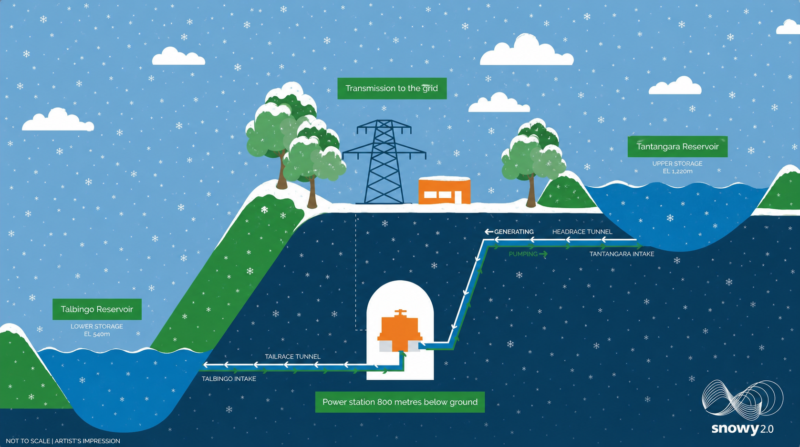
Originally announced in 2017, Snowy 2.0 is a mega pumped-hydro renewable energy project, acting as a massive “giant battery” for the national grid. The basic concept behind Snowy 2.0 is simple, albeit flawed, on account of its scale; off-peak electricity will be used to pump water ‘uphill’ from the Talbingo Reservoir, 27 km east to the Tantangara Reservoir, and during peak demand periods, allow the water to flow back ‘downhill’ through 2.2 gigawatt turbines to contribute power to the national electricity grid.
It can be likened to a 350 gigawatt-hour battery.
A cluster fiasco
The project is a taxpayer-funded financial disaster.
Assertions that Snowy Hydro Limited is bearing its own costs are deceitful; Snowy Hydro is a 100% owned Commonwealth corporation. The cost of Snowy 2.0, if not a direct cost to taxpayers by way of government equity injections, is money taken from the company’s revenue and not paid to the taxpayer by way of dividend or other capital investments.
Transmission line connection to the grid will cost taxpayers billions as well (but this has not been included in the cost).
The project was announced in March 2017 by then Prime Minister Malcolm Turnbull. The original cost estimate was $2B with a completion time of four years – power was to be flowing in 2021.
Snowy Hydro was, at the time of the announcement, jointly owned by the Commonwealth, NSW and Victoria. In June 2018, after the taxpayer bought NSW’s ($4.154B) and Victoria’s ($2.077B) shares, Snowy Hydro became a Commonwealth Company under the PGPA Act. The purchase was based on an agreed valuation of $7.8B – twice the previous valuation of Snowy Hydro of $2.2 – $4 billion.
So, a year after it was announced that the project would cost $2B, the taxpayer has forked out an additional $6B.
Engineering and project due diligence was carried out from March 2017, and in February 2019, the cost had risen from a ‘political’ $2B (again, ignoring the company purchase price and transmission line costs) to a worked-up $3.8B to $4.5B, with the taxpayer kicking in $1.38B by way of an equity investment. The project completion date had by then moved to 2025.
Just six weeks later, a major works contract was signed for $5.1B, $600M more than the worked-up upper boundary price.
Snowy 2.0 legal cost avalanche – more public money spent hushing more public information
Project reporting
MWM has been trying to get access to (now historical) project reports in the Federal Court. To date, that transparency fight has revealed Snowy Hydro’s reporting requirements to Government.
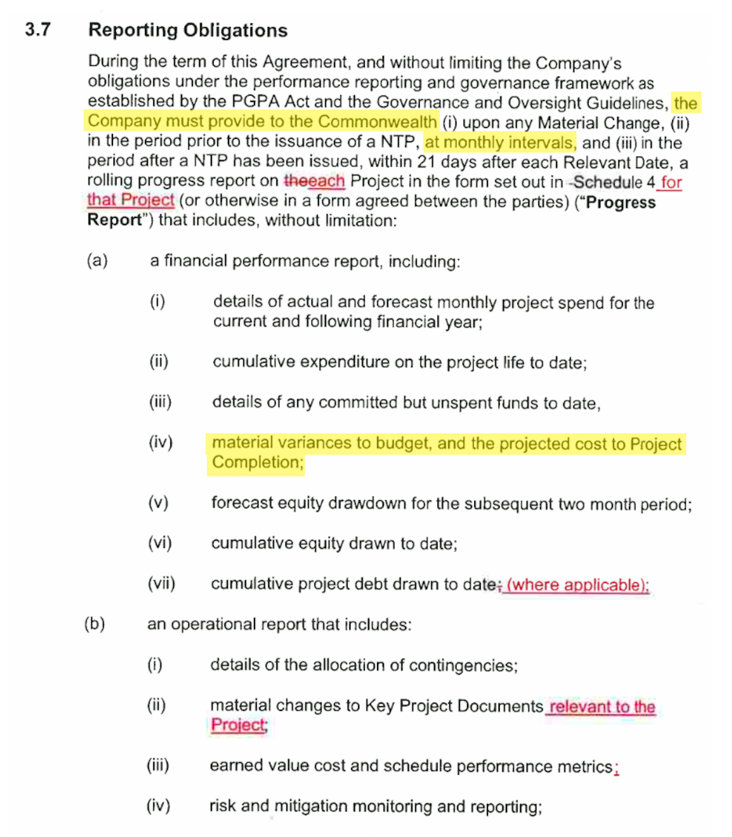
Extract from Snowy 2.0 Equity Subscription Agreement
It states the Government is updated on “material variances to the budget, and the projected cost to Project Completion”. The Government is also provided with “earned value cost and schedule performance metrics”. This happens on a monthly basis.
So, it’s not possible for the Shareholder Ministers, Chris Bowen MP and Senator Katy Gallagher, to have not known that the project was going into meltdown. Unless, of course, Snowy Hydro is not reporting cost and schedule variance to the Department, or the Department is not reporting cost and schedule variance to the Minister.
MWM requested, using Freedom of Information laws, access to both Snowy Hydro’s reports to the Department and the Department’s reports to the ministers.
Snowy Hydro and the Minister have spent more than $600K
collectively trying to stop these reports from being made public.
You’re paying for the project, but you don’t get to know (and you’re also paying for the legal teams that are making sure you don’t get to know).
Snowy Hydro performance shrouded in secrecy. The three-step trick.
The cost blowout
In August 2023, Snowy Hydro announced a project ‘reset’, which revealed the total project cost had risen to $12B. The ‘reset’ involved a further $2.6B equity injection by the taxpayer and a $4.5B taxpayer loan. The completion date was moved to 2028.
The Project was a Liberal National Party project up until that point. Bowen and Gallagher could have killed it off at that time – but both are professional politicians with no project management experience.
And now we find out how bad a decision it was to continue.
Last week it was reported that the Project has now blown out to $42B. That’s a cost that will ultimately be borne by the taxpayer (with the Government unable to spend that committed money on other worthy causes) and/or energy users in the National Energy Market (Queensland, NSW, ACT, Victoria, SA and Tasmania)
The project is in meltdown.
Expensive unaccountability
There are three very well-paid players who must be held responsibility for the meltdown.
The first is the CEO of Snowy Hydro, Dennis Barnes. When he was appointed as CEO of Snowy in January 2023, his background and experience made his $2M remuneration package look appropriate. He made a commitment when he took over the project that Snowy would be transparent.
Barnes is directly in charge of the project, has full visibility of the earned value management reports, and somehow hasn’t kept us up to date. The whole point of earned value management reports is to summarise how a project is performing against schedule and budget so that you can instantly see when something is going off the rails.
Sure, he inherited a flawed project from his predecessor, Paul Broad (who had worked his remuneration package from $2M in FY2020 to $2.7M in FY2022, as the project faltered), but Barnes promised transparency to the public and then set about betraying the public, for which Mr Broad could not be held responsible.
Second, there’s the secretary of the Department of Climate Change, Energy, the Environment and Water, Mike Kaiser, and his predecessor, David Fredericks. At $920K per annum, they are highly paid and responsible for oversight; both have failed the public in respect of Snowy Hydro. Fredericks was there from the project’s early days, and so is truly complicit in the disaster, but has managed to find his way onto the Board of Snowy Hydro.
And finally, there’s the shareholder ministers, Minister for Energy, Chris Bowen, and Finance Minister, Katy Gallagher,
who clearly knew of the train smash but did not bother telling the Parliament.
The remedy
Snowy 2.0 is not value for money. The taxpayer could have funded a multitude of baseload projects for even half the money now being wasted on it. The project is a double failure.
The first failure is the project itself, which will ultimately deliver something, but at a price that means many other projects and services that could have been available to the public are simply not available.
The second is the failure of accountability. In one case, that failure has led to a ‘promotion’ within the project itself. Some of the players are supposedly experienced project people. How did they get it so wrong? How is it that there’s an accountability vacuum?
The newer participants might reasonable argue they’ve been handed a hospital pass, but they have no excuse for burying the state of affairs under a secrecy snow blanket.
We need to have a general disclosure requirement for all cost and schedule variance reporting from any and all taxpayer-funded projects. That way, the public can be the adults in the room.
This story first published by the Energy News Bulletin, original here.

Rex Patrick is a former Senator for South Australia and, earlier, a submariner in the armed forces. Best known as an anti-corruption and transparency crusader, Rex is also known as the "Transparency Warrior."