


The 12th year of ATO corporate tax data shows progress, but gifting our vast offshore gas resources still leaves a foul stench. Jason Ward reports.
The ATO corporate tax transparency data for Australia’s largest corporations has just been released for the FY 2024-25 financial year. It includes payments from the Petroleum Resource Rent Tax (PRRT), and this year is the first to show the impact of the Labor government’s weak effort to reform the PRRT by capping the use of PRRT deductions at 90% of the value of production.
In other words, 90% of the value of offshore gas production still pays zero PRRT, and the flawed PRRT is applied to only 10% of production.
Following implementation of these reforms (advocated for by the industry itself), the PRRT take was less than $1.9B while LNG exports topped $65B in 2024-25. This equates to under 3% of the value of LNG exports, despite that PRRT rate being 40% (of the value of raw gas). This excludes state-level royalties on gas sold to the domestic market.
Given the ongoing and seemingly escalating conflict in the Middle East instigated by the belligerent US and Israeli attacks on Iran, the value of Australia’s world-leading (now only behind the US and ahead of Qatar) LNG exports is expected to skyrocket again.
LNG prices spiked after Russia’s invasion of Ukraine and Australia’s LNG exports peaked at $90B in 2022-23.
However, under the current ‘reformed’ PRRT, don’t expect Australia’s take on this massive export to increase much at all.
Australians are getting robbed, perhaps at even higher levels…
Chevron
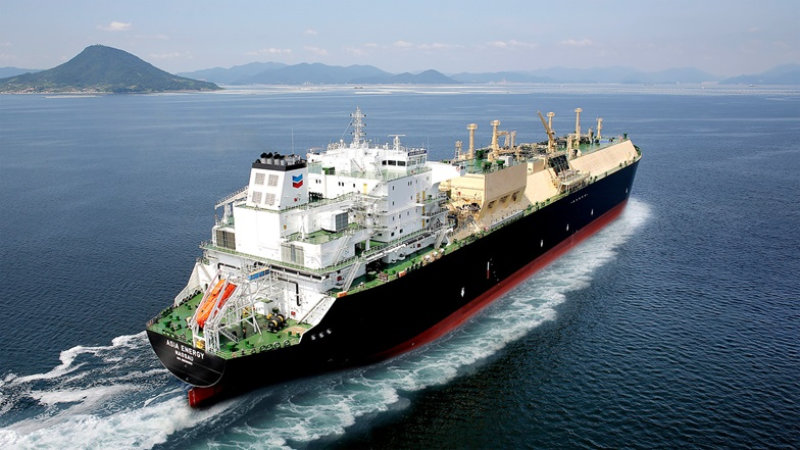
A closer look at Chevron, Australia’s largest gas producer and exporter, provides a clear example.
After a landmark High Court victory by the ATO against Chevron in 2017 for an epic profit-shifting scheme, the US oil giant now pays substantial amounts of corporate income tax. In fact, in the current 2024-25 data, its payment of $2.9B puts it fourth from the top of the list following Rio Tinto, BHP and Commonwealth Bank.
Chevron is now running ads touting its tax payments, saying it is proud to be “helping to fund the schools, hospitals and services Australians rely on every day.” That is a remarkable change of tune from earlier days and from Chevron’s tax practices elsewhere, including in its home country, the US.
The ATO corporate tax data – available at MWM‘s website – shows that Chevron had total income in Australia of nearly $17.3B in 2024-25, ranking it the 24th largest. Its taxable income was over $9.8B, resulting in an estimated profit margin of a whopping 57%. It’s easy to make incredible profits when the raw material is given to you for virtually free.
Chevron’s profit margin is among the highest in the top 100 corporations, where the average margin is just over 12%. The only higher profit margins in the top 100 are one BHP Iron Ore subsidiary with 61% margins, Hancock Prospecting (Gina Rinehart) at 76%, and one Rio Tinto subsidiary at nearly 143%.
More tax, but minimal royalties
These margins may be impacted by larger corporate structures, and these particular entities are likely to have paid substantial sums in royalties. However, this is not the case with Chevron. As a result of the Labor government’s reforms, it made its first-ever PRRT payments in 2024-25.
This is despite production and export at its massive Gorgon and Wheatstone projects beginning in 2016 and 2017, respectively. So after nearly a decade of free gas, the measly PRRT payment of under $167 million amounted to
less than 1% of Chevron’s total income in 2024-25.
Chevron, after being forced to dismantle its profit-shifting scheme, is now paying substantial amounts of corporate income tax. However, the ongoing gifting of Australia’s vast offshore gas resources, for virtually free, to the world’s largest oil and gas giants continues.
According to Chevron’s most recent global resource extraction payment report (FY ending 31 December 2025), it paid more taxes in Australia than in any other country except Canada. However, unlike in Australia, where royalties were zero, it also paid $US359m in royalties in Canada. Chevron’s US tax payments were only $US143m in 2025 (just over 8% of tax paid in Australia), but it paid over $1B in royalties there, significantly higher than in any other country.
Well over half (57%) of Chevron’s US royalty payments, ironically, were paid to the federal government in connection with offshore wells in the renamed “Gulf of America”.
According to Chevron’s 2025 annual report, Australia accounted for nearly 13% of its global production with 472 thousand barrels of oil-equivalent production per day. This was second only to US production of 1,858 thousand barrels and far greater than all of Asia (381k) or Africa (229k). The annual report also clearly notes that “Chevron is the largest producer of LNG in Australia.”
More reform needed
There are further reforms to the PRRT that have been proposed since then-Treasurer Scott Morrisson, released the PRRT review in 2017. These additional reforms should be reconsidered, but the PRRT has never been fit for Australia’s booming offshore gas industry.
Further actions are needed to protect Australians’ interests and to help fund public services.
While a national domestic gas reservation policy (as WA already has) would be a small step forward, it will not ensure a fair return from the exploitation and export of our finite natural resources. The idea that changes represent “sovereign risk” and will scare away future investment is, and has always been, a total farce.
Australia’s tax and royalty regimes for oil and gas are generous by global standards.
The resources are here, and Australia can set rules that actually serve Australian interests over those of Chevron and other global oil giants. The simple common-sense call for a 25% export levy on LNG is not going away anytime soon. The Labor government would be wise to reconsider its position, particularly with extraordinary profits that will be made from soaring LNG prices due to the conflict in the Middle East.
Finally, Australia must learn its lessons from the total failure of the PRRT to generate sufficient public returns from our vast offshore gas resources. It is time to get the tax, royalty and oversight regimes for lithium and other critical minerals, needed for the transition to renewables, right before the next mining boom gives us another kick in the ass…
The time has come to put Australians’ interests above those of the oil and gas industry.
Which Companies on the ATO’s List Paid No Tax This Year? | The West Report

Jason Ward is Principal Analyst at the Centre for International Corporate Tax Accountability & Research (CICTAR). Ward has been a frequent commentator on corporate tax issues as an analyst and spokesperson for the Tax Justice Network – Australia (TJN-Aus). He is currently a Visiting Fellow at the Business School at the University of Greenwich and a PhD student in accounting at the University of Technology Sydney.