

The AI race continues apace, driven by those who reap the financial benefits, while ignoring those who lose their jobs. Where is the regulation, Claudia Weisenberger asks?
American comedian and commentator Jon Stewart recently asked the question on his weekly show, “What do we get in exchange for paying for all of this?” referring to the enormous investments made in AI development and infrastructure.
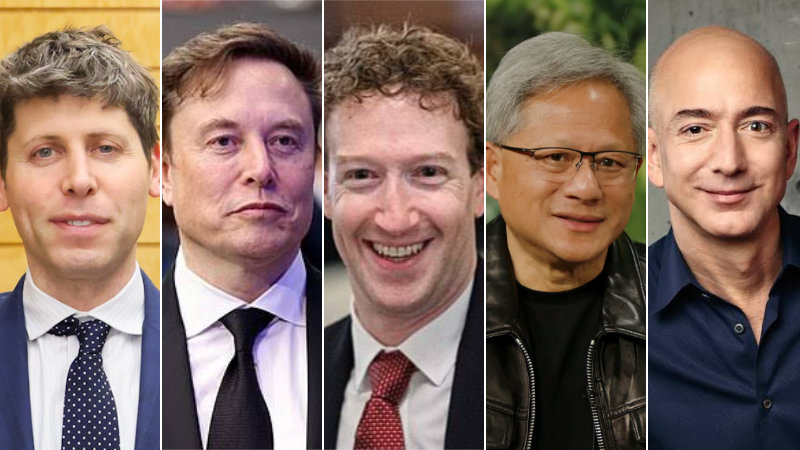
He then searched the public record of five of the most powerful architects of artificial intelligence: Sam Altman, Elon Musk, Mark Zuckerberg, Jensen Huang, and Jeff Bezos.
The answer, from all five, was the same:
nothing clear, nothing soon, and possibly nothing at all.
Protections missing
Consider what we have been told by the people in charge. Donald Trump — the most powerful elected leader in the world — assured us that the men running the technology companies are the most intelligent people alive and will regulate themselves responsibly.
No one asked the citizens of Western democracies whether they agreed.
Jensen Huang of NVIDIA promised a net gain in jobs. His evidence: the spa industry didn’t exist when he was young. Neither did the Roman Empire, apparently.
Elon Musk said many jobs will go, but people can have one as a hobby
— and promised an age of abundance with a universal basic income paid for by AI productivity.
The only universal income currently on offer in Australia is the JobSeeker payment: $808.70 a fortnight. Is that Musk’s idea of abundance?
Mark Zuckerberg said there will be new, better jobs. When pressed on which ones: ‘It is difficult to imagine the future.’
Jeff Bezos has said almost nothing on the subject at all.
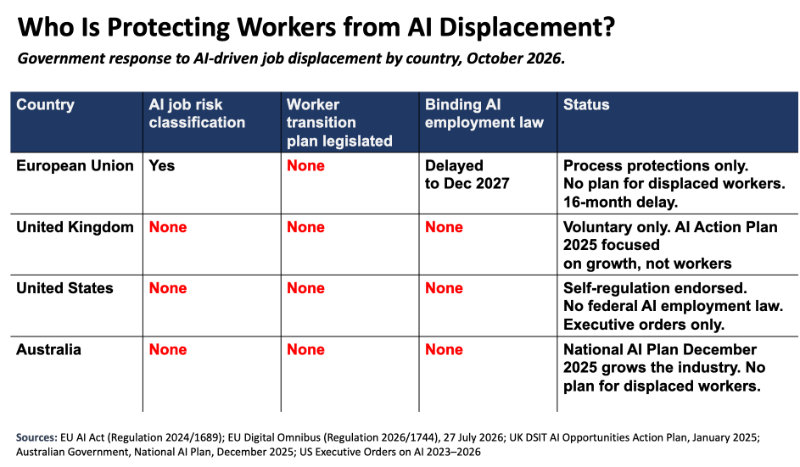
Governments found these answers satisfactory. Not one major English-speaking Western democracy — not the United States, not the United Kingdom, not Australia — has legislated a binding transition plan for workers displaced by AI.
European Union leads the way. Just.
The European Union has gone a bit further. The EU AI Act classifies AI systems used in recruitment, performance monitoring, termination decisions and worker surveillance as high-risk — requiring human oversight, transparency obligations and the right to challenge automated decisions. It also states fully automated firing is prohibited.
That appears to be the most significant AI employment regulation passed anywhere in the world.
It says nothing about what happens to workers whose jobs are eliminated before those systems are ever deployed. And even those process protections have been delayed: in July 2026, the EU pushed the high-risk employment provisions back to December 2027 — a 16-month delay.
Hollow promises
At corporate shareholder calls and product launches, the same promises recur. Artificial intelligence will cure cancer and Alzheimer’s disease. It will eradicate poverty. It will transform education.
When asked when, the answer is consistently the same: some day soon. Sam Altman has been more direct than most. In a recent interview on AI safety, he said: ‘We believe the world should accept some bad things happening for the benefits of this technology.”
He did not specify which bad things.
However, we can look at what AI is delivering right now.
Palantir tracks undocumented migrants for deportation in the United States — and is embedded inside Australia’s NDIS and AUSTRAC systems, using the same Gotham platform deployed by the Israeli Defence Forces in Gaza, tracking welfare recipients and identifying fraud.
Cellebrite extracts data from seized phones. BioCatch monitors financial behaviour across five major Australian banks without customers’ knowledge. AI-guided drones operate in Gaza. These are not hypothetical. They are already operational.
The people making the promises are not the ones living with the consequences.
Would you take a medication your doctor told you had a 10 to 20% chance of killing you? Probably not.
Transitioning out of control
In Australia, the transition is not approaching. It is here!
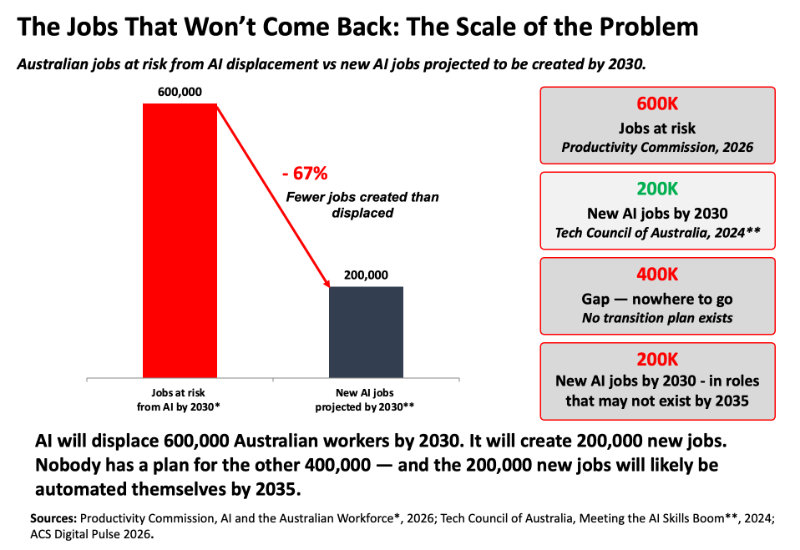
Technology job advertisements have more than halved since March 2023. Around 31,000 technology-related roles were lost in the year to May 2025. AI-linked job losses are projected to exceed 600,000 — 4% of Australia’s entire workforce — according to a 2023 report by the Productivity Commission.
The displacement is not evenly distributed. White-collar workers face the greatest risk — and within that group, women face nearly triple the displacement risk of men, concentrated in clerical, administrative and customer service roles that AI is replacing first and fastest.
The Australian government released a National AI Plan in December 2025. It is a plan to grow the AI industry.
It is not a plan for the workers the industry displaces.
As of mid-2026, the transition stewardship mechanism recommended by Jobs and Skills Australia remains in development. A May 2026 independent study described Australia as having an ‘absence of plan for workforce transition.’ Other than that, there is no legislation or regulation in place to control this transition.
Are we running out of time?
The productivity gains do not flow to workers. Nobel laureate economist Daron Acemoglu explains why: “The companies building this infrastructure do not see workers as people to be supported through a difficult transition.
They see them as a cost to be eliminated.
The consequences extend beyond lost wages.”
Every Australian who loses their job to AI also stops making superannuation contributions. Those lost contributions compound silently over decades into a significantly poorer retirement. No Australian government has published modelling on the superannuation impact of AI-driven job displacement, and no company deploying AI at scale has been required to account for it.
Economists have proposed alternatives. Governments have not acted on them. The Australian government has appointed a Chief AI Officer in every federal agency to drive AI adoption — and assured Australians, in the words of Minister for the Public Service Katy Gallagher, that this is ‘not about replacing people.’ Hence,
it has published no plan for the workers it does replace.
In 1979, IBM told its employees: ‘A computer can never be held accountable. Therefore a computer must never make a management decision.’
Today, algorithms make life-altering decisions about welfare payments, disability funding and fraud assessments for millions of Australians — faster than any human can review them, in ways no one can fully explain, with consequences that are often irreversible.
The IBM instruction has been ignored. The consequences have not.
I-CANnot. Is the computer algo replacing the clinician up to the task?

Claudia Weisenberger is a management consultant with deep experience in pharmaceuticals, hospital transformations, and strategic due diligence across four continents. She combines sharp analysis with hands-on execution.