
As rents and cost of living rise, Future Fund makes good money from Australian housing, including a $1.6B student accommodation portfolio. Is the Fund acting to its mandates? Sam Connor reports.
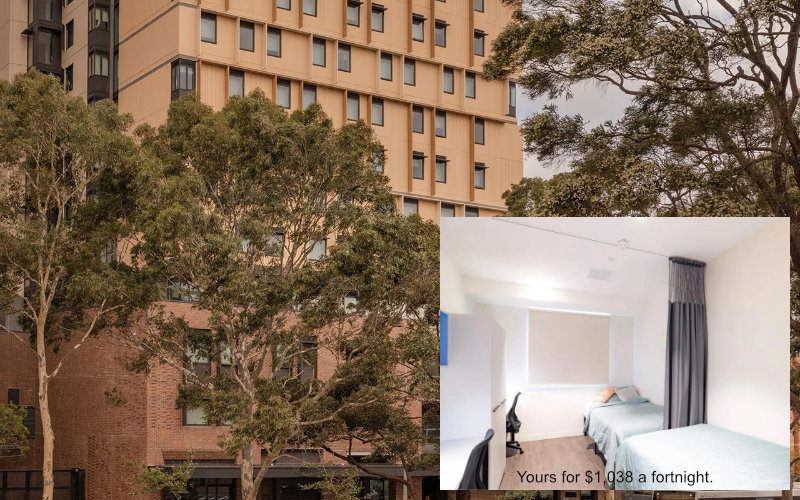
“Double the fun, half the cost,” reads Amber’s stock description for a shared student room at Accolade on Gibbons in Redfern, Sydney.
The current listing starts at $519 a week. A bronze twin-share ensuite is advertised from $589. At the other end is the Private Studio Gold, from a whopping $869 a week.
The photograph is almost aggressively ordinary: two single beds, two desk chairs, a curtain between them. At $519 a week, the cheapest advertised rate works out to $1,038 a fortnight.
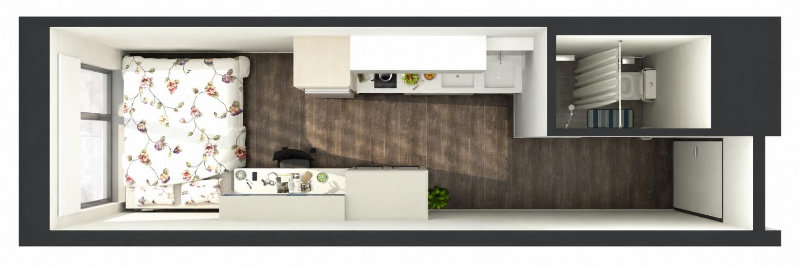
Image supplied
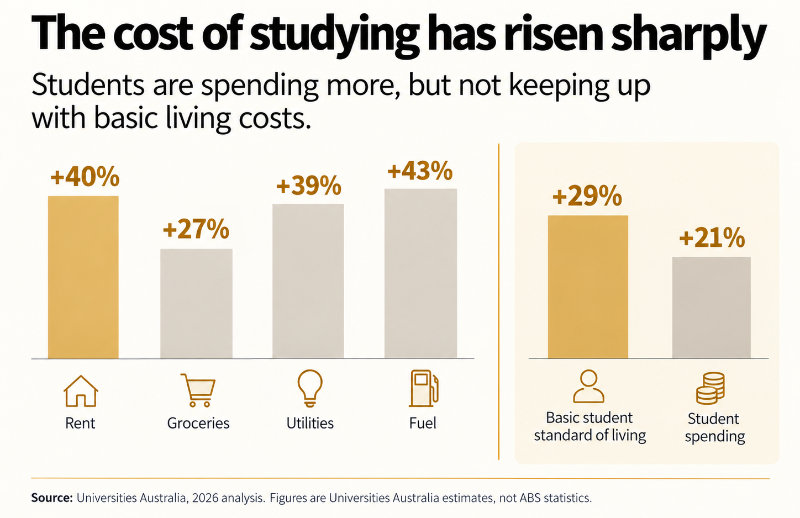
The maximum Youth Allowance for a single student aged 18 or over who has to live away from home is $677.20 a fortnight. Austudy’s basic maximum for a single student is the same. Even before food, transport, textbooks or the cost of the degree itself, the cheapest advertised room is $360.80,
more than the entire fortnightly payment.
And if that student is under 22, Centrelink will usually still treat them as dependent on their parents, even if they live away from home, meaning their parents’ income can reduce or wipe out their Youth Allowance.
International students are even worse off. They generally cannot fall back on Austudy because eligibility requires Australian residency. Most student visa holders can work no more than 48 hours a fortnight while their course is in session.
So students work. A 2026 University of Wollongong survey found 74% relied on paid employment to meet living costs and 36% worked more than 20 hours a week. Students reported skipping classes, delaying health care and cutting their study load because they needed the money.
Enter the Future Fund
In December 2024, the Future Fund partnered with global property manager Greystar to acquire seven Australian purpose-built student accommodation properties. The portfolio contains 5,662 beds across Sydney, Melbourne, Canberra, Adelaide and Brisbane. The acquisition was worth $1.6B.
Gibbons Street is one of them.
The ownership structure takes a little more explaining. Transaction documents show GS Tropics Trust holds 87% of the head trust above the seven properties. Singaporean-based Wee Hur Holdings, the previous owner, retained 13% per cent. GS Tropics Trust is itself held by a consortium of investors, and the structure is managed by a Greystar company.
The Future Fund publicly identifies itself as Greystar’s investment partner, but the transaction documents do not disclose exactly what percentage of that 87% belongs to the Fund.
So the Commonwealth is not the student’s direct landlord at Gibbons Street. Commonwealth funds do, however, sit inside the ownership structure of the portfolio receiving those rents.
One of the seven properties is built on Commonwealth land. At Y Suites on Moore St in Canberra, the Commonwealth of Australia is the landlord under a 99-year Crown lease. The Future Fund is now an investor in the portfolio that owns the student-housing business on that land.
And this is where the story gets strange.
Future Fund mandate change
The Future Fund now describes its purpose in broad language. Its 2025-26 Year in Review says it invests “on behalf of current and future generations of Australians”.
But Parliament gave the original fund a more specific job. The Future Fund Act says, very clearly, that its main purpose is to discharge unfunded Commonwealth superannuation liabilities. The Department of Finance still describes its purpose that way today.
Those liabilities are not mysterious. The official target includes the old public service schemes, military schemes, judges’ pensions, the Parliamentary Contributory Superannuation Scheme for MPs who entered Parliament before October 2004, and the Governor-General pension scheme.
The money was accumulated because the Commonwealth knew those bills were coming, and the fund has done extremely well at accumulating it.
By 31 March this year, Finance recorded $60.5B in credits and $208.5B in net investment earnings. Policy withdrawals from the core Future Fund since it began were zero. Not a single dollar was drawn down to pay for politicians’ entitlements and superannuation, despite the Fund’s core purpose. And by 30 June, the Fund’s value had reached a record $289.7B.
To be clear, this is not because of rules or anything but government decision-making. Law has allowed the Fund to be drawn down for those superannuation liabilities since 1 July 2020. The government has chosen not to do so. In November 2024, it announced there would be no drawdowns until at least 2032-33.
Meanwhile, the 2025-26 Budget allowed $10.3B in cash payments for Public Sector Superannuation Benefits alone. Unfunded benefits under the old Commonwealth schemes are paid from consolidated revenue as they fall due.
Kiwi High Court ruling to pave the way for changes at Future Fund?
Social vs fiscal responsibility
There is a defensible economic argument for leaving the Fund invested. If its returns exceed the government’s cost of borrowing, compounding the asset can improve the Commonwealth’s long-term financial position. The Parliamentary Budget Office has modelled precisely that argument.
But Australians are entitled to scrutinise what is being done with this public asset while we wait. At a time when ‘sustainability’ is being used to justify cuts to essential services, including the NDIS, aged care and veterans’ supports, while the wider population struggles through a cost-of-living crisis, there is a simple question:
does what we are doing with this money really pass the pub test?
Because elsewhere, governments are making very different decisions about public money.
The 2026-27 Budget says the latest NDIS changes will reduce projected spending by $37.8B over four years. Women With Disabilities Australia has warned that reductions in funded disability support risk transferring more care back to families, especially women, forcing some to cut paid work or leave it altogether.
We already know what heavy unpaid caring does to employment. Two-thirds of Australia’s 1.2 million primary carers are women. Among working-age primary carers providing 40 hours or more of care each week, only 45.4% are employed. Among primary carers of children and young people with disability, 31% said they had reduced their working hours since taking on the caring role.
Changing ownership, not building houses
One arm of government is paying the old superannuation bills from taxpayers’ money, Australia’s consolidated revenue. The fund created to help meet them keeps its capital invested. Part of that capital is now exposed to student accommodation where a weekly room can cost more than an eligible student receives from Centrelink in a fortnight.
None of this means the Future Fund caused the rental crisis, student poverty or inequalities faced by disabled young people and unpaid carers. Buying student housing is legal. Institutional capital can finance new accommodation.
However, the government’s recently revised mandate asks the Fund to ‘have regard to increasing housing supply’. But spending $1.6B on 5,662 existing beds did not create another 5,662 places for students to live; it just changed their ownership
NDIS: how they dudded the disabled and duchessed the corporations

Samantha Connor AM is a disability rights activist, writer and former President of People with Disability Australia. A wheelchair user with decades of experience in disability advocacy, she writes about the NDIS, disability policy, government accountability and human rights.