

The algorithm tool the government plans to use to determine disability funding for NDIS has yet to be validated or approved by the TGA. Claudia Weisenberger with the story.
An anonymous tip and a Senate submission from an independent researcher show the planned algorithm-based tool to determine funding for 800,000 disabled Australians has neither been properly validated nor independently reviewed.
It also may meet the legal definition of a software medical device, but the Therapeutic Goods Administration (TGA) has not been approached to approve it.
The government calls it the gold standard. The science says otherwise.
I-CAN outed
A Senate submission into the NDIS Amendment (Securing the NDIS for Future Generations) Bill 2026 (submission 1567) raised serious questions about the scientific foundations of I-CAN: the Instrument for the Classification and Assessment of Support Needs, version 6.
This is the tool the NDIA has procured under a commercial licence to determine the funding of every NDIS participant aged 16 and over, new and existing, in a rollout commencing 1 April 2027 over five years. The submission’s author — a psychologist and PhD candidate — requested their name withheld, but agreed to speak to MWM.
A clinical psychologist who independently reviewed the same submission described the findings as deeply concerning and said they should worry every clinician and every person with a disability.
Under the NDIS Amendment Act 2026, a new participant sits through a structured interview of up to three hours. Their answers are entered into a computer. An undisclosed algorithm converts those answers into a dollar figure that cannot be overridden. The NDIA’s own staff briefings confirm that once I-CAN generates a budget,
NDIA staff have no authority to change it.
For existing participants, the assessment process may differ — but the same algorithm determines the outcome. The same rules apply.
An old tool repurposed
The I-CAN was designed 20 years ago as a qualitative care planning tool — not a financial calculator.
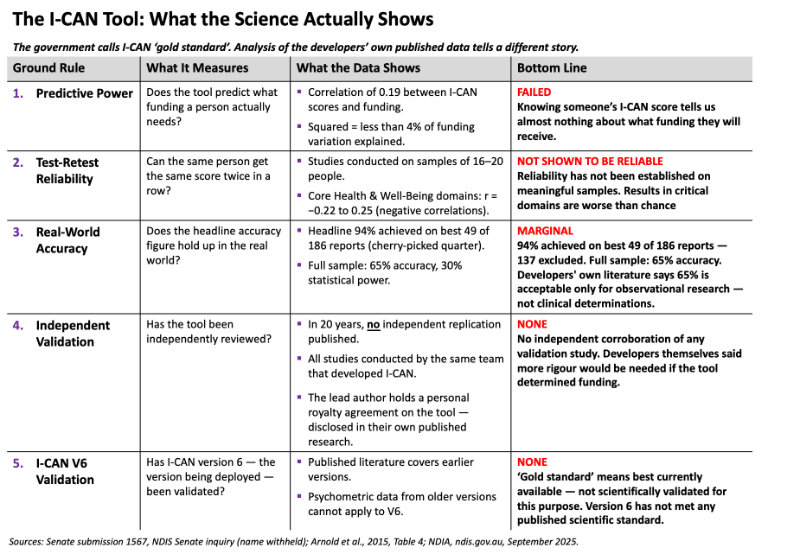
The government took that clinical tool, plugged it into an undisclosed algorithm and passed a law tying $53.8B in annual disability funding to its outputs. The NDIA describes I-CAN as a ‘gold standard’ assessment tool. The psychologist and PhD candidate who examined the published evidence told MWM that ‘gold standard’ is a marketing term, not a scientific designation.
The published validation literature covers versions 2.0 to 4.2 only, while I-CAN version 6 — the version being deployed — has not been independently validated. It has never been tested in conditions where the result determines a participant’s funding.
The ART of no power
During 2024–25, the Administrative Review Tribunal changed the outcome in 73% of finalised NDIS decisions it was asked to review.
Under the new Act, the Tribunal’s powers have been effectively nullified. It can no longer alter a participant’s plan or reinstate their funding — only order a reassessment by the same algorithm that produced the contested result.
A system that overturned nearly three in four decisions on review is now almost impossible to correct.
For the 800,000 Australians who will be assessed under this system, an error is not abstract. It is a substantial funding cut. It is the support worker who no longer comes. It is the activity, the outing, the moment of connection that no longer happens.
It is the family member who fills the gap until they can’t anymore.
I-CANnot
The developers of I-CAN — the Centre for Disability Studies — own the intellectual property, profit from its use, and are consortium partners in the NDIA’s own implementation.
The lead author of their published validation studies holds a personal royalty agreement on the tool — a fact the developers themselves disclosed in their own published research. The people who built I-CAN, validated it, profit from it and are helping the government roll it out are the only people who have ever tested whether it works.
In 20 years, not one independent researcher has been asked to check their work.
Moreover, the developers’ own published data show that I-CAN scores explain less than 4% of what participants actually receive.
The other 96% is determined by factors the tool does not measure.
In addition, reliability studies of the tool were conducted on a sample of no more than 20 people, far too small to be meaningful. The developers knew this — they acknowledged in 2009 that using I-CAN to determine funding would require much more rigour. It never happened.
Finally, the developers’ own published research headlines a 94% accuracy figure, but that was achieved by using only the best 49 of 186 real-world reports, discarding the rest as too inconsistent. When it includes all 186, accuracy drops to 65%.
The developers’ own literature says 65% is acceptable only for low-stakes research. Deciding whether a participant receives $40,000 or $400,000 a year is not low-stakes.
Incidentally, the NDIS is not the first Australian government program to replace clinical judgement with an algorithm. The aged care system has been running the same experiment since November 2025, with poor results.
Pay per shower: fully-funded aged care turns market-driven aged support
The assessors, the algorithm and the pipeline
Three further findings from submission 1567 have received no public attention.
Job advertisements for Support Needs Assessors confirm that ‘active professional registration is not required.’ A participant’s funding could be determined by someone with a counselling degree or an education qualification — with no professional accountability, no code of conduct and no disciplinary pathway if something goes wrong. There is no recourse.
There is also a legal word change buried in the new Act that has received almost no public attention.
- The existing law required assessors to ‘identify’ a participant’s disability and support needs — a clinical determination.
- The new Act replaces that word with a requirement merely to ‘include information about’ those needs.
The assessor is now entering data. The algorithm makes the determination. This single word change allows an unregistered workforce to conduct what is, in every practical sense, a clinical assessment — without being legally required to answer for it.
No independent review
Second, the algorithm that converts I-CAN scores into dollar figures has never been independently reviewed.
A participant who receives less than they need has no way to know whether the problem lies in their assessment, in the algorithm, or in both. According to submission 1567, it would feasibly meet the definition of a software medical device under the Therapeutic Goods Act — potentially in the same risk class as an implantable medical device. The government has never approached the TGA to find out.
I-CAN is also only one part of the pipeline of the tools to be rolled out.
The PECQ
Alongside it sits the PECQ — the Personal and Environmental Circumstances Questionnaire — and a series of assessment modules.
The researcher told MWM they had no information about the scientific properties of the PECQ. Not limited information. None. Three tools. One funding outcome. No study has assessed how they work together. If any one fails, the participant pays,
and there is no way to know which one failed.
The new act allows the NDIA to refuse a support if no peer-reviewed research backs it — even when a participant’s own doctor recommends it. I-CAN version 6 — the tool used to assess that same participant — has no peer-reviewed validation either.
The government is applying to disabled Australians a standard of evidence it cannot meet itself.
NDIS: how they dudded the disabled and duchessed the corporations

Claudia Weisenberger is a management consultant with deep experience in pharmaceuticals, hospital transformations, and strategic due diligence across four continents. She combines sharp analysis with hands-on execution.