
In detention centres around Australia, scores of refugees are facing the threat of being on the next plane to Nauru. One of them celebrated with MWM in July. Kim Wingerei reports.
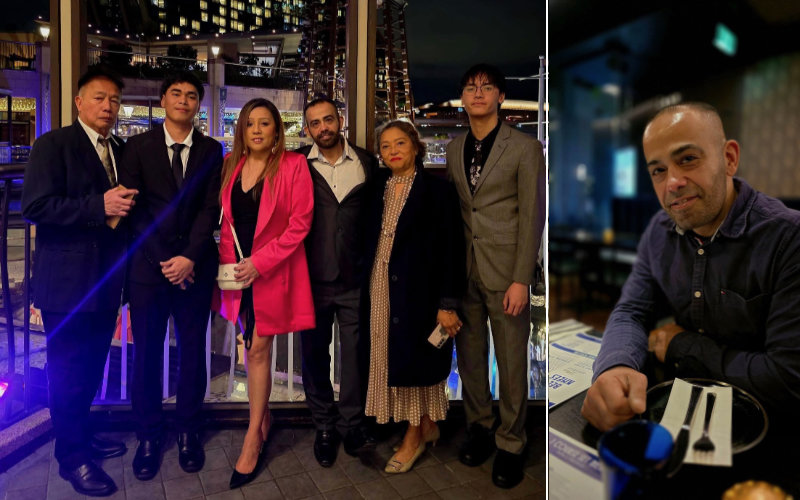
Ahmed Mahmoud and some of his family members came to our 10th Anniversary dinner in July along with his lawyer, Alison Battisson. He was the applicant in the case that eventually declared Australia’s indefinite detention regime illegal, known as AJL20.
He came to Australia as a refugee from Syria in 2005 and was granted a visa, which was cancelled in 2014 on “character grounds” due to a conviction for assault when he was 17 years old, for which he served a three-year sentence.
For an Australian citizen, that would (and should) have been the end of the matter, but for Ahmed, the end may be 30 years in Nauru. Since 2014, he has been in and out of detention, but has never been in breach of his visa conditions or broken the law again.
Last week, Australian Border Force served notice to his lawyer (currently overseas) at 11 pm on Thursday night, and then raided his home the next morning. His wife, Danice Frichitthavong, told MWM, “Around 5.45 am, while it was still dark, one of our worst fears was realised. ABF officers woke us up as they banged on our door, yelling to open up … they barged through our house,
clearing each room like it was a murder scene.”
An ABF officer said Ahmed’s bridging visa has been cancelled, and he was granted approval to be removed to Nauru [for 30 years]. Ahmed has today been told it may happen as early as next week, despite Danice originally being told it would be “at least 14 days”.
Danice and all of Ahmed’s close family are Australian citizens.
Illegal detention. High Court tells Government to obey the law
Danice told us, “I can’t even begin to articulate what this absolute bureaucratic shit show does to a person. It’s incomprehensible and unforgivable. 12 years this has been going on. In 12 years, he’s tasted freedom 3 times, and now they’re locking him back up again. I have no idea how Ahmed will cope this time round; I just know that he’ll never be the same after this.”
It’s reasonable to say that no one in that family will be the same and this is now backed up by statistically significant research.
The human side of detention
For the past three years, University of Sydney researchers have been interviewing families about the impact of parental detention and deportation and have published the results in partnership with the Australian Human Rights Commission (AHRC).
The study included over 100 interviews with children and found that financial strain, food and housing insecurity are widespread. Importantly,
the effects of deportation are “long-term and intergenerational.
Said lead researcher, Dr Michelle Peterie:
“The overwhelming finding of the research is that the impacts of immigration detention and deportation do not only happen to affect the person directly targeted. They also have profound and often negative impacts on their children and families. As one young person told us, ‘it’s like a ripple effect of suffering.”
AHRC Children’s Commissioner, Deb Tsorbias added:
“Their stories paint a different picture to the usual view presented in the media of people whose visas have been cancelled on character grounds, showing that many are also parents or caregivers. Children suffer the consequences of adult and government actions through no fault of their own.”
The illegality of indefinite detention
For Ahmed and the NZYQ cohort that followed his Habeas case (AJL20), the implications are even more profound because they are being sent to the world’s smallest island state, which is also a record-holder for unemployment (~70%) and a place with high climate change risk.
This group – almost all refugees and stateless people who had visas cancelled on “character grounds’ – cannot be returned to their countries of birth. They represent a wide variety of criminal offending and breaches of visa conditions, but there are also people with no offending. Like Ahmed, many have served their sentence and not offended since.
For those who have been through the justice system, it reveals a two-lane highway. If you’re a citizen, you can be rehabilitated. For everyone else, including families, the punishment is indefinite.
It’s worth noting that for the vast majority, their time in immigration detention is far longer than any custodial sentence, and has a more profound effect on their mental health because there is no known date of release. Those facing a future in Nauru speak of it as a life sentence.
That is the consequence of applying a legal framework developed for terrorism offences to people who have already served their sentences, and in some cases have no criminal offending at all.
Our government says these men cannot remain in Australia. But if they have served their sentences, rebuilt their lives and are supporting families,
what is the purpose of continuing to punish them?
And what does it say about our idea of rehabilitation when citizenship determines whether a person can ever reach the end of their sentence?
Maybe it is counting on a community so accustomed to harsh border protection rhetoric that we won’t stop to ask what, exactly, is being protected, from whom, and at what cost.
The battle against authoritarian government begins with the separation of powers

Kim Wingerei is a businessman turned writer and commentator. He is passionate about free speech, human rights, democracy and the politics of change. Originally from Norway, Kim first came to Australia in 1989. Author of ‘Why Democracy is Broken – A Blueprint for Change’.