
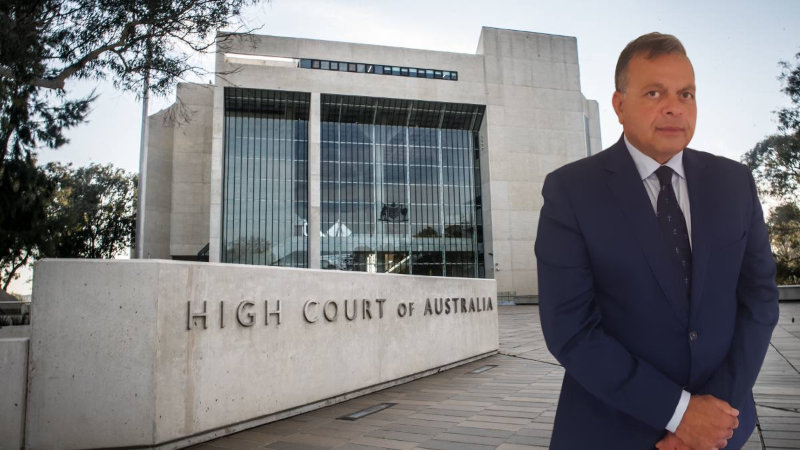

The High Court decision on false imprisonment of refugees in a big win for human rights and a reprimand for government. Alison Battisson and Janet Pelly report.
Last week, the High Court decided (Abdel-Hady v Commonwealth of Australia) that if detention continues after a person’s removal is no longer reasonably practicable, this amounts to false imprisonment. It is the most significant human rights and immigration ruling since indefinite detention was unanimously ruled unlawful in 2023.
But while media coverage has focused on the size of the compensation bill, there are more fundamental questions: what logic drives a decision to unlawfully deny liberty? What harms follow? What is the scale of those harms? And what will change?
Government immunity denied
One of the most challenging aspects of the Abdel-Hady case was the Commonwealth’s defence of its officers’ actions.
After indefinite detention was found to be unlawful in 2023, the practice continued. In Abdel-Hady, the Commonwealth argued that it should not bear the consequences of defying the High Court’s illegal detention ruling (NZYQ) because it had relied on its own understanding of the law.
The full bench of the High Court unanimously rejected that argument, reaffirming a principle that predates federation:
liberty is not protected by the good faith of government officials but by the legality of the detention itself.
Justice Edelman put it most clearly, saying that this would mean government officers enjoyed an immunity that ordinary citizens do not, “The former would be immune from liability for false imprisonment if acting upon a mistaken understanding of the law, but the latter would not.”
He went on to say that such a result would be inconsistent with the principle of legal equality, “All persons are required to comply with the law in its proper application to their conduct…”
In effect, the Government is not to be accorded any special dispensation from the laws of the land.
Nauru refugees. Indefinite detention a definite breach of High Court ruling
Government accountability
The legal fiction underpinning decades of indefinite detention was that removal always remained an achievable objective.
After the illegal detention ruling, it was revealed that hundreds of people had remained in detention for years (and could have remained possibly forever) despite there being no realistic prospect that they could be removed from Australia in the foreseeable future.
The vast majority could not be returned because they were recognised refugees, while others faced practical barriers to deportation, such as refusal by the receiving country or being stateless.
They were released, and despite evidence to the contrary, political commentary claimed the cohort was all dangerous criminals and any available actions were justified to keep Australians safe.
Inhuman and degrading treatment
While the Safwat Abdel-Hady case is often discussed alongside the NZYQ cohort, his case illustrates that the consequences of the High Court’s 2023 decision extend beyond the men released immediately after that ruling.
The principle established in NZYQ applies wherever detention continues despite there being no real prospect of removal in the reasonably foreseeable future.
In Abdel-Hady’s case, the obstacle was not statelessness or diplomatic deadlock but serious illness that prevented him from being able to travel by air. The result was the same: detention continued after its legal justification had disappeared.
Another example can be found in the March 2026 findings of the United Nations Human Rights Committee about former immigration detainee Mirand Pjetri.
For the first time, the Committee concluded that Australia had subjected an immigration detainee, Mr Pjetri, to inhuman or degrading treatment and had arbitrarily deprived him of his liberty. It concluded that compensation was merited and necessary.
Mr Pjetri spent eight years administratively detained under Australia’s migration laws.
He had broken no laws and was consistently assessed as low risk.
Despite this, he remained incarcerated while his mental and physical health deteriorated until he was assessed as being at risk of imminent death. He was deported against medical advice, at 45kgs and diagnosed with a serious autoimmune disease.
Governments frequently characterise such cases as exceptional. The evidence accumulated over decades suggests otherwise. Psychiatrists, medical practitioners, detention visitors, lawyers, former detention staff and human rights organisations have repeatedly documented the devastating effects of prolonged immigration detention.
For years, governments have defended detention as an administrative necessity. The Pjetri findings invite a different question: at what point does a system designed to manage migration become a system that predictably destroys the lives of people subjected to it?
Evidence and liability
The question of liability sits uncomfortably beside the Commonwealth’s position in Abdel-Hady’s case. On one hand, the government argued it should not be liable because it believed the detention was lawful. On the other hand, the evidence of the human consequences of prolonged detention has been impossible to ignore for many years.
Abdel-Hady is ultimately a case about accountability. After detention became unlawful, the Commonwealth defied the High Court, then argued it should be exempted from responsibility because of an “unintentional mistake”.
The High Court responded that accepting this defence would be
an inversion, if not a perversion, of constitutional principle.
What’s next?
As a democracy, Australia should be less concerned with the cost to taxpayers than the cost to people subjected to unlawful detention, including families who endured years without parents, partners and providers.
What happens next matters. The compensation claims that follow the Abdel-Hady case will determine not only how past wrongs are remedied, but whether governments learn anything from them.
If unlawful detention is treated as an expensive administrative misstep, the underlying problems will remain.
If, however, Abdel-Hady prompts a genuine examination of how people came to be detained for years without lawful authority, it may mark the beginning of a more accountable immigration system.
Exile to a vanishing shore: human rights, climate and the Nauru ‘solution’

Ali Battisson is a human rights lawyer with international recognition for her work in advocating for the rights of refugees, stateless individuals, as well as those detained or imprisoned wrongly by governments. She is Director Principal @HumanRights4A,, Partner Heretic Law Advisor, incl awada.com.au

Janet Pelly is a Melbourne-based refugee and detention rights advocate. She has worked with Human Rights 4 All since 2019.