


Politicians went AWOL from Parliament by the dozen on the NDIS vote amid denials about automation and Palantir’s role. Is this Robobdebt II? Claudia Weisenberger investigates.
On 18 August 2026, the Senate passed the NDIS Amendment Bill. On 19 August, it passed the Lower House. The Royal Assent was granted on 20 August 2026.
A Bill that strips 240,000 disabled Australians from a scheme they depend on, gives automated decision-making powers to a computer program, and removes the right of appeal passed both houses of Parliament last week.
Nobody was prosecuted the last time the government did something like this. The Robodebt architects faced no consequences. Here is how it happened. And what was never asked. Twenty-eight senators made it happen.
Of the 76 senators, 28 voted yes. 12 voted no. 36 did not vote. Every one of those 36 is paid by Australian taxpayers. Every Australian citizen is legally required to vote at elections. But there is no law requiring senators to vote on legislation. On the most significant disability legislation in a decade,
more senators chose not to vote than voted yes.
The Bill passed anyway.
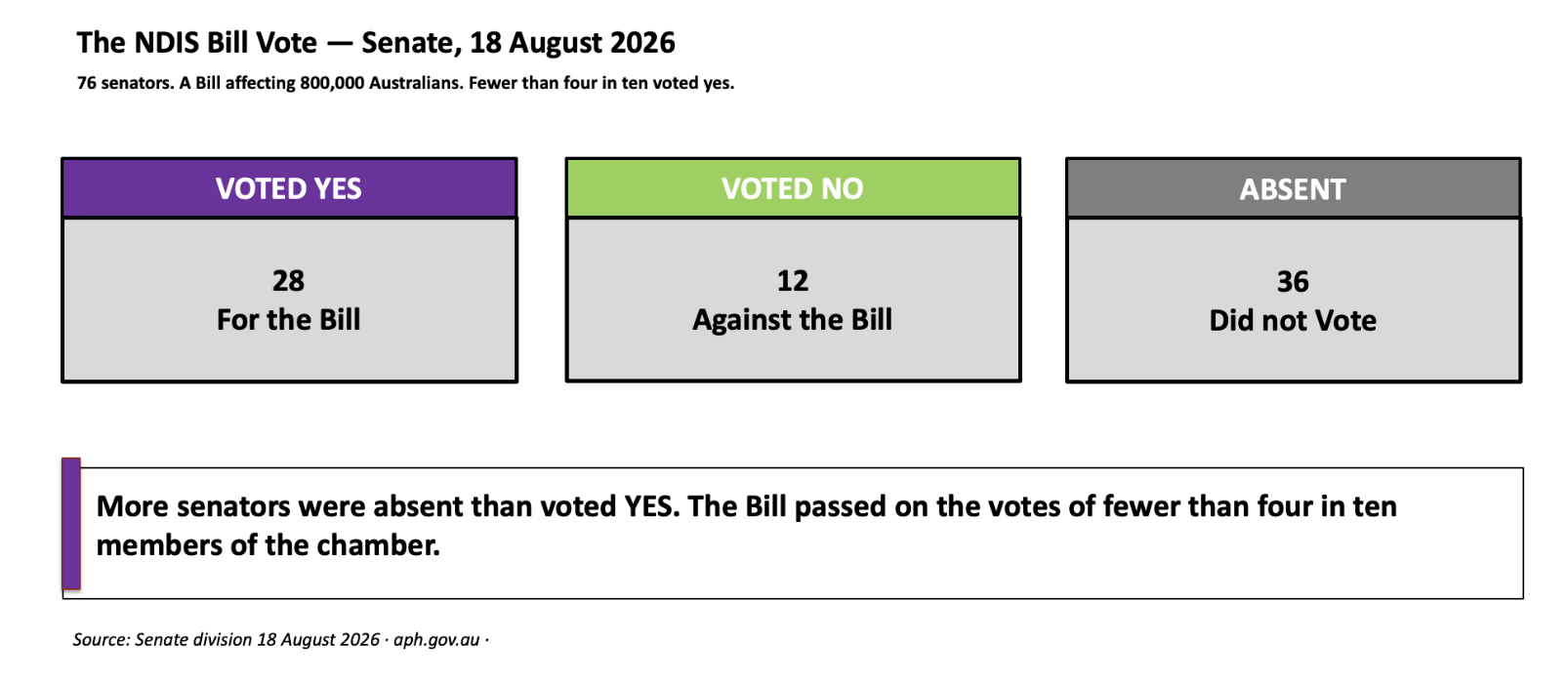
How they voted
Labor voted 24 to nil. Two Liberals voted yes. Neither spoke. Three One Nation senators voted yes. The Greens voted 11 to nil against. Three cross-bench senators voted no.
Eighteen Liberals were absent. Three LNP. Three Nationals. The Coalition would not vote against the Bill. Most would not vote for it.
They simply were not there.
One senator was in the building. They voted on an earlier division. When the final vote came, they did not vote. According to disability advocate Samantha Connor AM, “Seven of WA’s Senators didn’t show up. They did not support us, but neither did they vote for a Bill that they all knew would cause harm.”
What was said
Senator Jordon Steele-John spoke for more than an hour before the vote. The disabled senator put on the record what the government did not: 4,500 submissions opposing the Bill. 94 million hours of unpaid care transferring to Australian families. More than 51,600 full-time equivalent support-worker jobs at risk, stating, “Disabled people are not a burden. Let me say that again. Disabled people are not a burden. We should never, ever be made to feel as though we are a burden by our government or by the society that we live in.”
Rather than taking on and taxing the gas exporters
“— rather than take those people on — you’ve decided to cut the supports of disabled people and stick your metaphorical fingers in your ears, as expert after expert warned you what this bill could do and is likely to do.”
And he put the warning to the Chamber, “You won’t always be there, folks. These people over there — they’ll be there again at some point. What will they do with these powers, I wonder? … Who pays the price of that concession? We do. Disabled people do. We pay with our lives and with our liberties.”
Senator David Pocock raised the Robodebt Royal Commission directly. The Commission recommended that when algorithms make decisions about people’s lives, independent experts must be able to check the algorithm’s work. He asked NDIS Minister Jenny McAllister whether that will happen here.
Jenny McAllister said the rules each algorithm must follow would be published for inspection.
Senator Pocock pushed back. Publishing the rules is not the same as independent scrutiny of the algorithm itself, the actual code doing the work. In aged care, he said, senators had asked to see the algorithm and were told no because, in the government’s words, if people knew how it worked, they could game it.
The Robodebt Royal Commission said that exact argument was wrong and dangerous.
Would the NDIS be different?
McAllister did not answer. She then corrected herself on a crucial point. The documents setting out each algorithm’s rules, called Standard Operating Procedure Instruments, can be tabled in Parliament for senators to read and inspect.
But under the Bill, they are notifiable instruments, not disallowable ones. In plain English: a senator can read the rules the algorithm must follow. A senator cannot vote to stop them. Once the rules are set, Parliament has no power to reject them, amend them or block them from taking effect.
Parliament gets to watch. It does not get a say.
The last time a government said trust us on the algorithm, 433,000 people received unlawful debts.
Source: MWM correspondence with NDIA, AusTender, Hansard
What was never asked
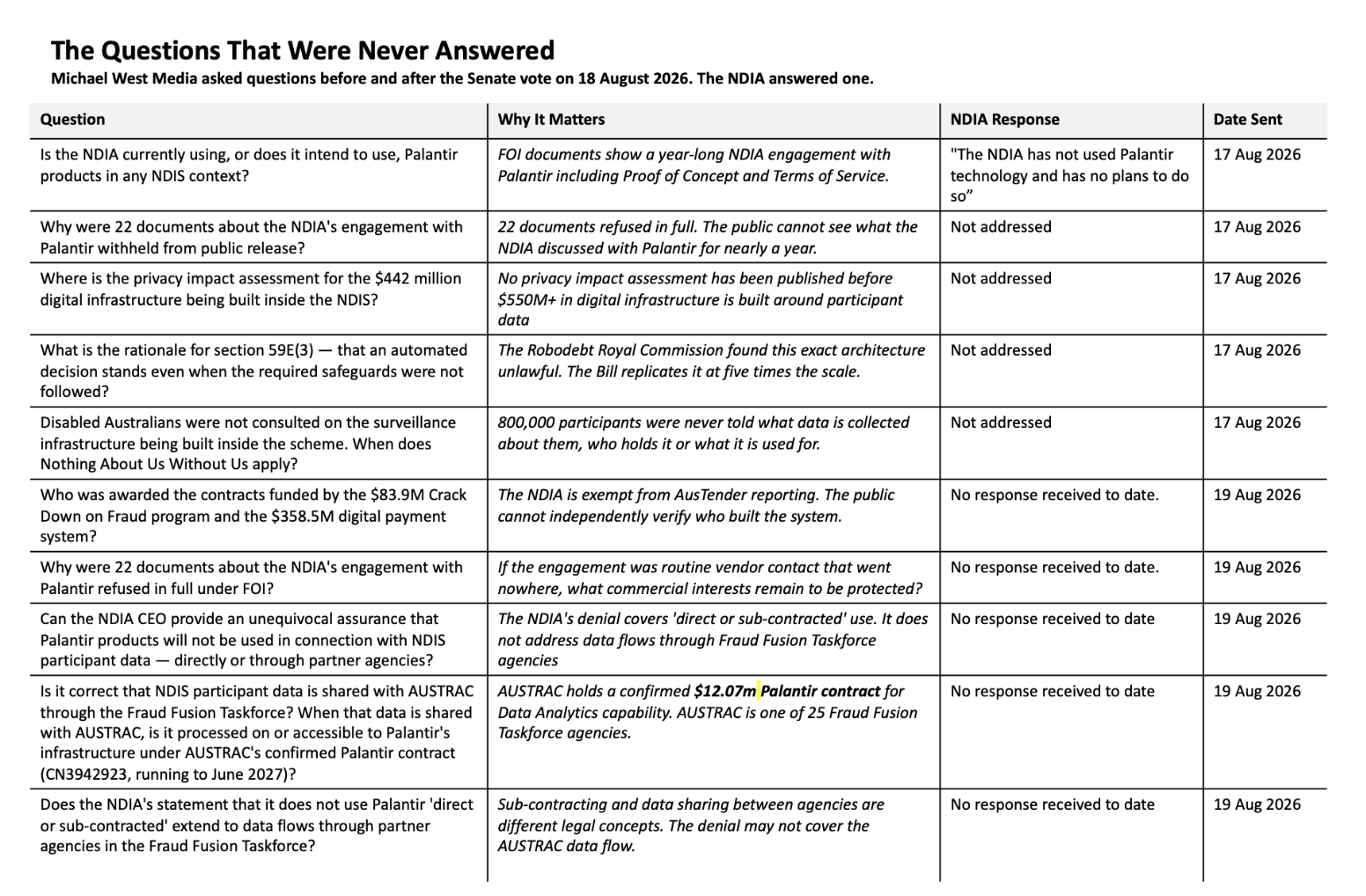
Before the vote, we put five questions to the NDIA about the automated decision system being built inside the scheme. The NDIA answered one, stating that “the NDIA has not used Palantir technology and has no plans to do so.”
It did not address the remaining four questions, including why 22 documents about a year-long engagement with Palantir cannot be seen by the public.
The NDIA’s denial is precise in what it covers.
It states the agency does not use Palantir ‘direct or sub-contracted’. It does not address whether NDIS participant data shared with AUSTRAC, which holds an active Palantir contract for data analytics worth more than $12 million across the base contract and its variations, is processed on Palantir infrastructure.
Sub-contracting and data sharing between agencies are different legal concepts. The denial covers one. It does not cover the other.
Palantir is an American technology company whose software runs inside the CIA, the Pentagon and Immigration and Customs Enforcement. Its CEO has described the company’s purpose as helping the West scare enemies and, “on occasion, kill them”.
Palantir denial
Since publication, we have sent the NDIA five further questions, including who built the fraud detection and payment systems, whether the NDIA CEO can provide an unequivocal assurance that Palantir products will not be used in connection with NDIS participant data, and whether NDIS participant data shared with AUSTRAC is processed on Palantir infrastructure under AUSTRAC’s confirmed Palantir contract.
No substantive response to those OTHER questions has been received.
Parliament was never told who is building the system it just voted to authorise.
On 21 August 2026, the NDIA responded to our follow-up questions. The response did not answer whether the engagement with Palantir proceeded to a contract, who built the fraud detection and payment systems, whether the NDIA CEO can provide an unequivocal assurance about future Palantir use, or whether NDIS participant data shared with AUSTRAC is processed on Palantir infrastructure.
Instead, the NDIA requested two changes to the published article. We have made the amendments.
What happens now
The Bill passed both houses on 19 August 2026, and Royal Assent was granted on 20 August 2026. From 1 October 2026, social and community participation budgets will be cut by around 50 per cent as plans are renewed, bringing allocations back to 2023 levels.
From 1 February 2027, tighter assessment of supports begins for new entrants and existing participants. From 1 January 2028, a new eligibility assessment process begins, with existing participants reassessed over a transition period.
Government modelling suggests around 240,000 existing participants will leave the scheme by 2031; of whom approximately 154,000 are aged 18 or under and around 145,000 have autism or developmental delay as their primary disability.
The automated decision system will be built. The government has invested more than $550 million in NDIS digital infrastructure and fraud detection systems. The data will flow across 24 agencies.
Parliament was never told who is building it.
The last time a Commonwealth agency built this kind of automated decision architecture, a Royal Commission found it unlawful. People lost their homes. People took their own lives. Nobody was prosecuted.
The Bill has passed. More than 4,500 Australians made submissions opposing it. The Senate passed it anyway. Thirty-six senators did not even vote.
When this goes wrong and people are harmed, will the architects of this system face criminal prosecution? Or will history simply repeat itself?

Claudia Weisenberger is a management consultant with deep experience in pharmaceuticals, hospital transformations, and strategic due diligence across four continents. She combines sharp analysis with hands-on execution.