


Putting NDIS care in the control of an algorithm, stripping humans out of the process, will damage peoples’ lives. Claudia Weisenberger interviews plan managers on the ground.
The overhaul of NDIS has enormous ramifications for Australia’s disabled. Yet it does not solve the critical problem of system design failure.
On 30 July 2026, NDIS Minister Jenny McAllister told ABC Sydney Mornings that plan managers were providing low-quality services, operating with significant conflicts of interest, and in the worst cases facilitating wrongdoing. She announced the government’s intention to move to a commissioned panel of plan managers — in her words;
‘Quality providers who’ve got strong integrity obligations, strong capacity, and the ability to provide good services.’
The specific terms of the panel have not been publicly confirmed.
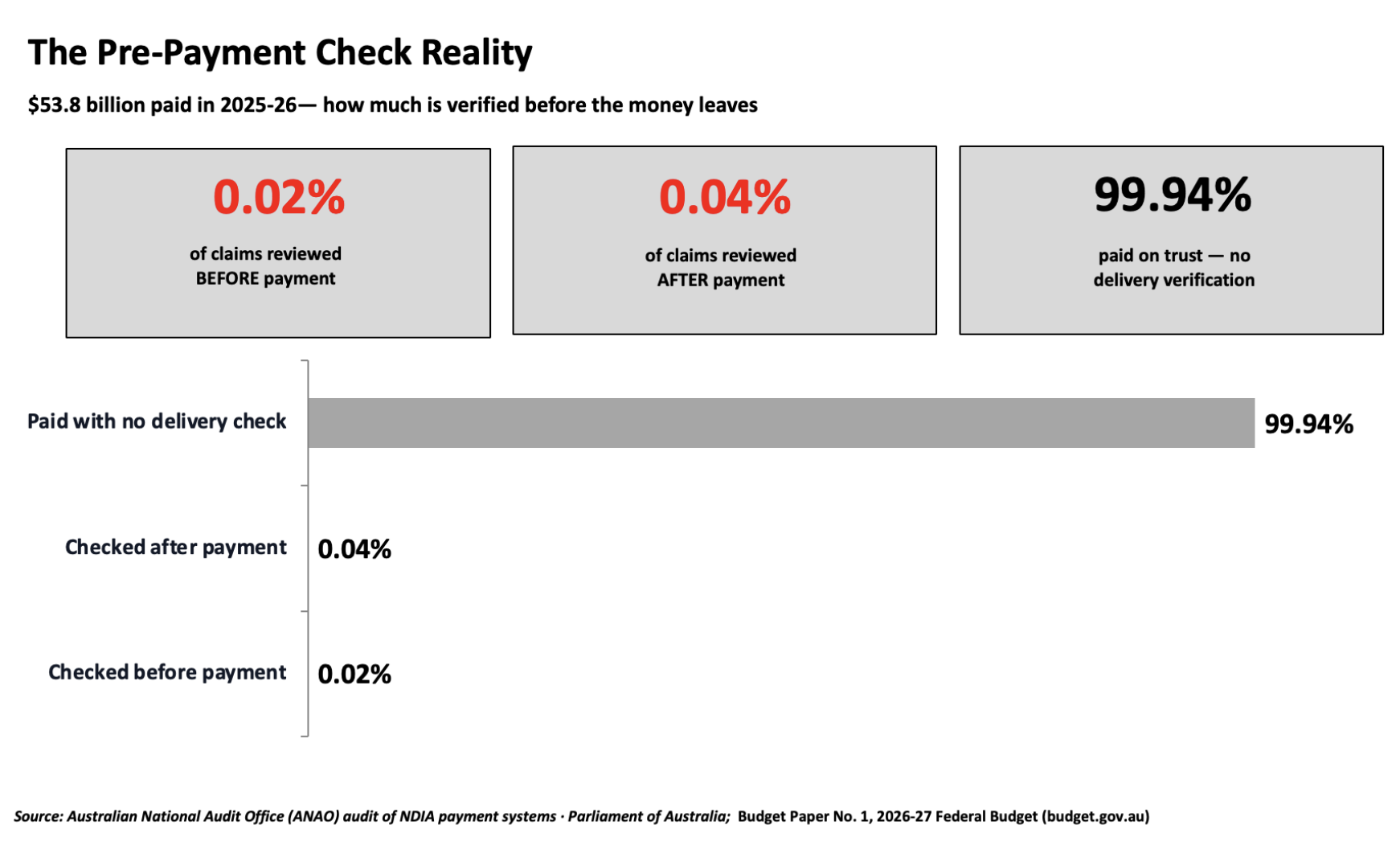
That same week, Katrina Bourne from Advantage Plan Management submitted evidence to the Senate: a $40,433 invoice for a participant sleeping rough on the claimed dates, a $10,000 car detailing trip billed as respite for a legally blind participant, and $80,000 in home modifications by a carpenter without a builder’s licence.
In each case, a plan manager reading the invoices was the
only thing that stopped it going further.
What the evidence shows
I spent a day in discussion with Katrina and Amanda Bourne, the sisters behind Advantage Plan Management and its verification service CareTick. What they showed me was not what the Minister described — it was the invoices they were questioning.
Jenny McAllister is right that conflicts of interest exist — but she has identified the wrong culprit. The evidence before the same Senate Committee she cited shows the same organisation simultaneously providing support coordination, plan management and direct supports: recommending the care, delivering it, and managing the money.
The Bill does prohibit plan managers from providing other NDIS services — a genuine step. But it does not prevent the same organisation doing so through separate entities.
On 5 August 2026, Jenny McAllister told the Business Council of Australia that more than $900 million had been lost to fraud and integrity leakage in 82 days. Her own definition includes mistakes, incorrect claims and bad record-keeping —
the routine errors vigilant plan managers catch every day.
The government is using that figure to justify removing the very people catching it.
NDIA data shows the agency rejected more than 8,000 plan manager claims worth $19 million in nine months — more than half for services never delivered — and placed 1,400 plan managers under manual review; all have since stopped operating.
These are real problems. But the conflict the data describes — plan managers steering participants to their own services — is different from what this article examines. The government’s solution addresses the first problem. It removes the second safeguard in the same move.
“Fraud in the NDIS is a serious issue, but the government has been too focused on targeting participants instead of the providers who are exploiting the scheme for profit. We need a fraud response that is evidence-based, properly resourced and focused on those committing the fraud, not one that creates fear and unnecessary barriers for disabled people accessing the supports they need.”
Senator Jordon Steele-John, Sydney Morning Herald, 30 July 2026
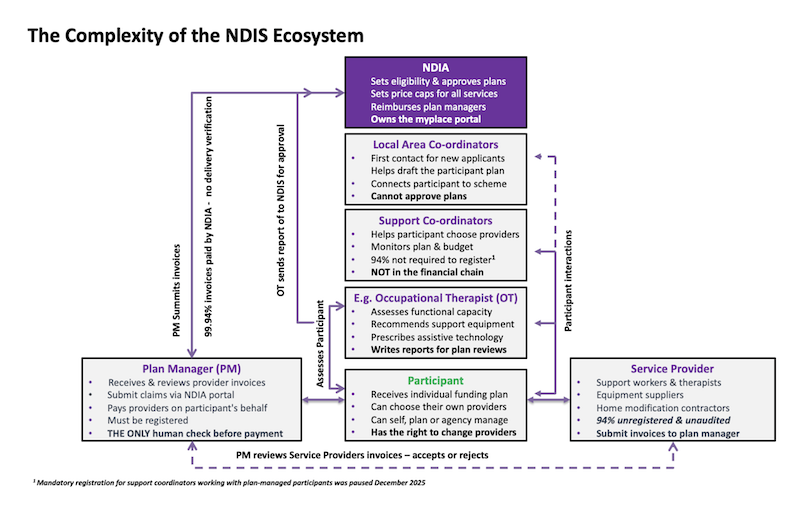
NDIS. Complex eco-system
What plan managers actually catch
Retrospective billing
The government has announced a 90-day limit on retrospective claims — an improvement that does not resolve cases already in the system. In one case, a participant terminated her support coordinator. Within three days, $40,433 in invoices arrived for services allegedly delivered over the previous three months — months she had spent sleeping rough. Both have been reported to the NDIA. The invoices remain unresolved.
Conflict of interest
Support coordinators are supposed to help participants choose providers independently. In this case, the support coordinator and the provider were from the same organisation — the support coordinator recommended their own organisation’s services to the participant, and then generated that organisation’s invoices. The participant had no independent advocate.
This is not a rogue operator. It is a systemic design failure.
Coercive control
A participant can change plan manager at any time — and a provider refused payment can exploit that right. In one case, after $111,000 in invoices were refused, the provider isolated two vulnerable participants from their family, removed a family member as nominee, and contributed to the termination of both the plan manager and support coordinator. The incoming plan manager received no history, no context and no record of the disputed invoices.
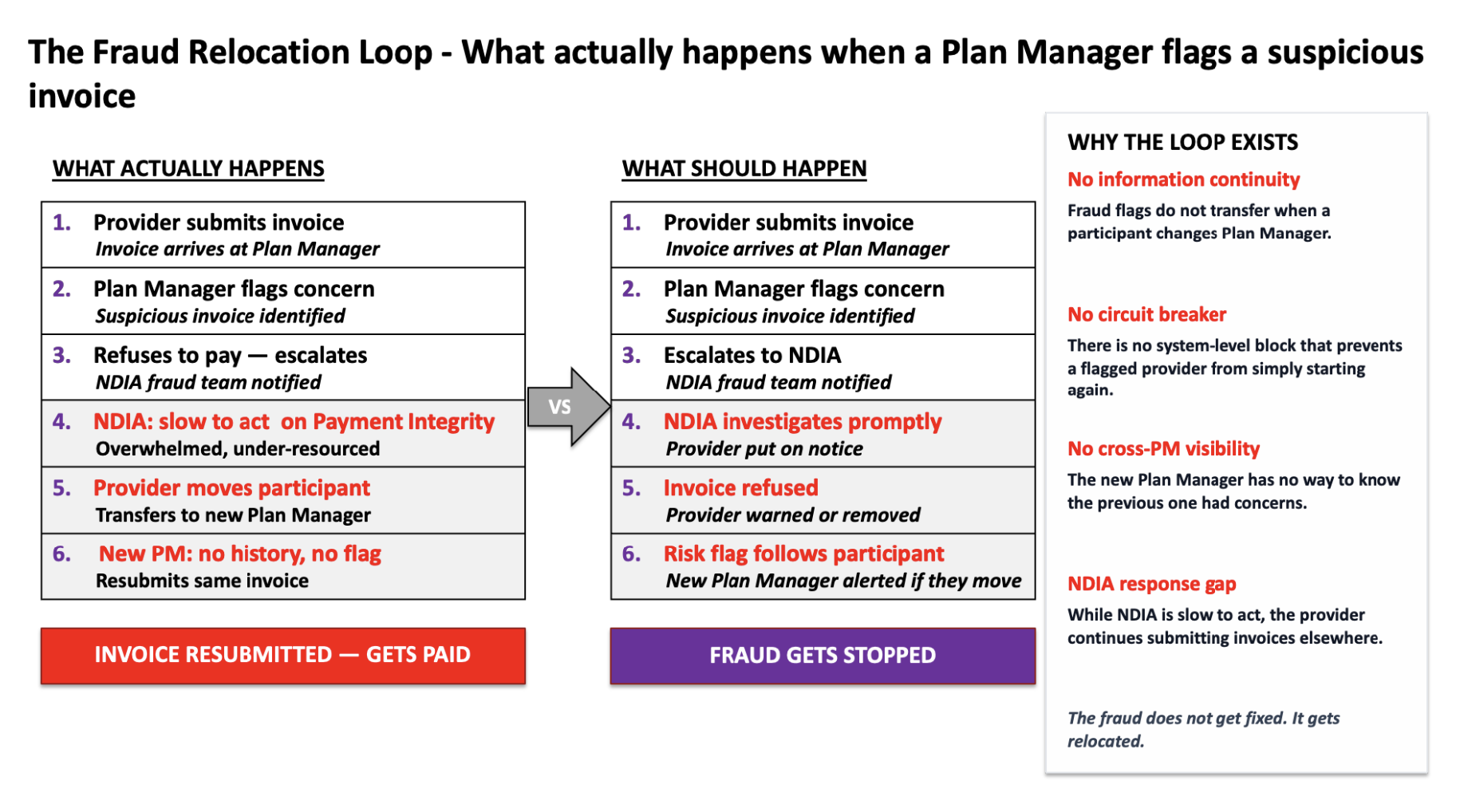
The NDIS fraud relocation loop
No information continuity
A legally blind participant was invoiced more than $10,000 for a car detailing trip claimed as respite. The plan manager identified there was no basis for the claim and withheld the invoice. The provider moved the participant. The outgoing plan manager contacted her successor directly. She believes the invoice was paid anyway. The NDIA holds this information. It does not share it.
Services which don’t qualify
During a routine invoice review, a support worker admitted she had spent the week caring for a participant’s cat and watering her garden while the participant was on holiday. The invoice exceeded $2,000. It was billed as disability support.
Without the plan manager’s question, it would have been paid.
Unqualified providers
The NDIA’s advice to participants is that they are responsible for verifying their provider holds appropriate qualifications.
In one case, bathroom modifications costing approximately $80,000 were carried out by a contractor with only a carpenter’s licence — no contract, no insurance, no builder’s licence. The participant was left with a defective home and no legal recourse. This participant had no way of knowing. Neither did the NDIA.
What gets lost
Every case above was caught the same way — by a plan manager who knew their participant and said no. The NDIA’s automated system checks three things: Is the service date in the past? Is there budget? Is this a duplicate? No algorithm asks whether an invoice makes sense for the specific person it was submitted for. This requires someone who knows the participant.
At scale, plan management becomes claims processing. Claims processing does not ask whether an invoice makes sense for a specific participant. It checks the date, checks the budget, and pays. That is not a plan manager. That is a portal with a logo.
And that is what the government is proposing to replace Katrina and Amanda Bourne with.
“At the heart of this issue is that the Government is not adequately addressing fraud and payment integrity, which should be a primary focus for improving the sustainability of the NDIS. Instead, vulnerable participants risk having their funding reduced while the underlying weaknesses in the payment system remain unresolved.”
— Katrina Bourne, submission to the Senate Community Affairs Legislation Committee, July 2026
Wrong answer to the right question
On 5 August 2026, the Australian Human Rights Commission called on the government to halt the Bill. Its President and seven Commissioners found the proposed changes constituted
“a significant interference with the rights of persons with disability.”
The government pressed ahead with the Bill.
Nearly 3,000 registered plan management providers currently operate across Australia. My Plan Manager alone supports close to 50,000 participants — the scale that will qualify for the commissioned panel.
The boutique operators catching what this article documents are a different world entirely. They are not the villains in this story. They are the last line of defence — and they are about to be replaced by organisations that process claims at scale and have never met their participants.
Case study details have been generalised to protect participant privacy. Provider names, participant names and identifying details have been omitted.

Claudia Weisenberger is a management consultant with deep experience in pharmaceuticals, hospital transformations, and strategic due diligence across four continents. She combines sharp analysis with hands-on execution.