
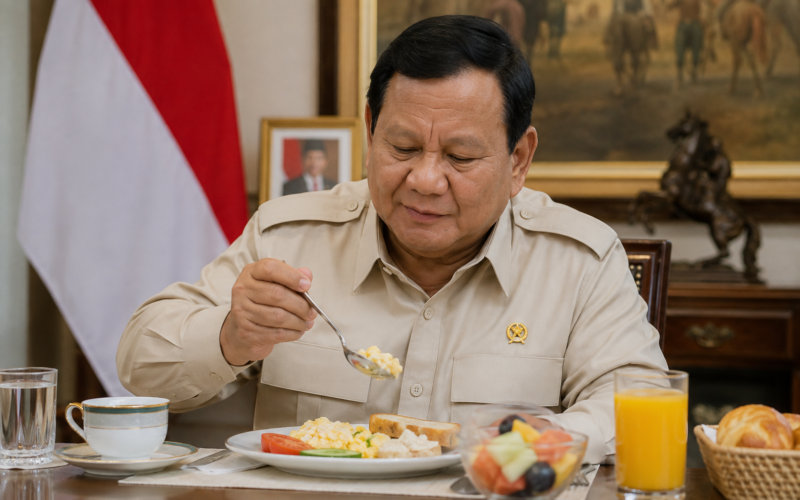
Indonesian President Prabowo Subianto is losing popular support, his children’s breakfast program inedible, and the military lurking. Duncan Graham reports from Indonesia.
In pop culture, dictatorships die in a clash of armies and ideologies wielded by ferocious leaders. In Indonesia, the reality will not be gore-soaked battlefields, but dirty kitchens, rotting meals and the sight and sounds of kids writhing on school floors, gripping their guts in a mess of vomit and the stench of diarrhoea.
Two years ago, the cashiered former general Prabowo Subianto won the presidency with 58.6% of the vote by promising a free nutritious school meal programme, Makan Bergizi Gratis.
His pledge was welcomed, and his reputation soared. He put military men in charge to feed mega millions, then left the country on overseas jaunts. What should have been a Nobel Prize garland for fighting malnutrition and widespread stunting (up to 20% in some areas) has become an albatross.
Hygiene has been vile– more than 34,000 youngsters suffered food poisoning, thousands were hospitalised, some sent to emergency, but no reported deaths.
Three top MBG directors have been charged with alleged corruption estimated to cost the state US$640 million a year. Spending has been reckless. Almost 22,000 new electric motorbikes have been seized by the authorities,
with 414 kitchens exposed as fictitious.
To make up the losses, top-ups were lifted from an already skint education budget. The Constitutional Court has stopped this plunder.
Prabowo Subianto (PS) became synonymous with MBG, his flagship policy now in tatters. What voter would continue to support a leader who hurt the nation’s children he promised to cure?
Nothing to eat see here…
The President reacted by claiming the percentage of those affected was small, and the programme was still finding its footing. To recover his reputation, Prabowo is compounding errors by turning the democracy next door into a military state.
Australian legacy media favouring Washington and London news means readers may not know that Indonesian youngsters are frequently protesting on the streets of Jakarta, confronting shields and batons, tear gas and water cannons.
Their gripes are many: the MBG scandal, price hikes, military involvement in civilian affairs and economic mismanagement. The rupiah has collapsed more than ten per cent in the past year.
Prabowo has said it matters not because “everyday citizens” don’t use greenbacks; “the macroeconomic panic remains confined to wealthy urban elites and global travellers.”
Live rounds have yet to be fired in the demos; Should that happen, as it did in 1998, killing four uni students when Prabowo’s former father-in-law Soeharto was in power – expect a revolution.
The teens and twenties have discovered Prabowo is yesteryear, not the harmless dancing grandpa promised in the 2024 election campaign.
Instead, they’ve got a cruel former general and special forces commander, cashiered for his alleged human rights abuses in East Timor and West Papua, banned in Australia and the US, facts ignored by the voters.
Indonesia’s Clark Kent ripped open his shirt to reveal a Supercon beneath, turning 75 this October. He rules a nation where more than half the citizens are under 32 and can flick a smartphone message faster than their elders can turn a book page.
Age should not be a disadvantage unless hardened by an inflexibility of attitude and action. This is where Prabowo fails.
The military threat
One NGO has started a petition, The Dangers of Remilitarisation for Democracy, signed by 58 civil society organisations, arguing:
“The military is essentially trained and educated for war, not to carry out political, economic or power interests … that deploying active-duty military members in civilian affairs risked undermining professionalism.”
Another scandal came with boot camps for staff with the government’s Merah Putih (Red and White) retail convenience shops. Five candidates died through exposure and harsh training, yet the programme continued. In Prabowo’s stores, shelf packers need to learn how to salute customers.
Indonesia has the biggest military in the region outside China, 400,000 ‘active land personnel’, plus 65,000 in the navy and 35,000 in the air force – with double as reservists.
In well-organised societies, school leavers have career choices based on their interests, be they lovers of learning seeking academia or hands-on tradies.
Not all military recruits are the untethered. Some join for the free training, housing and a job where imposed discipline is better than individual decision-making.
Others have bought the service-to-nation rhetoric of politicians with bone spurs, but all like guns. It takes a worrying personality to squint down the sights of an M16 and carelessly end the life of a fellow human they’ve never known.
All nations that collect data on returned vets reveal a suicide rate twice that of civilians. Health studies have shown that many are racked by guilt about what they did and saw.
A fragile democracy
Prabowo’s policies are damaging a society that only became a democracy at the start of this century. Last year it was labelled ‘flawed’ by The Economist Intelligence Unit in a review of 167 nations. Indonesia came 59th.
Soeharto’s 32 years in power were marked by brutality and widespread official fraud, earning his nation the international title Soeharto Inc. Yet Prabowo made him a National Hero.
The first job once Prabowo was behind the wheel was to select reverse and plot the way ahead through the mirrors. Next, make Indonesia shine big on the world stage to match its rank as the fourth most populous nation and a thrusting economy.
Since taking office in October 2024, Prabowo has made 54 trips abroad to 29 separate nations, usually striding down red carpets through parades of bayonets. It’s his favourite playground.
Without local consultation, he joined Donald Trump’s Board of Peace and offered his nation’s services as a mediator in the US-Iran war. Pakistan got the job.
At first, electors enjoyed watching a toughie at the top shouting warnings about unnamed foreign threats. His latest distraction is an education campaign against “LGBTQ Western culture”, mixing gays with terrorism, radicalism, drugs and gambling.
Prabowo backing on the wane
He soon had a claimed 80% public backing.
No longer. Pollsters now reckon he’d lose heavily if there was another election this month. Wrote one ANU academic: “Prabowo’s mandate has been rented rather than earned, specifically by being bought back with handouts as opposed to good governance.”
Senator Hanson should relax – this is unlikely to start a flood of refugees. Unlike the Chinese and Scots, Javanese rarely like relocation; their proverb rindu kampung halaman expresses homesickness.
The prez has made the minor umrah pilgrimage to Mecca while on a state visit to Riyadh. The South China Morning Post claimed Prabowo, who comes from a multi-faith family, was “trying to cultivate an image as a Muslim.”
If designed to make him look caring, it didn’t work. The Asian Trump is better known for his belligerence and bombast than faith.
Although a factor in his unpopularity, the food poisoning is the decider; the memory of writhing bodies being soothed by distraught parents praying the sirens are for their ambulance.
Indonesia. Militarism on the rise amid censorship over West Papua

Duncan Graham has a Walkley Award, two Human Rights Commission awards and other prizes for his radio, TV and print journalism in Australia. He now lives in Indonesia.